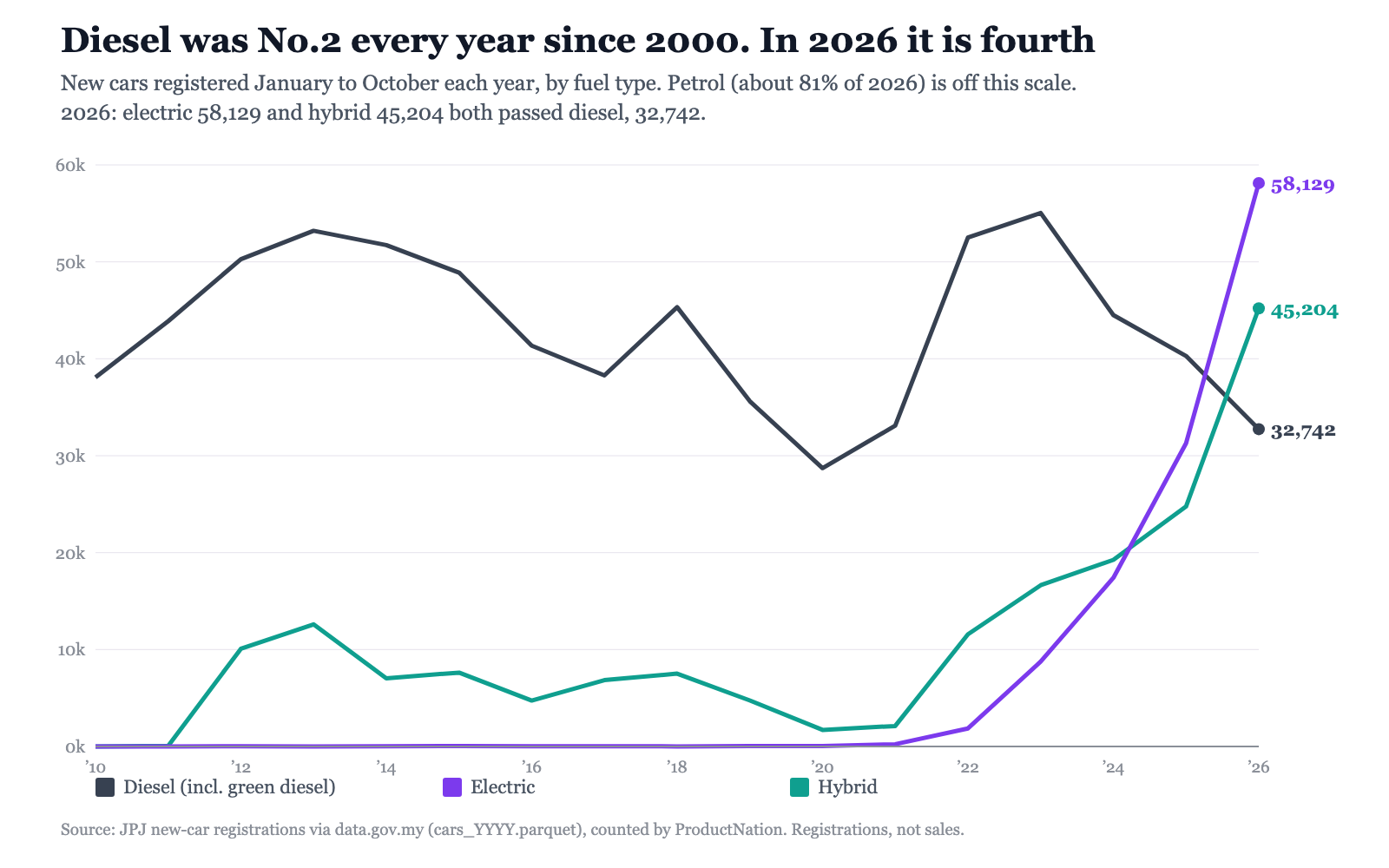
In the January to October period of every year in the public record, back to 2000, diesel was the second most common fuel among new cars registered in Malaysia, behind petrol. In the first ten months of 2026 it fell to fourth. Electric cars (58,129 registrations) and hybrids (45,204) both overtook diesel (32,742), counted from the Road Transport Department's (JPJ) own registration files.
It happened fast. On matched January to October windows, a year ago diesel was still comfortably second at 40,292, ahead of electric at 31,273 and hybrid at 24,748. In twelve months, electric registrations rose 85.9 per cent, hybrid rose 82.7 per cent, and diesel fell 18.7 per cent, while the whole market grew 3.0 per cent.
Contents
The month each one crossed
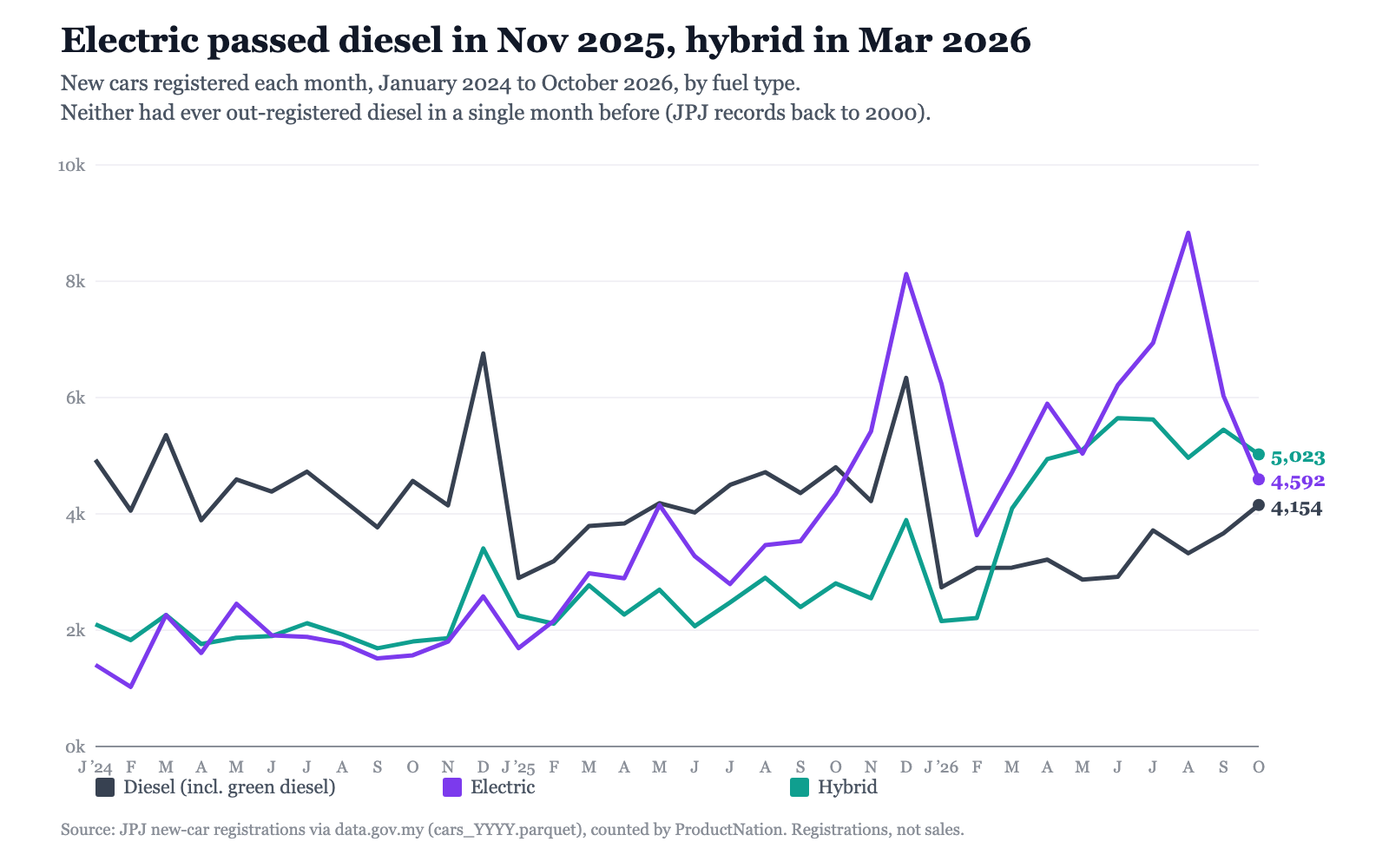
Month by month, electric cars out-registered diesel for the first time in November 2025 (5,417 against 4,224) and have done so in every month since, twelve in a row. Hybrids first did it in March 2026 (4,093 against 3,076) and have stayed ahead for eight straight months. Neither had beaten diesel in any single month before, in records back to 2000.
The newest month is October 2026. The 2026 car file on data.gov.my (cars_2026.parquet) was updated on 12 November 2026 and now runs to 31 October; the catalogue page may still show the earlier end date until it catches up. Hybrid led the three with 5,023, electric had 4,592 and diesel 4,154. October was also a softer month overall: 75,004 new cars, down 7.9 per cent on October 2025's 81,404, which remains the biggest October on record. Even so, January to October 2026 is the busiest first ten months in the record, at 715,879 registrations, ahead of 700,000 in 2024.
The ranking does not depend on the newest month. On data to the end of September alone, the order is the same: electric 53,537, hybrid 40,181, diesel 28,588 (a year earlier: diesel 35,491, electric 26,928, hybrid 21,944).
The numbers, January to October
| Fuel type | 2018 | 2025 | 2026 | 2025 to 2026 |
|---|---|---|---|---|
| Petrol | 462,716 (89.7%) | 599,041 (86.1%) | 579,803 (81.0%) | -3.2% |
| Electric | 8 (0.0%) | 31,273 (4.5%) | 58,129 (8.1%) | +85.9% |
| Hybrid | 7,517 (1.5%) | 24,748 (3.6%) | 45,204 (6.3%) | +82.7% |
| Diesel (incl. green diesel) | 45,324 (8.8%) | 40,292 (5.8%) | 32,742 (4.6%) | -18.7% |
| All new cars | 515,567 | 695,356 | 715,879 | +3.0% |
Diesel's 32,742 is its lowest January to October count since 2020 (28,718), and its 4.6 per cent share is its lowest in that window since 2002.
Who moved the numbers
On the hybrid side, two makers account for most of the rise. Of the 20,456 extra hybrid registrations over January to October 2025, Toyota added 7,737 (7,201 to 14,938) and Proton added 6,957 (from none, counted by the maker field), 72 per cent of the net increase between them. All 6,957 of Proton's hybrid registrations are recorded under the model name e.MAS 7 with a hybrid fuel type, which we take to be the e.MAS 7 PHEV, the plug-in hybrid Proton launched on 4 February 2026 according to Proton's own launch announcement. That is our inference: the file records the model name and fuel category, not the variant. The first of them appear in the file in February 2026. (The battery-electric e.MAS 7, launched in December 2024, carries the same model name in the file but is recorded as electric, so it is not in these hybrid figures.) Chery (1,409 to 4,664) and Great Wall (3,648 to 5,079) also rose, while Mercedes-Benz fell (3,632 to 2,743).
On the diesel side, four makers account for 82 per cent of the net fall of 7,550: Toyota (24,343 to 22,384), Mitsubishi (3,944 to 2,298), Ford (3,131 to 1,766) and Isuzu (5,386 to 4,188). These are makers rather than models, because that is how we counted them; the file does not say why fewer diesels were registered, and we do not claim a cause.
We have tracked the electric side before: our January to July count put electric cars at 7.9 per cent of registrations, with Proton the most-registered electric brand. Diesel in Malaysia is mostly a pick-up story: counting the file's own vehicle-type field for January to October 2026, 27,824 of the 28,406 registered pick-ups (98 per cent) are diesel, and those pick-ups are 85 per cent of the 32,742 diesel registrations. Their shrinking share showed up in our count of the SUV takeover. For the market as a whole, see September's record month.
Every year in the record, January to October
The full series behind the claim that diesel led electric and hybrid every year until 2026, and behind the record for the first ten months. Petrol, always first, makes up almost all of the rest; a handful of registrations sit in other small fuel categories.
| Jan to Oct | Diesel | Electric | Hybrid | All new cars |
|---|---|---|---|---|
| 2000 | 12,424 | 0 | 0 | 290,997 |
| 2001 | 14,700 | 0 | 0 | 337,102 |
| 2002 | 15,485 | 0 | 0 | 381,797 |
| 2003 | 17,678 | 0 | 0 | 366,490 |
| 2004 | 22,315 | 0 | 0 | 409,245 |
| 2005 | 25,487 | 0 | 0 | 476,463 |
| 2006 | 23,712 | 0 | 0 | 404,141 |
| 2007 | 23,358 | 0 | 0 | 396,093 |
| 2008 | 26,001 | 0 | 0 | 469,899 |
| 2009 | 27,642 | 1 | 2 | 446,738 |
| 2010 | 38,090 | 0 | 1 | 509,016 |
| 2011 | 43,879 | 6 | 74 | 511,169 |
| 2012 | 50,271 | 25 | 10,083 | 519,932 |
| 2013 | 53,199 | 7 | 12,599 | 553,911 |
| 2014 | 51,722 | 15 | 7,041 | 558,971 |
| 2015 | 48,885 | 47 | 7,620 | 552,817 |
| 2016 | 41,358 | 27 | 4,736 | 475,413 |
| 2017 | 38,282 | 24 | 6,843 | 476,914 |
| 2018 | 45,324 | 8 | 7,517 | 515,567 |
| 2019 | 35,615 | 40 | 4,747 | 505,134 |
| 2020 | 28,718 | 47 | 1,708 | 422,839 |
| 2021 | 33,095 | 235 | 2,116 | 399,091 |
| 2022 | 52,504 | 1,860 | 11,579 | 600,389 |
| 2023 | 55,041 | 8,760 | 16,638 | 674,932 |
| 2024 | 44,511 | 17,403 | 19,257 | 700,000 |
| 2025 | 40,292 | 31,273 | 24,748 | 695,356 |
| 2026 | 32,742 | 58,129 | 45,204 | 715,879 |
What this does and does not say
These are registrations, not sales: a vehicle is counted when it is registered with JPJ, which can lag the moment it was bought. The figures describe new cars registered, not the cars already on Malaysian roads, which include vehicles bought over many years.
JPJ records fuel as a category. Its hybrid category does not separate plug-in hybrids from hybrids that cannot be plugged in, so "hybrid" here means both, as the file records them. Diesel here combines the file's "diesel" and "greendiesel" fuel categories (plus the "diesel_ng" and "greendiesel_ng" categories, which hold no more than a few entries in any year); we do not interpret those category labels beyond what the file records. "Cars" is JPJ's car category, which spans motorcars, MPVs, SUVs, jeeps, pick-ups and window vans. And 2026 is a part year, so every comparison above uses January to October on both sides. data.gov.my notes that the earliest years of the series were harder to compile, so we treat pre-2005 figures as indicative; diesel's second place in those years was not close (it was never below 4 per cent of registrations while electric and hybrid were at or near zero).
How to reproduce this: download the yearly car files (cars_2000.parquet to cars_2026.parquet) from data.gov.my under transportation, keep the rows dated January to October in each year, and count them by the fuel field (and, for pick-ups, the type field; for makers, the maker field) yourself. Every figure here is our own count of those files, taken from the versions downloaded on 12 November 2026.