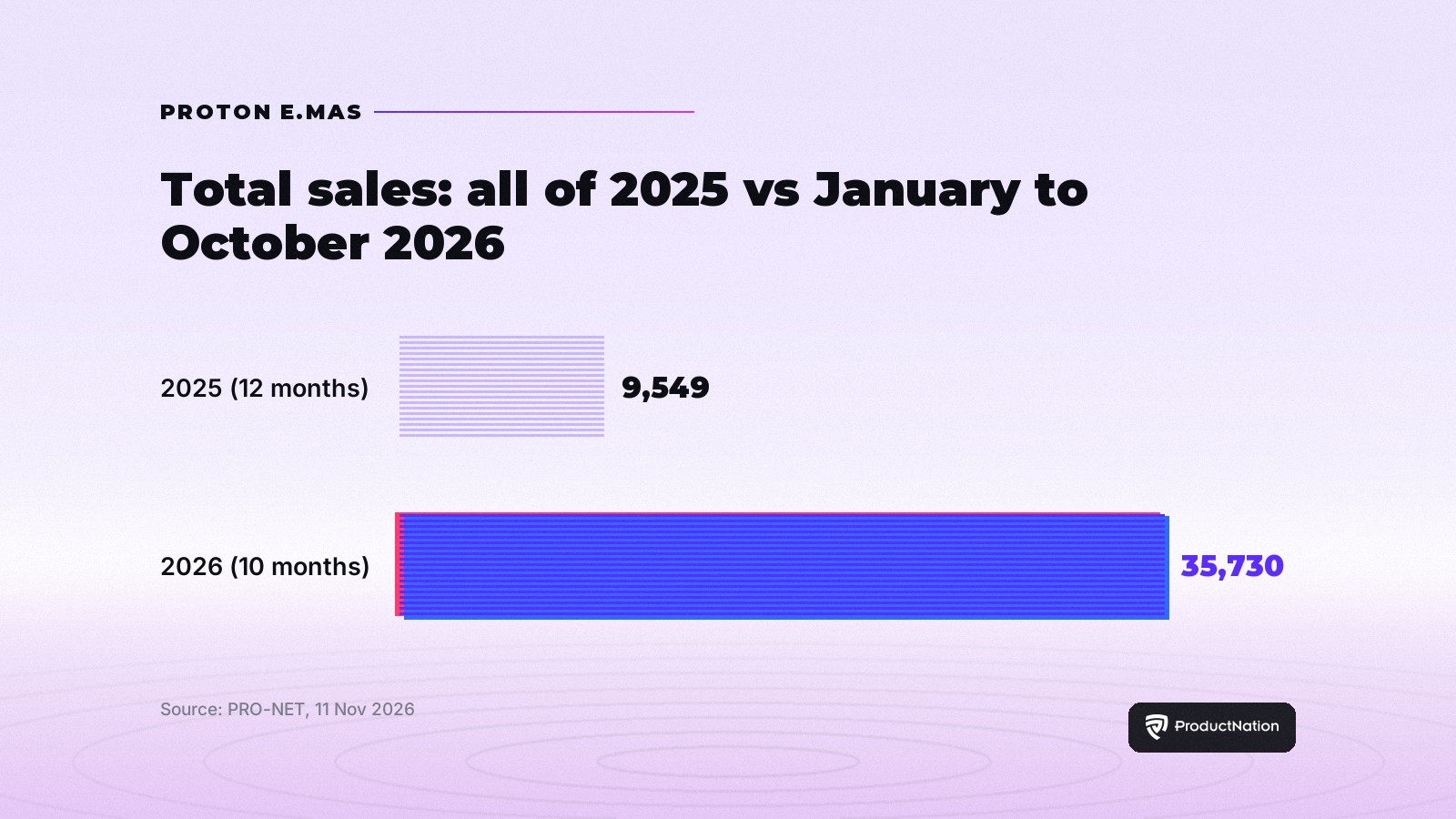
If it feels like there are a lot more Proton electric cars on Malaysian roads this year, the numbers back that up. Proton e.MAS sales reached 35,730 units across Malaysia and its export markets between January and October 2026, close to four times the 9,549 cars the brand sold in the whole of 2025.
Quick facts
Contents
- Sales, January to October 2026: 35,730 (34,629 in Malaysia, 1,101 exported)
- All of 2025: 9,549
- Best seller: e.MAS 5, 22,589 sold in Malaysia
- Battery EV market share: 47.3%, by JPJ registration data
The figures come from PRO-NET, the Proton subsidiary that runs the Proton e.MAS brand, and they cover all three models in the range: the e.MAS 5 hatchback, the fully electric e.MAS 7 SUV and the e.MAS 7 PHEV plug-in hybrid.
Proton e.MAS sales by model, January to October 2026
Of the 35,730 total, 34,629 cars were sold in Malaysia and 1,101 went overseas. At home, the split looks like this:
- e.MAS 5: 22,589 units
- e.MAS 7 PHEV: 6,957 units
- e.MAS 7 (fully electric): 5,083 units
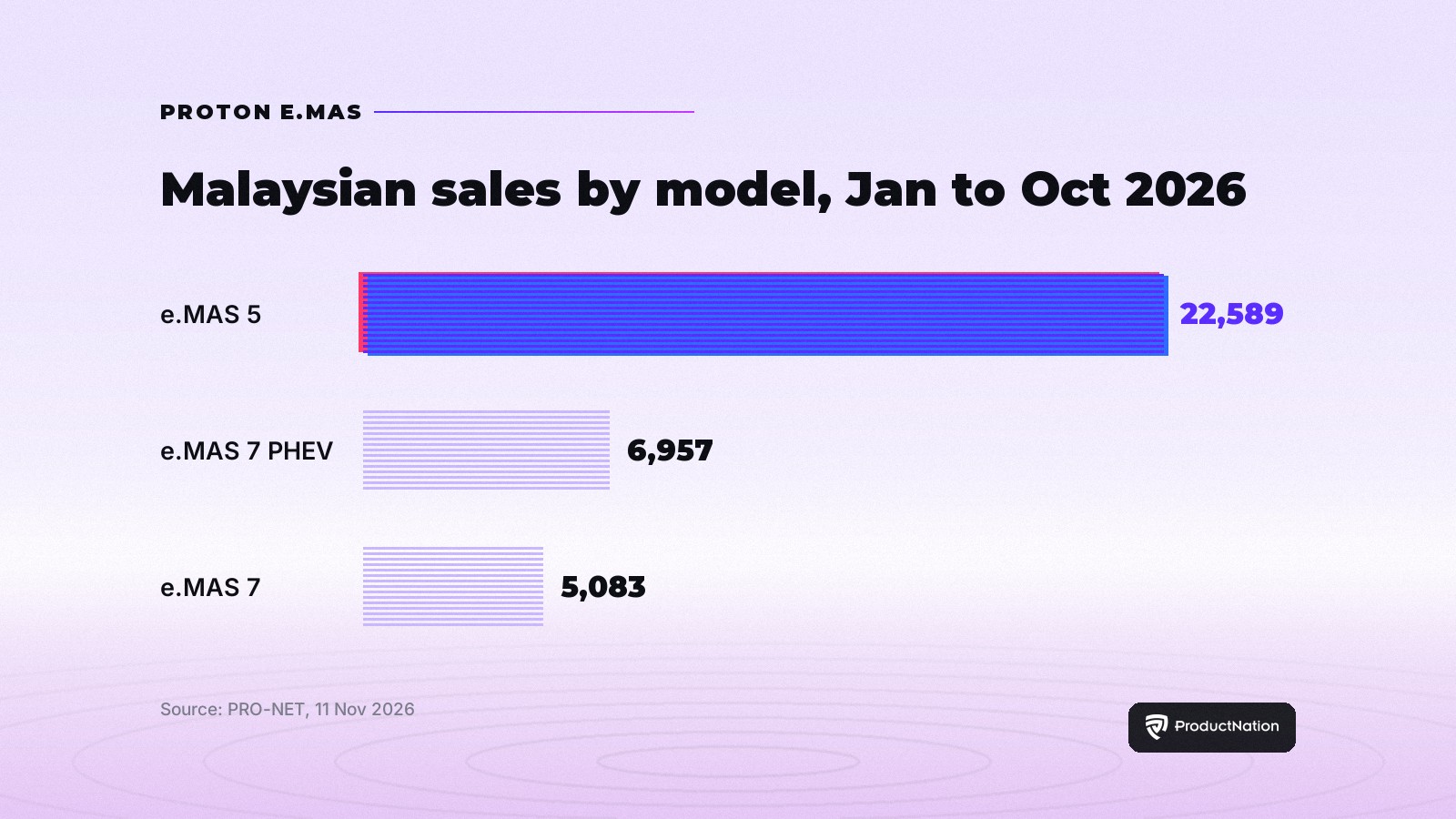
By our count, that puts the e.MAS 5 at about 65% of the brand's local sales, or roughly two in every three e.MAS cars sold here this year. The plug-in hybrid e.MAS 7 makes up about one in five, which says a fair number of buyers still want a petrol range extender as a fallback while they get used to driving on electric power. The fully electric e.MAS 7 accounts for the remaining 15% or so.
Exports are still small, but they are growing quickly. The 1,101 cars shipped abroad so far this year are already about 67% more than the 659 the brand exported in all of 2025.
Close to half of Malaysia's battery EV market
Proton e.MAS says it holds 47.3% of Malaysia's battery-electric vehicle (BEV) market for January to October 2026, based on the latest registration data from the Road Transport Department (JPJ). A BEV share counts fully electric cars only, so that figure is driven by the e.MAS 5 and the electric e.MAS 7, not the plug-in hybrid.
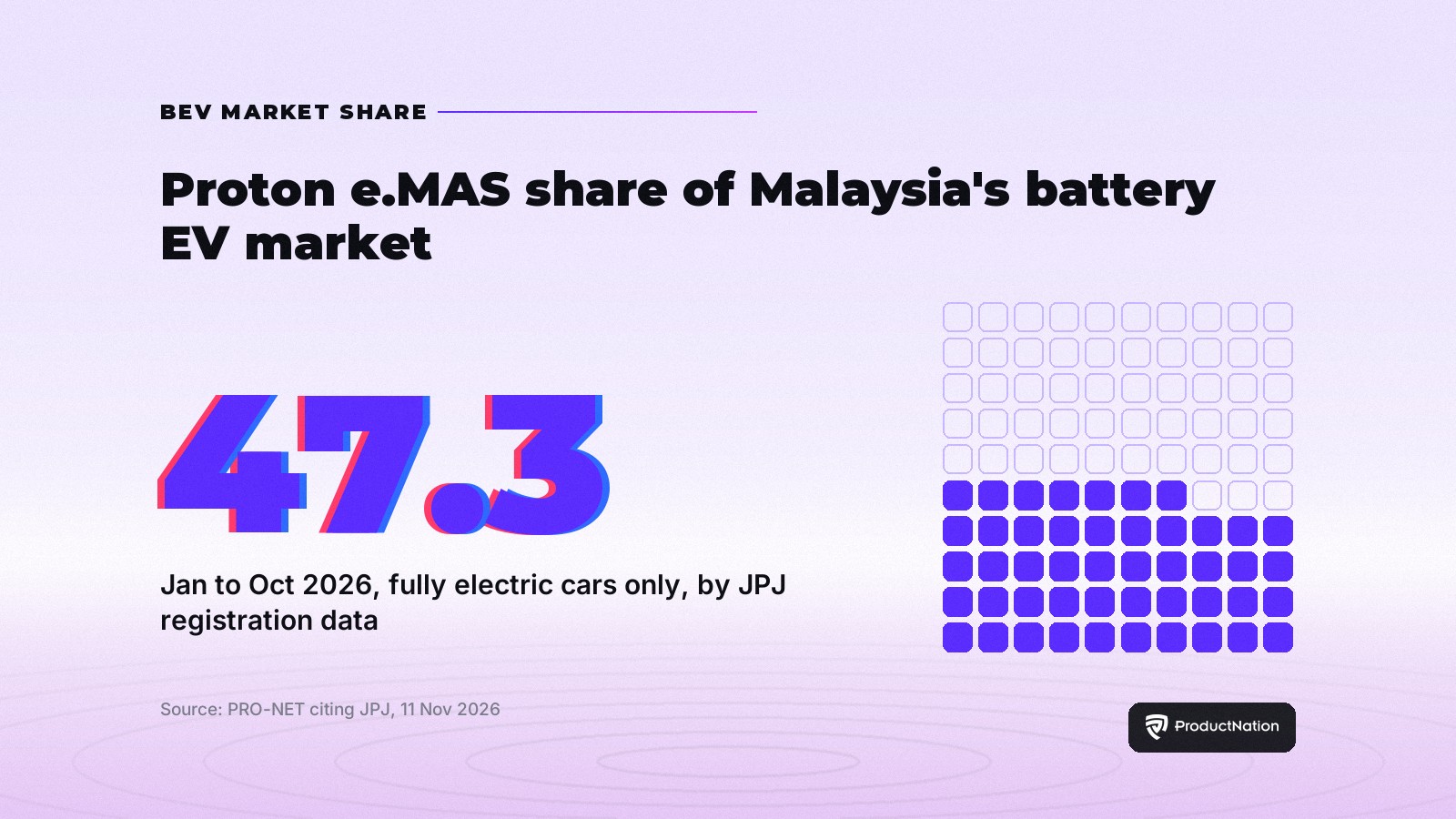
Put simply, close to one in every two new battery EVs registered in Malaysia this year has carried an e.MAS badge. That sits alongside the wider shift we found in registration data earlier this year, when roughly one in 13 new cars in Malaysia was electric, and the brand had already passed 40,000 EV deliveries by the end of September.
October was steady, not a spike
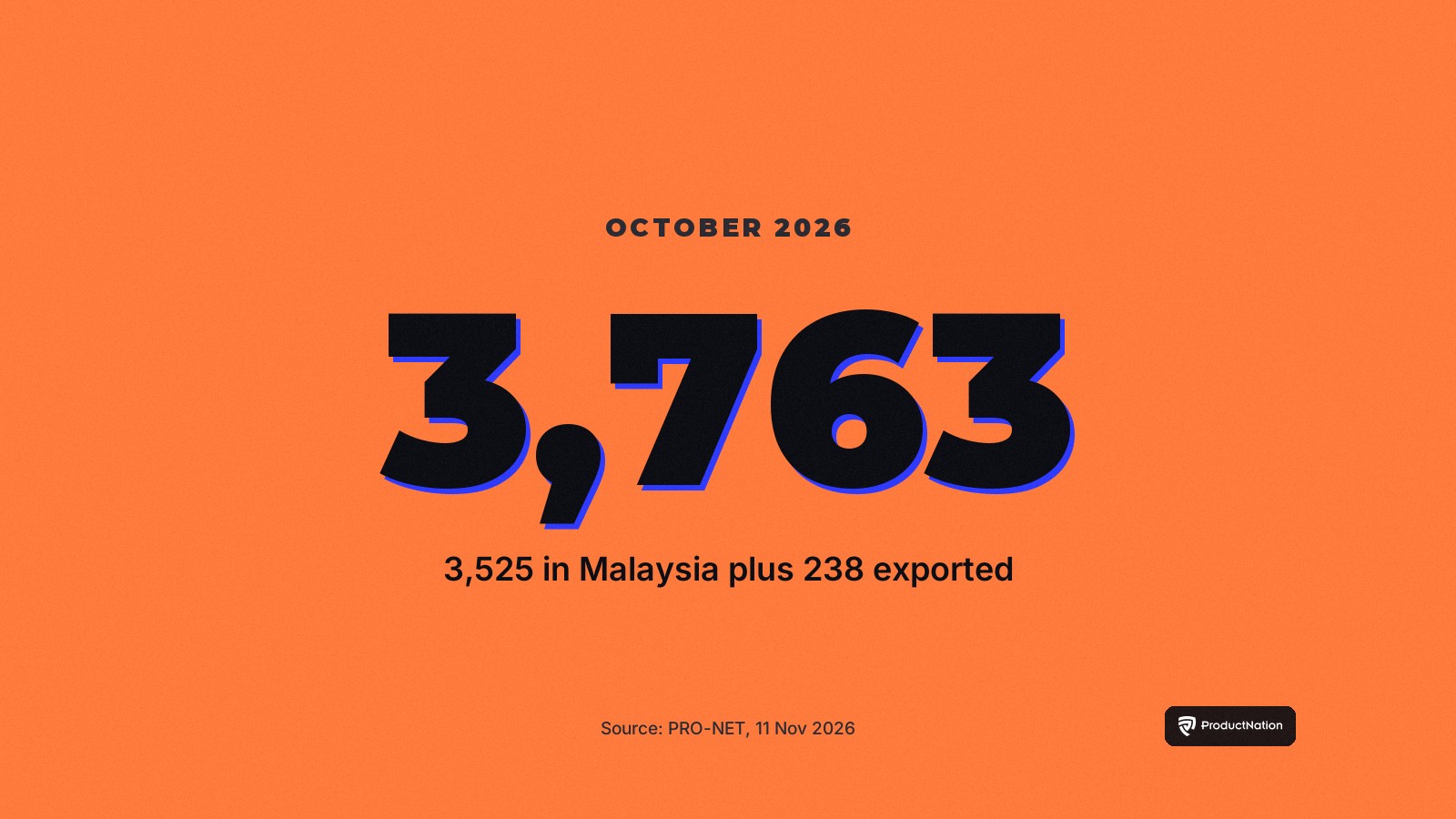
October alone brought 3,763 sales. In Malaysia that was 2,262 e.MAS 5, 710 e.MAS 7 PHEV and 553 e.MAS 7, with another 238 cars exported (175 e.MAS 5 and 63 e.MAS 7). Across the ten months the brand averaged about 3,570 sales a month, so October landed slightly above the year's run rate rather than as a one-off surge.
"Surpassing more than 35,000 sales in the first ten months of 2026 is a significant milestone for Proton e.MAS," said Zhang Qiang, Chief Executive Officer of PRO-NET. He added that the company will focus on the ownership experience, aftersales and the wider charging network as its customer base grows.
What it means if you are shopping for an EV
A large local owner base matters more for an electric car than for a petrol one. More cars on the road gives dealers and service centres a reason to stock parts, train technicians and add chargers, and it gives buyers a clearer picture of how the cars hold up over time. PRO-NET says its next priorities are aftersales, ownership support and charging partnerships, which are exactly the areas first-time EV owners tend to worry about.
For anyone weighing up an accessible EV, the takeaway is simple: the e.MAS 5 is now the e.MAS range's biggest seller by a wide margin, and the brand behind it is selling cars at close to four times last year's pace. Proton has also been taking the range around the country, like its recent roadshow in Sabah, so seeing one in person is getting easier outside the Klang Valley too.
Image courtesy of Proton e.MAS.