On Malaysia's six main payment systems, almost every transaction is a retail transfer and almost all of the reported value sits in a tiny number of large-value ones. DuitNow was four out of five transactions in 2025, averaging RM669 each. RENTAS, the large-value system banks use to settle with each other, was under 1 in 1,000 transactions, averaging RM12.96 million each. A single RENTAS transfer is about 19,000 DuitNow payments by average value.
We counted every transaction and every ringgit that Bank Negara Malaysia reports for the six systems in its payment-systems statistics, for the full calendar year 2025. These are Malaysia's main account-to-account and interbank systems. They do not include card payments at the till, e-wallet balances, cheques or cash, which Bank Negara reports in separate series. Within this set, the count and the size of a payment pull in opposite directions.
Contents
The count is retail. The size is wholesale.
DuitNow (reported by Bank Negara as RPP, the Real-time Retail Payments Platform, which covers instant transfers, QR and online payments) handled 5.44 billion transactions in 2025, 79.7 per cent of the six-system total. That is the familiar cashless Malaysia: the QR code at the night market, the instant transfer that splits a bill. Its mean transaction was RM669.
RENTAS is the opposite kind of system. It is Malaysia's large-value real-time gross settlement system, the plumbing banks and large institutions use to move big sums and settle securities. It processed just 5.8 million transactions in 2025, under 1 in 1,000 of the six-system total, and each one averaged RM12.96 million. That is the clean, like-for-like gap at the heart of this: a RENTAS transfer is about 19,000 times the size of a DuitNow one, and both figures are simply each system's own reported value divided by its own count.
Here is the full 2025 breakdown. Each row is that system's own reported transactions and ringgit value. The share columns and the totals are computed from the unrounded figures, so the displayed rows may not re-add to the total exactly.
| Payment system | Transactions | Share of count | Reported value | Share of value | Mean per transaction |
|---|---|---|---|---|---|
| DuitNow (RPP, instant retail) | 5,438.6 million | 79.7% | RM3.64 trillion | 4.5% | RM669 |
| FPX (online banking) | 956.1 million | 14.0% | RM0.47 trillion | 0.6% | RM487 |
| IBG (Interbank GIRO) | 307.7 million | 4.5% | RM1.61 trillion | 2.0% | RM5,231 |
| JomPAY (bill payments) | 94.5 million | 1.4% | RM0.06 trillion | 0.1% | RM619 |
| Direct Debit | 19.2 million | 0.3% | RM0.09 trillion | 0.1% | RM4,502 |
| RENTAS (large-value settlement) | 5.8 million | 0.09% | RM75.27 trillion | 92.8% | RM12,957,943 |
| All six systems | 6,821.8 million | 100% | RM81.13 trillion (combined) | 100% |
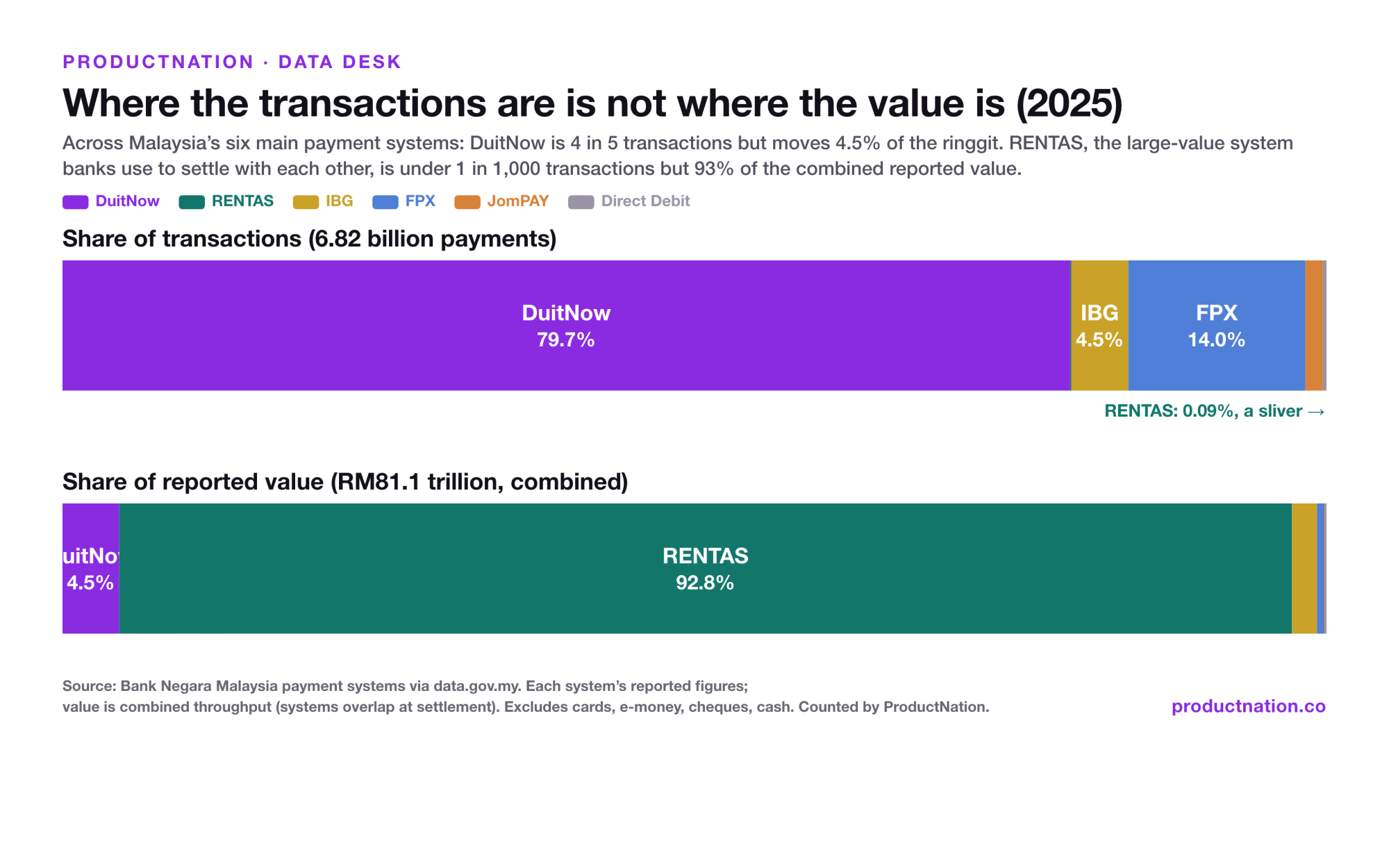
One figure in that table needs a caveat stated plainly, not buried. The RM81.1 trillion combined value is not a pool of distinct money, and the 92.8 per cent is a share of combined reported throughput, not of all the ringgit in the economy. These six systems overlap: retail systems ultimately settle across RENTAS, so a ringgit can be counted both in a retail system and again, netted, in RENTAS. The value total also far exceeds the size of the Malaysian economy because a settlement system moves the same underlying money many times over as banks square up. So read the value column as throughput through each system's own pipes. The mean-transaction figures are each a system's own reported value divided by its own count, and we lean on those and on the per-system counts rather than on any single share of the combined value.
Six years that changed the count, not the size of a payment
Between 2019, the first full year in this payment-systems dataset, and 2025, DuitNow's share of all transactions on these systems rose from 20.3 per cent to 79.7 per cent. One transaction in five became four in five. By the count, the way money moves through these systems shifted hard toward instant retail transfers.
The balance of reported value shifted far less. RENTAS was 97.5 per cent of the combined throughput in 2019 and 92.8 per cent in 2025, a fall of under five percentage points, though the retail systems' combined share nearly tripled over the six years, from 2.5 to 7.2 per cent.
| Year | DuitNow, share of transactions | RENTAS, share of reported value |
|---|---|---|
| 2019 | 20.3% | 97.5% |
| 2020 | 45.1% | 96.8% |
| 2021 | 49.6% | 95.7% |
| 2022 | 58.1% | 95.6% |
| 2023 | 65.3% | 95.0% |
| 2024 | 73.5% | 93.6% |
| 2025 | 79.7% | 92.8% |
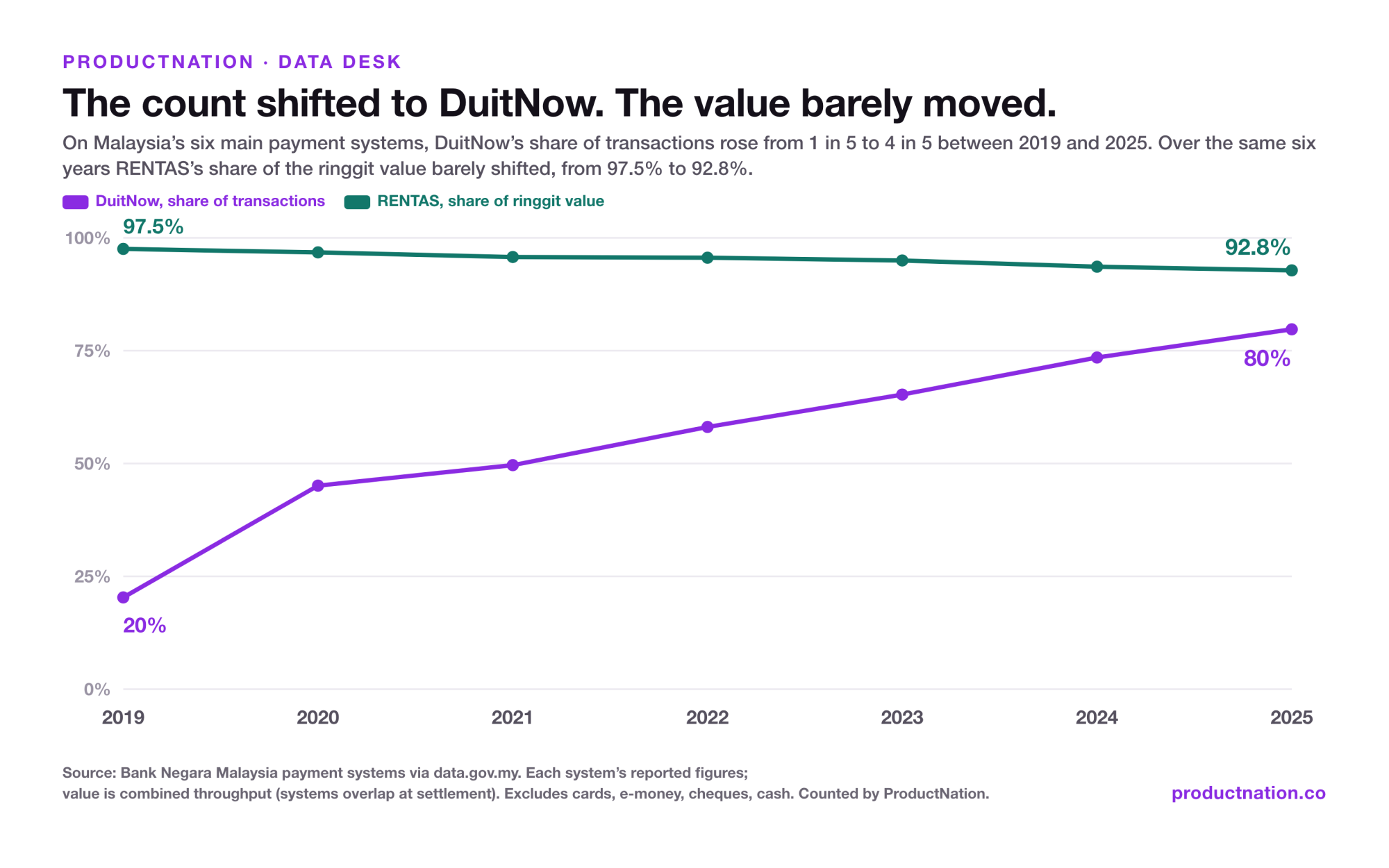
One change in the data deserves a flag rather than a smoothing-over. Late in 2025 Bank Negara introduced RENTAS+, which settles DuitNow retail transactions one by one, immediately, rather than in twice-daily net batches. That could affect how the most recent figures compare with earlier years. In the published series it does not appear as a break: RENTAS's reported transaction count stayed between 0.4 and 0.6 million a month through the end of 2025 and into the first half of 2026, nowhere near DuitNow's roughly 500 million a month, so the new per-transaction settlements are not visible in the RENTAS count. Bank Negara has not documented how those settlements enter its published statistics, so we cannot fully confirm that the final months of 2025 are measured identically to 2019, and we would not lean on the last quarter alone. The six-year shift does not need it: DuitNow's transaction share had already risen from 20.3 per cent in 2019 to 73.5 per cent in 2024, before RENTAS+, and RENTAS's value share had already eased from 97.5 to 93.6 per cent over those same pre-change years.
Both systems grew in absolute terms over the six years. RENTAS's reported value rose from RM56.8 trillion in 2019 to RM75.3 trillion in 2025, up about 33 per cent, so its falling share is the retail systems growing faster around it off a far smaller base, not RENTAS shrinking. DuitNow's own value rose from RM151 billion to RM3.64 trillion. We are describing two things moving, not one causing the other: the retail count grew, and the typical size of a payment on these systems stayed split between a few very large transfers and billions of small ones.
What this is, and what it is not
A few limits matter, because a payment statistic is easy to over-read.
This is a subset of Malaysia's payments, not all of them. The six systems are the main account-to-account and interbank rails. They exclude card payments at the point of sale, e-money and e-wallets, cheques and cash, each of which Bank Negara reports in a separate series. Every figure here is about these six systems only.
Bank Negara also publishes three different views of payments: by system (what we used here), by instrument (cards, e-money, cheques) and by channel (mobile, internet, ATM). The three overlap, because the same payment can appear in more than one view, so they must never be added together. Everything in this piece comes from the single by-system view, and that view does not record the device or channel a payment was made on, so nothing here says whether a payment was made by phone, computer or branch.
The value figures are reported throughput, not distinct money, because the systems overlap at settlement as described above, and RENTAS value includes securities settlement, not only funds transfers. A transaction count is a count of payments, not of people or of sales, and a mean transaction value is an arithmetic average, not the size of a typical payment.
Anyone can reproduce the count. Download the payment_systems dataset from data.gov.my, keep the rows for each calendar year, and sum the value and volume columns by system. The 2019 and 2025 figures above are the result.
This piece sits alongside our earlier work on the same statistics: that Malaysia made 5.4 billion DuitNow payments in 2025, fifty times its 2019 figure, and that most of Malaysia's credit-card spending moved online while debit stayed in shops. Together they describe how money moves through Malaysia's main transfer systems: by count, dominated by instant retail transfers, while the largest sums move through a system most people never see.