We counted every year of the government’s own survey of how Malaysians get online, and the tablet does something the other devices do not. We tend to assume a device only catches on, its share creeping up year after year. The tablet instead jumped and then eased: the share of surveyed internet users who went online on a tablet more than doubled in a single year, from 14.1 per cent in 2020 to 30.9 per cent in 2021, and has not reached that level in the four years since, settling at just over one in four (27.4 per cent in 2025).
The figures come from the Department of Statistics Malaysia’s (DOSM) ICT Use and Access by Individuals and Households Survey, published every year on data.gov.my. It covers individuals aged 15 and above living in private households, and asks which devices they used to go online in the three months before the interview, so each year’s reading reflects that window rather than the whole calendar year. The device figures are shares of people who use the internet, and because a person can use more than one device the shares overlap and do not add to 100 per cent. We pulled the device table for all seven years it covers, 2019 to 2025, and counted the shares ourselves. Where we quote figures below, “internet users” means those surveyed individuals.
Contents

2021 was a peak, not a step up
At its 2021 high, nearly one in three surveyed internet users reached the web on a tablet. By 2025 that is just over one in four. The decline from the peak is modest and the level is still roughly double what it was before 2021, so this is not a collapse. But it is a clear peak-and-settle rather than steady growth, and as the next chart shows, every non-phone device in the survey did the same thing in the same year.
The timing is worth noting without overreading it. 2021 was the year Malaysia’s schools spent long stretches closed, with pupils on home-based learning (PdPR); public records of the Education Ministry’s directives put the affected primary and secondary enrolment in the millions. It is also the year the survey’s own measure of individuals using the internet rose from 89.6 per cent to 96.8 per cent. We cannot show from this survey that home learning drove the tablet’s rise, and we are not claiming it did: the survey records which device people used, not why. What it shows plainly is that the tablet’s highest reading in seven years coincides with 2021, and that it has been lower every year since.
It is not just the tablet
Look across the devices and the same shape repeats. Every device except the phone recorded its single highest reading of the seven years in 2021, and none has returned to that high since.
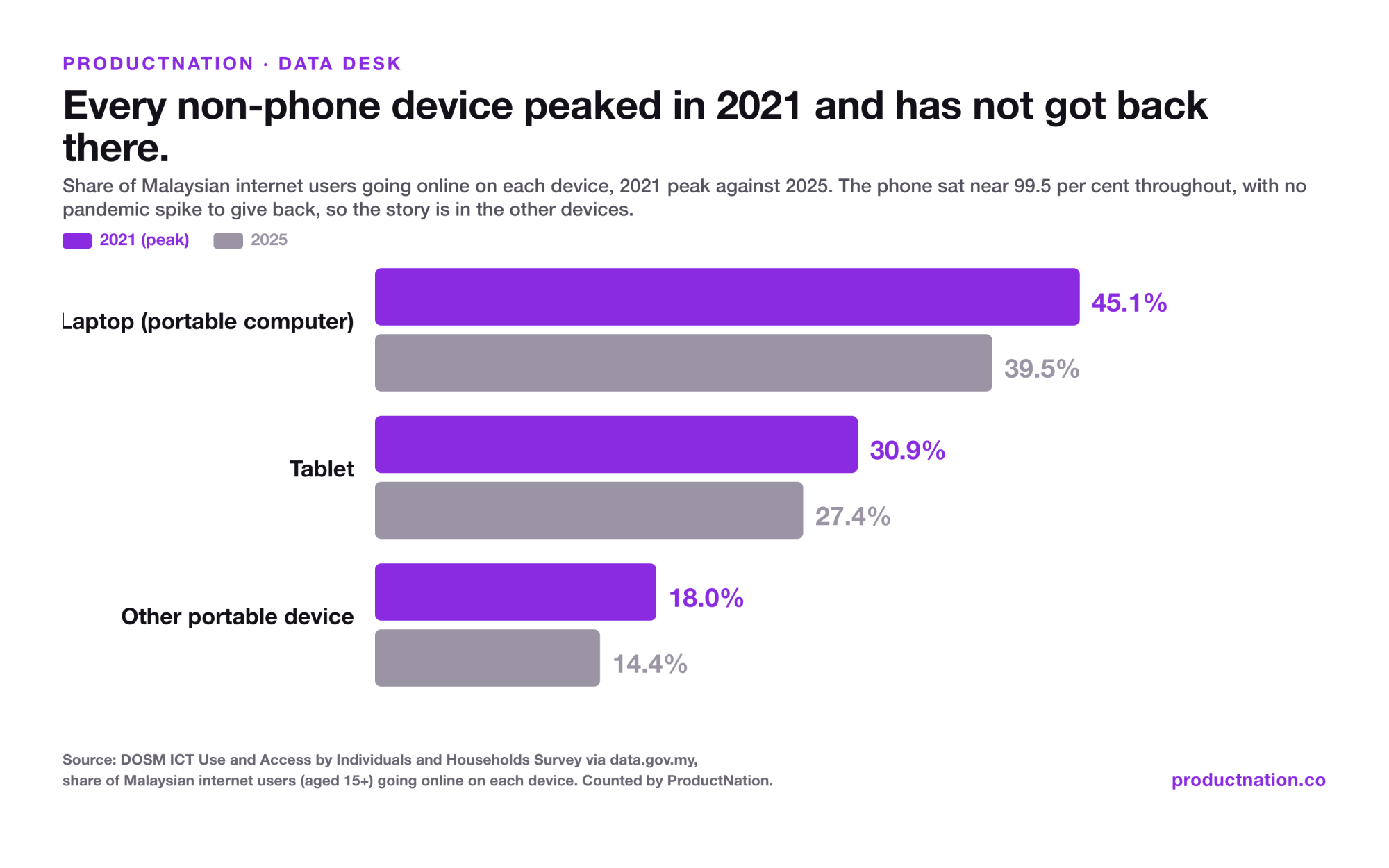
The laptop, which the survey calls a portable computer, peaked at 45.1 per cent in 2021 and is 39.5 per cent now. Other portable devices peaked at 18.0 per cent and are 14.4 per cent. The tablet peaked at 30.9 per cent and is 27.4 per cent. Three different devices, the same 2021 high-water mark, the same failure to get back to it.
The phone is the exception. It sat at about 99.5 per cent of surveyed internet users in every year from 2019 to 2025 (99.6 per cent in 2019, 99.4 per cent in 2025). At that level there is almost no room left on the scale for it to rise, so a jump like the tablet’s was arithmetically off the table whatever happened in 2021. That is the other half of a finding we published last week, that 99 per cent of surveyed Malaysian internet users go online by phone and just 40 per cent by laptop: the phone has been near-universal in every year on record, while the devices around it have proved more changeable than the steady-growth story would suggest.
The numbers behind it
| Device | 2020 | 2021 peak | 2025 |
|---|---|---|---|
| Mobile phone | 99.6% | 99.7% | 99.4% |
| Laptop (portable computer) | 37.8% | 45.1% | 39.5% |
| Tablet | 14.1% | 30.9% | 27.4% |
| Other portable device | 7.4% | 18.0% | 14.4% |
What this does and does not say
Four things keep the finding honest. First, this is a household survey of individuals aged 15 and above in private households, reporting their own use in the three months before the interview, not a count of devices owned or sold. Second, the figures are shares of people who use the internet, not of the whole population, and because a person can use more than one device the shares overlap and do not sum to 100 per cent. Third, the survey’s “computer” means a portable computer, a laptop: desktop computers are not counted here at all, so this is not a statement about every kind of computer. Fourth, the internet-user base itself grew over this period, most sharply in 2021, but it has been stable at 96.8 to 98.3 per cent of individuals since, so the fall in device shares after 2021 is measured against a steady base rather than being an artefact of more people coming online.
How to reproduce this: on data.gov.my, open the data catalogue entry icths_internet_device (the DOSM ICT Use and Access by Individuals and Households Survey), filter to state “Malaysia” and strata “overall”, and read the yearly proportion for each device: that is the source of every device figure here. The individual internet-use figures (89.6 and 96.8 per cent) come from the companion table icths_internet_strata in the same survey. The 2021 school-closure context is from public Education Ministry records, not from this survey.