The smart glasses at the centre of a new criminal investigation in France are not officially sold in Malaysia, and buyers here have relied on imports. Reuters reported on 18 September 2026 that Paris prosecutors had opened a probe into suspected sexual harassment involving smart glasses, after clips began circulating of women filmed on the street without their knowledge and posted online. Prosecutors have not named a brand.
For readers here, the uncomfortable question is not what France does next. It is what Malaysian law actually does when a stranger wearing a camera on their face points it at you.
Contents

What France is investigating
Paris prosecutors have opened a criminal probe into suspected harassment involving smart glasses, Reuters reported. The market is led by Meta's glasses, made with eyewear group EssilorLuxottica, which the report puts at roughly 76 per cent of global smart-glasses sales. Meta's AI glasses sold 7 million units in 2025, according to the same report. The camera sits in the frame and, as Reuters describes it, lets the wearer record discreetly, though the glasses carry a small light meant to signal when recording is on.
That discretion is the whole problem. Internet-safety group e-Enfance describes recordings being distributed to thousands of people afterwards, and rights groups say women are the primary target. France's data-protection regulator, the CNIL, said it had received fewer than ten complaints about smart glasses used in workplaces, but that a growing number of businesses are asking whether they can ban the devices on their premises. Meta says it "built privacy into our AI glasses from the ground up" and will keep strengthening its protections. EssilorLuxottica declined to comment.
What Malaysian law actually reaches
This is where Malaysia looks thin. Unlike Singapore, which has a dedicated voyeurism offence (Penal Code Section 377BB), Malaysia has no dedicated voyeurism law, a gap legal academics have flagged for years and one that, going by cases still charged under older provisions in 2026, remains open. Even voyeurism laws are built around private acts, not someone filming you on a public street. Taking a photo or video of a person in a public place is not, on its own, a specific offence here, though how the footage is later used can create liability.
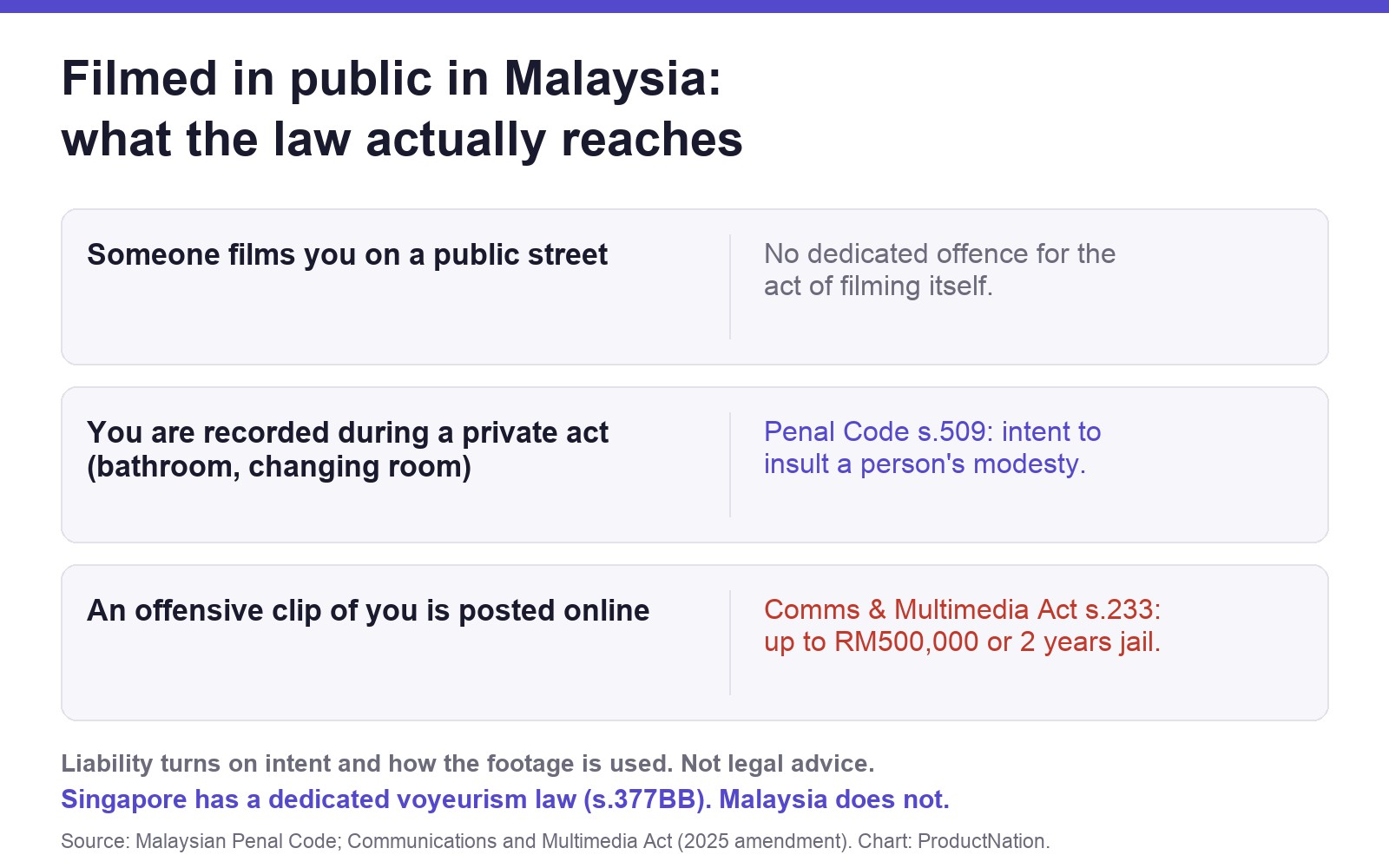
What Malaysia has instead is a patchwork that turns on intent and on what happens next. Recording someone during a private act, in a bedroom, bathroom or changing room, is still charged under Penal Code Section 509, which punishes an act intended to insult a person's modesty. Posting a clip can fall under Section 233 of the Communications and Multimedia Act, which covers content that is indecent, obscene, false, menacing or offensive and shared with intent to annoy or harass, and which since a 2025 amendment carries a fine of up to RM500,000, up to two years in jail, or both. In our reading, the everyday French case, a stranger quietly filming a passer-by and uploading it as a prank, does not map cleanly onto any one of these, because each turns on facts a prosecutor would have to prove.
Why this should matter to buyers here
Malaysia is not outside this trend. Buyers here have relied on imports rather than an official channel, and we have written before about how camera wearables collide with Malaysia's data-protection rules and about the wider push to put a camera on everyone's face. The appeal for the wearer, a camera few people around them notice, is exactly what leaves the person in front of them with little say.
None of this is legal advice, and harassment or civil claims may apply depending on the circumstances. But for now, a Malaysian filmed on a public street has no offence written for the act itself, only rules built for other situations. The glasses arrived faster than the law did, and that gap is the part worth watching.
Images courtesy of Daniil Velychko and Rich Smith on Unsplash.