
The iPhone is the phone that draws the most search impressions to our Malaysian pages. It is not the phone our readers click to buy. We measured two things on our own Malaysian sites: which phone brands surfaced our pages most often in Google's results, and which phone brands those readers then clicked through to a store to buy. The iPhone leads the first list and sits sixth on the second.
The figures are our own, from the two sources we can measure directly, and they count different things, so we keep them apart. The buy-clicks are 36,454 clicks on phone buy-links from our Malaysian sites, aggregated by calendar month across July, August and September 2026, with September still in progress when we counted. The search figures are Google Search Console impressions, meaning how often our Malaysian pages for each brand appeared in a search result, from 22 July to 11 September 2026. Our click warehouse records clicks by calendar month, not by day, so the September figure is a part month rather than a fixed cut-off date. To be sure the incomplete month is not doing the work, we checked the ranking on the two complete months alone, July and August: Apple is sixth on those two months as well, so the result does not depend on September. The two windows overlap but are not identical, and we do not divide one figure by the other. An impression is not a search we can attribute to a named person, and a click is not a sale. We treat the clicks as buy-intent, count each brand the same way in each dataset, and check the direction against a national shipment estimate at the end.
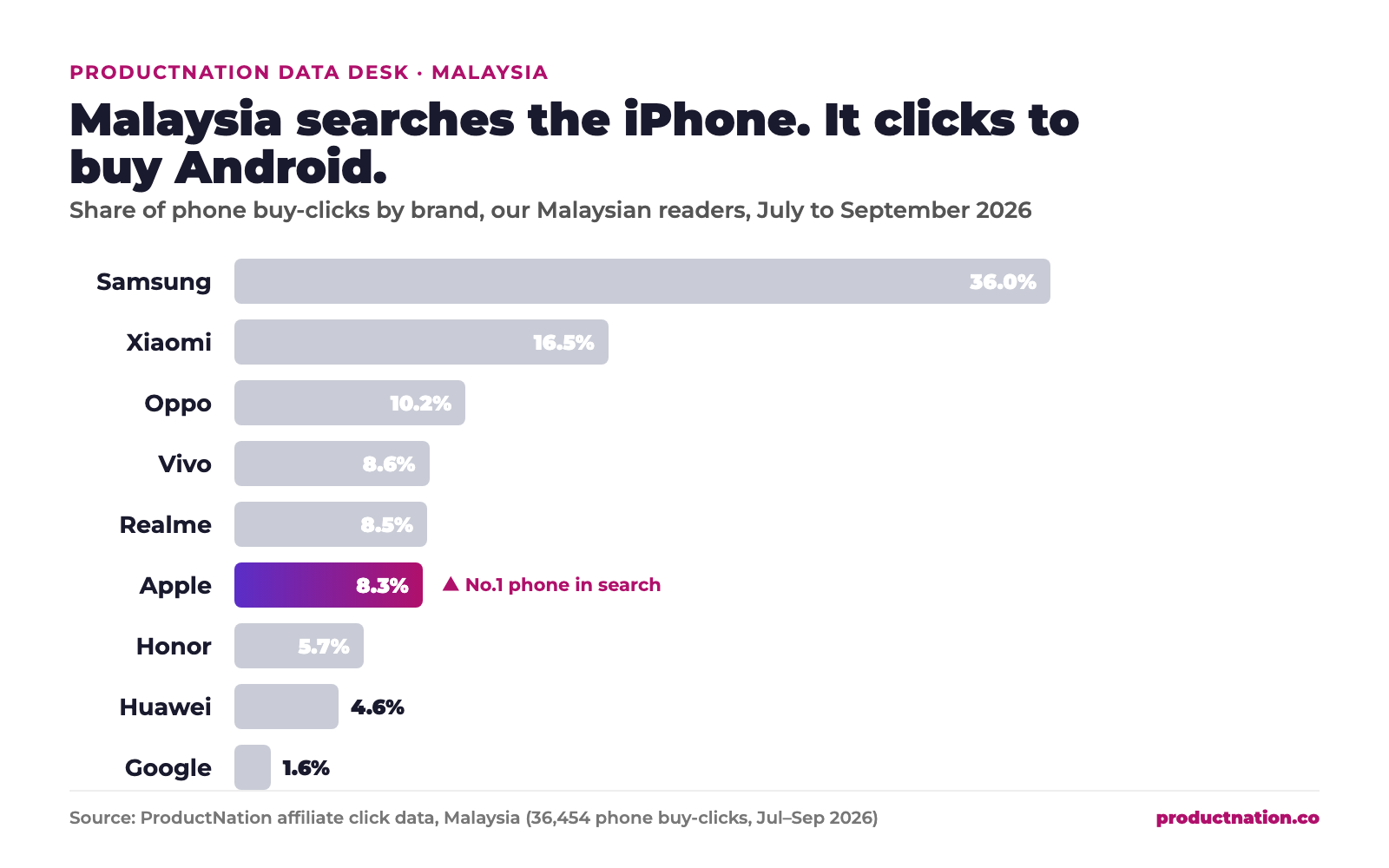
Table of Contents
What our readers click to buy
Samsung is the clear leader in buy-clicks, taking more than a third of every phone click. Behind it sit five brands close together, four of them Chinese. Apple is sixth, on 8.3 per cent of phone clicks, behind Samsung, Xiaomi, Oppo, Vivo and Realme.
| Brand | Phone buy-clicks (our Malaysian sites, Jul to Sep 2026) | Share |
|---|---|---|
| Samsung | 13,116 | 36.0% |
| Xiaomi | 6,022 | 16.5% |
| Oppo | 3,716 | 10.2% |
| Vivo | 3,131 | 8.6% |
| Realme | 3,098 | 8.5% |
| Apple | 3,025 | 8.3% |
| Honor | 2,093 | 5.7% |
| Huawei | 1,659 | 4.6% |
| 594 | 1.6% |
The single-model picture is starker. No iPhone appears anywhere in the eight most-clicked phones on our Malaysian sites. That list is six Samsung models, led by the Galaxy S25 Ultra on 804 clicks, plus the Xiaomi 15 Ultra and the Honor X9c. Apple's clicks are spread thinly across many models, and the most-clicked single iPhone listing over the period, the iPhone 14, drew 176 clicks. We make no price comparison here, only the count: the phone brand people search for most does not produce a single top-eight phone in what our readers click to buy.
The gap between looking and buying
The surprise is that interest runs the other way. When we count the search impressions our Malaysian pages earned for each phone brand, counting each brand by the same method, the iPhone is first, ahead of Samsung and well ahead of every other brand.
| Phone brand searched | Search impressions on our Malaysian pages (22 Jul to 11 Sep 2026) |
|---|---|
| iPhone (Apple) | 26,321 |
| Samsung | 21,748 |
| Vivo | 4,927 |
| Xiaomi | 1,654 |
| Huawei | 1,351 |
| Oppo | 1,118 |
| Realme | 1,087 |
| Google (Pixel) | 916 |
| Honor | 358 |
A launch was coming, and the search terms show it. Apple opened pre-orders for the iPhone 18 Pro and iPhone 18 Pro Max on 12 September and puts them on sale in Malaysia on 18 September, according to Apple's own newsroom. Our search figures end on 11 September, so what they capture is the anticipation before the phone was even orderable: the top iPhone searches our pages answered were about the coming model's price and release date. "iphone 18 pro max price in malaysia" drew 3,851 impressions on its own, "iphone 18 malaysia" 768, and "iphone 18 release date in malaysia" 434, each worded about the coming phone rather than a model already on sale. We cannot say how much of the iPhone's search lead is this one launch and how much is standing interest, only that the terms are dominated by the new phone. Over the overlapping months, the buy-clicks went the other way: overwhelmingly to non-Apple brands, led by Samsung and the Chinese makers.
These two measures are not one number, and we are not dividing one by the other. Search impressions count how often our pages surfaced for a brand's queries, which is a proxy for search demand and also reflects how many pages we have published on each brand. Buy-clicks count taps on a store link. What they show, side by side, is that the phone brand people most often look up on our sites is not the brand they most often move to buy.
The national shipment estimate points the same way
If this were only a quirk of our audience, a national estimate might point the other way. It does not. Industry shipment trackers have placed Malaysia's smartphone market in the hands of Chinese vendors and Samsung for years, with Apple confined to the premium end rather than the top of the volume table. The most recent figures we found, from Omdia's Southeast Asia tracker for the second quarter of 2026 as carried in the regional technology press, put Oppo first in Malaysia on about 19 per cent of shipments, then Samsung and Xiaomi near 16 per cent each and Honor and Vivo near 13 per cent each, with those five vendors taking roughly three-quarters of the market. The load-bearing point for us does not rest on any single percentage: Apple was outside that top five, as it has been in Malaysia for years.
That is a different measure from ours, over an earlier quarter, and shipments into the channel are not consumer purchases. It cannot validate our click data, and we do not use it to. But the two are consistent with the same reading: Chinese vendors and Samsung at the top, and Apple outside the leaders. On the buy-clicks we can see, and in Omdia's five disclosed vendors, the iPhone is nowhere near the front, however much it is searched for.
What this shows, and what it does not
Our search and click figures are our own, drawn from our Malaysian readers and our pages over about two months, not a census of the whole market, and both come from our internal analytics rather than a public dataset a reader can pull. Someone set on an iPhone may skip a comparison site and go straight to a store, which would hold Apple down in a dataset like ours. That is a fair objection, and it is why we checked the direction against Omdia's national shipment estimate, which is built across the market and still places Apple outside the top five. Neither our clicks nor Omdia's shipments are a sales table for Malaysia, and the shipment share is Omdia's work, not ours. Within those limits, both point the same way: on our sites, the iPhone draws the most phone searches, and the clicks to buy go to Android.


