For a year the story has been that Malaysia is becoming a power supplier to its richest neighbour. In October 2025 Singapore's Energy Market Authority gave conditional approval to import 1 gigawatt of hydropower from Sarawak. In August 2026 it approved another 900 megawatts of solar from Johor. Both land inside Singapore's plan to buy about 6 gigawatts of low-carbon electricity from the region by 2035.
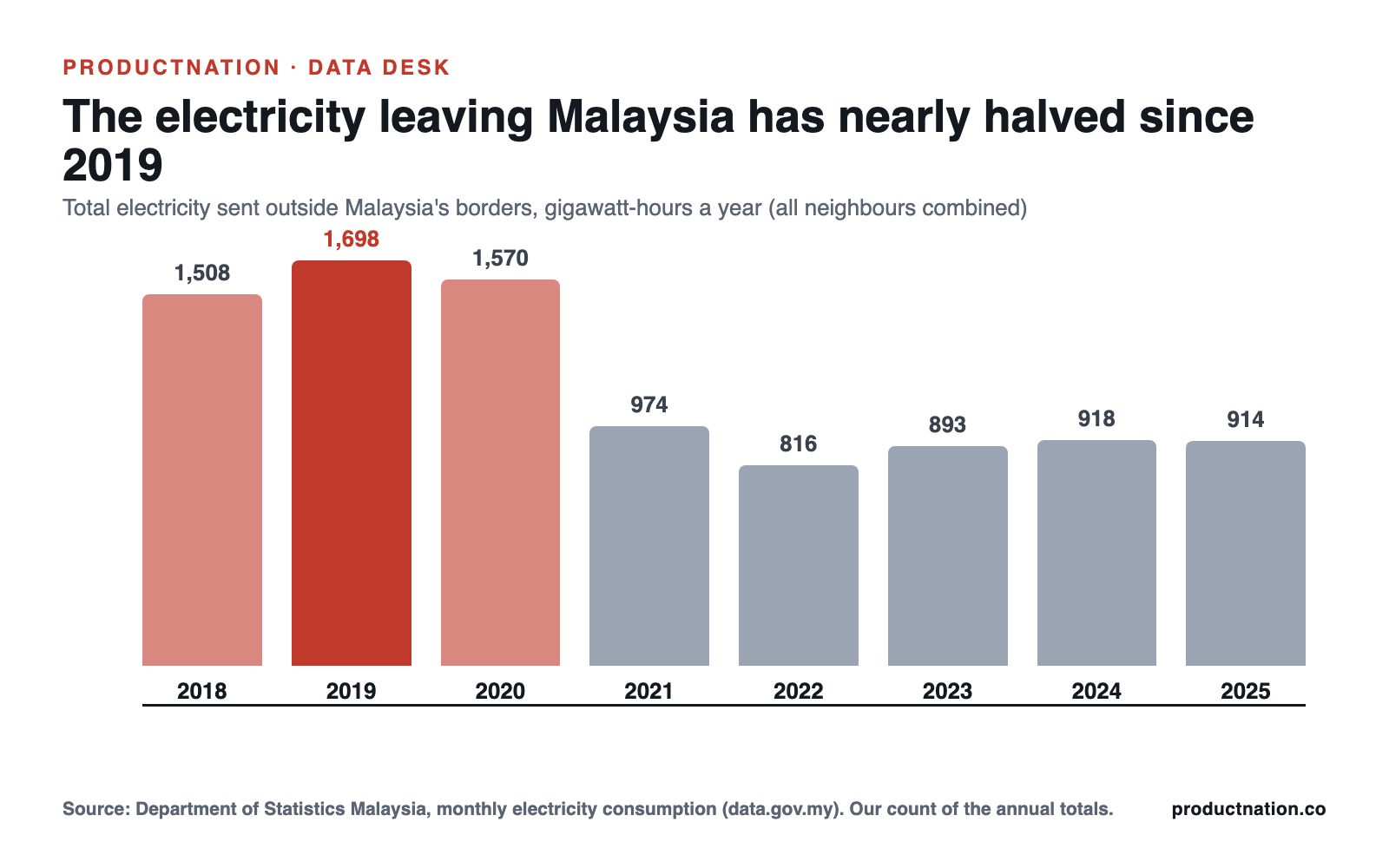
The electricity that has actually crossed Malaysia's borders tells a quieter story. We counted the Department of Statistics Malaysia's monthly electricity record, which reports the electricity sent outside the country each month. In 2019 Malaysia exported 1,698 gigawatt-hours. In 2025 it exported 914. That is a fall of 46 per cent, and exports stayed below the 2019 peak in every year from 2020 to 2025.
Contents
As a share of the total electricity recorded in the series, which covers domestic use, system losses and exports together, exports went from about one per cent in 2019 to under half a per cent in 2025. The series records more than 193,000 gigawatt-hours in total last year, and the electricity leaving the country is less than half a per cent of that, down from about one per cent in 2019.
What the record shows, year by year
The monthly file lets us add up each full year. The exports column covers power sent to all of Malaysia's neighbours combined, not Singapore alone. The record does not say where each unit went, so we make no claim about any single border.
| Year | Electricity exported (GWh) | Exports as a share of total recorded electricity |
|---|---|---|
| 2018 | 1,508 | 0.92% |
| 2019 | 1,698 | 1.01% |
| 2020 | 1,570 | 0.96% |
| 2021 | 974 | 0.58% |
| 2022 | 816 | 0.46% |
| 2023 | 893 | 0.49% |
| 2024 | 918 | 0.47% |
| 2025 | 914 | 0.47% |
The step down came in 2021. Monthly exports ran around 130 to 150 gigawatt-hours through 2019 and 2020, then fell through 2021 to roughly half that, averaging about 70 gigawatt-hours a month in every year since 2022. We checked the monthly series for an abrupt one-month jump of the kind a change in accounting would produce, and found none: the decline spreads across the whole of 2021. We do not claim a cause for it; the record shows the level, not the reason.
Approved is not delivered
The gap between the announcements and the record is mostly a gap between a decision and a delivery. Singapore's approvals are conditional, and each carries a start date years away. The two Johor solar projects, 300 megawatts for Sembcorp and 600 megawatts for Southern Solar Alliance, are both working towards commercial operation around 2029. The 1-gigawatt Sarawak hydro link is dated around 2035.
Against those gigawatts, what has actually begun is far smaller. Malaysia established the Energy Exchange Malaysia (ENEGEM) in April 2024 as the single channel for selling green electricity across the border, and cross-border green-electricity trading commenced on 13 December 2024. That first supply is sized at up to 50 megawatts of capacity. The gigawatts being approved are decisions, not yet power.
Two numbers that do not share a unit
It is tempting to set the approved gigawatts straight against the exported gigawatt-hours, but they do not measure the same thing. A gigawatt is capacity, the most a plant can produce at any instant. A gigawatt-hour is energy, what is actually delivered over time, which depends on how often the plant runs. So the approvals and the record cannot be read off against each other directly. What can be said plainly is the shape of the two: the capacity being promised is large and years away, and the energy actually crossing the border is small and well below where it stood in 2019.
The limits of this reading
Four limits belong on the record, not under it. First, the DOSM exports figure is all cross-border electricity combined; it does not break out Singapore, Thailand or any other destination, so this piece contrasts a national total with a Singapore-focused set of announcements and does not claim the fall happened on the Singapore link. Second, the unit is energy delivered, not capacity approved, and the two should not be compared without care. Third, DOSM marks its most recent six months as provisional, so the first half of 2026 may be revised; those six months show 463 gigawatt-hours of exports, a run-rate close to 2025. Fourth, our annual totals are our own sum of the DOSM monthly file and can differ by around one per cent from the Energy Commission's separately published annual figures (its 2020 total is 1,586 gigawatt-hours against our 1,570); we use one consistent method across every year, which is what makes the matched 2019-to-2025 comparison valid.
We have separately read the same DOSM electricity series to look at how Malaysia uses power at home. Set beside that, the plain fact here is narrower and firmer: Malaysia is sending less electricity across its borders than it did in 2019, even as the plans to send far more of it abroad grow louder. For that earlier count, see how Malaysia's homes grew their power use faster than its businesses.
How to reproduce this
Download the monthly electricity consumption dataset from data.gov.my (id electricity_consumption), keep the rows where the sector is exports, and sum the gigawatt-hours by calendar year. The total share uses the total sector over the same months. Every figure above is our own count of that public file.