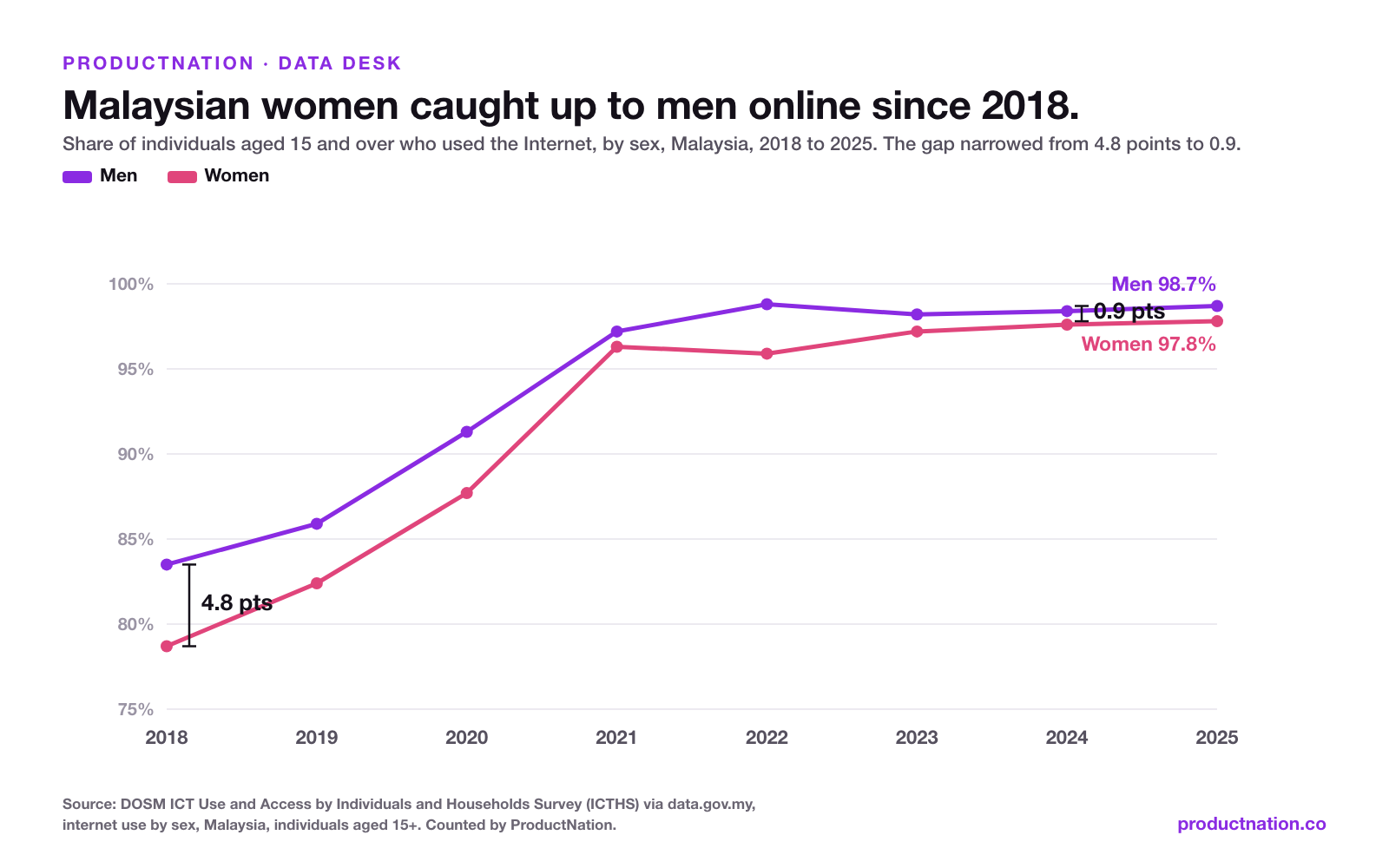
Malaysia has quietly reached something the world as a whole has not: internet-use gender parity. In 2025, 97.8% of Malaysian women aged 15 and over used the internet, against 98.7% of men, a difference of 0.9 of a percentage point. On the standard measure the International Telecommunication Union (ITU) uses, that counts as parity. Worldwide, 71% of women use the internet against 77% of men, a gap of 6 points, and on the ITU's own measure the world has made no progress since 2019.
We counted the Malaysian figures from the Department of Statistics Malaysia (DOSM) ICT Use and Access by Individuals and Households Survey, published on data.gov.my, and set them against the ITU's latest global figures. Each half is public. The join is the finding.
Contents
From nearly five points to under one
In 2018, 83.5% of Malaysian men used the internet against 78.7% of women, a gap of 4.8 points. By 2025 the gap was 0.9 of a point. The path was not smooth: the gap reached 0.9 of a point as early as 2021, widened again to 2.9 points in 2022, and has sat at or near a single point every year since 2023. The direction across the period is clear even though the year-to-year path is not.
Between 2018 and 2025, women's internet use rose 19.1 points (78.7% to 97.8%) and men's rose 15.2 points (83.5% to 98.7%). The group that started further behind gained more ground, so the two lines met near the ceiling. The survey counts internet use, not its causes, and we make no claim here about what drove the change.
| Year | Men | Women | Gap (points) | Parity score (women ÷ men) |
|---|---|---|---|---|
| 2018 | 83.5% | 78.7% | 4.8 | 0.94 |
| 2019 | 85.9% | 82.4% | 3.5 | 0.96 |
| 2020 | 91.3% | 87.7% | 3.6 | 0.96 |
| 2021 | 97.2% | 96.3% | 0.9 | 0.99 |
| 2022 | 98.8% | 95.9% | 2.9 | 0.97 |
| 2023 | 98.2% | 97.2% | 1.0 | 0.99 |
| 2024 | 98.4% | 97.6% | 0.8 | 0.99 |
| 2025 | 98.7% | 97.8% | 0.9 | 0.99 |
Share of individuals aged 15 and over who used the internet, Malaysia. Source: DOSM ICTHS via data.gov.my, counted by ProductNation.
The measure the world uses, and where Malaysia lands on it
The ITU tracks this with one number, the gender parity score: the share of women who use the internet divided by the share of men. A score between 0.98 and 1.02 counts as parity. Malaysia's score reached 0.99 in 2025, inside that band, up from 0.96 in 2019 and 0.94 in 2018.
On the matched window the ITU uses, 2019 to 2025, the contrast is plain. Malaysia moved from 0.96 to 0.99 over those years. The world's score was 0.92 in 2019 and is still 0.92 in 2025, no movement in six years. In its Measuring digital development: Facts and Figures 2025, the ITU reports that 77% of men worldwide use the internet against 71% of women, and that about 280 million more men than women are online. It records parity reached in Europe, the Americas and the CIS region, while Africa sits at 0.78, up from 0.70 in 2019.
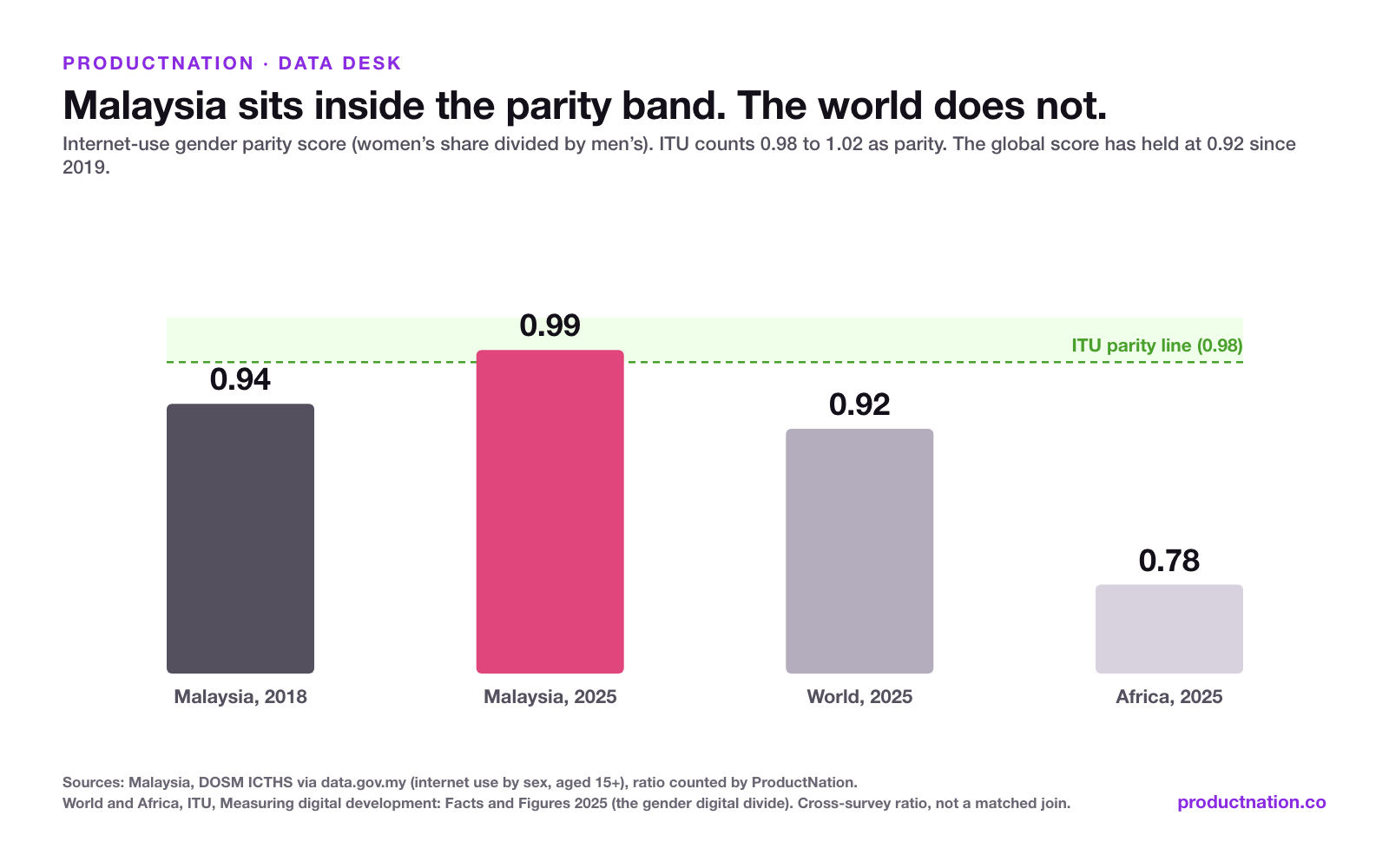
So on this measure Malaysia now sits where Europe and the Americas sit, inside the parity band, while the world as a whole remains below it and has not moved in six years. That is the part worth citing: the global gender gap in internet use has not closed, and Malaysia has reached the ITU's parity threshold on it.
How to check this yourself
Download the internet-use-by-sex table from the DOSM ICTHS dataset on data.gov.my (dataset id icths_internet_sex), keep the rows where the state is Malaysia, and read the male and female proportions for each year from 2018 to 2025. The parity score is the female figure divided by the male figure. The global figures and the parity-band definition are in the ITU's Facts and Figures 2025 report on itu.int, in the section on the gender digital divide.
What this does and does not say
The Malaysian figures come from a DOSM household survey of individuals aged 15 and over who used the internet within the survey's three-month reference period. They measure use, not device ownership, connection quality, digital skills or what people do once online; parity in use is not parity in everything digital. We use the national figures, which cover the full 2018 to 2025 span; the survey's state-level breakdown only begins in 2022.
The comparison with the world is a benchmark, not a matched join. The Malaysian number is DOSM's national survey and the global number is the ITU's estimate across countries, built on different methods. We compare using the gender parity ratio because it is the ITU's own standard measure, which puts both sides on the same yardstick, and we do not merge the two surveys into one series. Internet use in Malaysia overall rose from 81.2% in 2018 to 98.3% in 2025, so the country is near saturation for both sexes.