Malaysia's single largest export is machinery and transport equipment: computers, chips, telecommunications gear, electrical machinery, and the vehicles, aircraft and ships grouped with them. In 2025 the country sold RM809 billion of it abroad, just over half of everything it exported. The same broad category is also Malaysia's single largest import. In 2025 it bought RM748 billion of machinery and transport equipment from the rest of the world, which was more than half of everything it imported, and the highest import share this category has reached since 2007.
We counted the Department of Statistics Malaysia (DOSM) external trade series, published on data.gov.my, which splits both exports and imports by SITC section. We summed the monthly values for each full calendar year from 2000 to 2025 for section 7, "machinery and transport equipment", on both sides of the trade account.
Contents
The finding, in one line
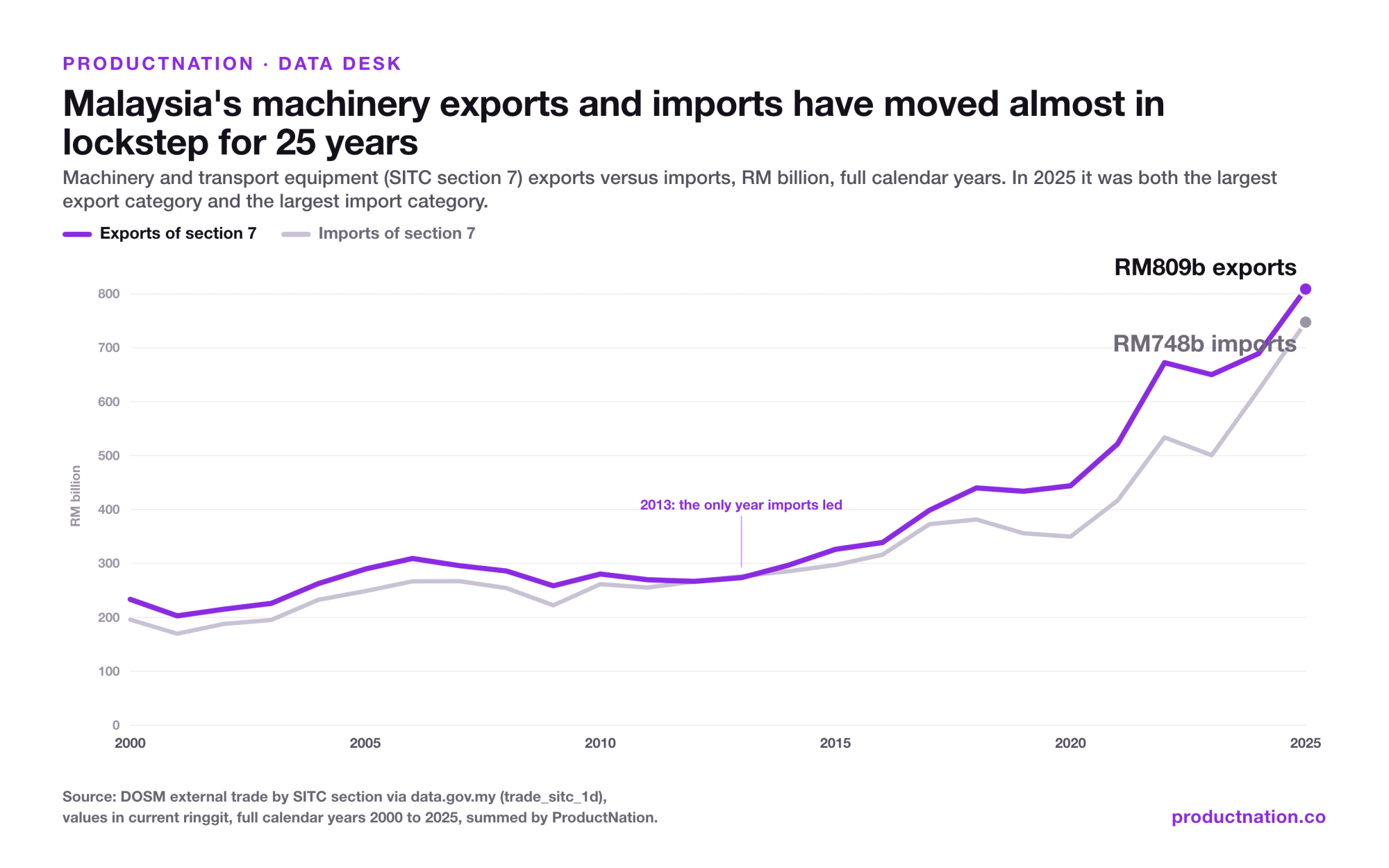
In 2025 machinery and transport equipment was at once Malaysia's biggest export (RM809.0 billion, 50.3 per cent of all exports) and its biggest import (RM747.5 billion, 51.5 per cent of all imports). The two have risen almost in step for a quarter of a century. For every RM100 of machinery Malaysia exported in 2025, it imported about RM92 of the same broad category.
The surplus is real, but thinner than the export figure suggests
Because the import bill is almost as large as the export earnings, the category's trade surplus is a fraction of its headline export value. In 2025 section 7 exports of RM809.0 billion were set against RM747.5 billion of section 7 imports, leaving a net surplus of RM61.5 billion. That is about 8 per cent of the category's gross export value, not the whole of it. It is still a large part of the country's trade balance: on the same DOSM series, Malaysia's total 2025 trade surplus was RM156.8 billion (RM1,609.4 billion of exports less RM1,452.6 billion of imports), so section 7 alone accounts for about two fifths of it. The two lines have tracked each other so closely that in one year, 2013, imports of the category actually exceeded exports, and section 7 ran a small deficit of RM2.6 billion.
The two series have stayed close to one another even as both rose steeply between 2013 and 2025: exports from RM273.7 billion to RM809.0 billion, and imports from RM276.3 billion to RM747.5 billion over the same years. The gap between them has stayed narrow across the series. The section-level trade data shows this co-movement but cannot on its own explain it, so we report the pattern and do not read a cause into it here.
The import share is the part that changed in 2025
The newer development is on the import side. For most of the 2010s and early 2020s, machinery and transport equipment sat at roughly 41 to 45 per cent of Malaysia's total imports. In 2024 it was 45.4 per cent. In 2025 it rose to 51.5 per cent, the first time above half since 2007. In ringgit, section 7 imports rose from RM621.8 billion in 2024 to RM747.5 billion in 2025, an increase of about a fifth in a single year, faster than the total import bill grew. The recorded value of machinery and transport equipment imports is rising faster than the total import bill.
The full series
Here are section 7 exports, imports and the net balance, in billions of ringgit, for selected full calendar years. All figures are our own sum of the DOSM SITC trade series.
| Year | Section 7 exports (RM bil) | Section 7 imports (RM bil) | Net balance (RM bil) |
|---|---|---|---|
| 2000 | 233.4 | 195.7 | +37.7 |
| 2005 | 289.6 | 248.8 | +40.8 |
| 2008 | 286.1 | 254.3 | +31.8 |
| 2013 | 273.7 | 276.3 | -2.6 |
| 2015 | 326.1 | 297.1 | +29.0 |
| 2020 | 444.2 | 349.6 | +94.6 |
| 2022 | 672.4 | 533.8 | +138.6 |
| 2024 | 689.2 | 621.8 | +67.4 |
| 2025 | 809.0 | 747.5 | +61.5 |
What sits inside section 7
Section 7, "machinery and transport equipment", groups electrical and electronic (E&E) goods together with transport equipment and non-electronic machinery, and the SITC section-level data does not split them apart. This piece measures the whole section on both sides of the trade account, not electronics on their own. DOSM publishes a separate E&E figure in its monthly releases on its own definition, which we do not combine with our section 7 series because the two are defined differently. The point of this piece is the symmetry between the export and import sides of one consistent category, which is why we hold the definition identical on both sides.
What this does and does not show
These are trade values in current ringgit and are not adjusted for inflation. Our yearly figures are our own sum of DOSM's monthly trade_sitc_1d file and can differ by a fraction of a per cent from DOSM's separately published annual totals, which are revised after the fact; we use one consistent counting method for every year, on both the export and the import side. International trade classifications have been revised over this quarter-century and we have not reconstructed the SITC section boundaries across those revisions, so a reader should treat the broad shape of the twenty-five-year trend, and the 2025 symmetry, as the robust finding rather than any single year-to-year move. We used full calendar years only, so the figures are not affected by the unusually high monthly trade values recorded from 2026 onwards, which fall outside this comparison.
Anyone can reproduce the count. Download the trade_sitc_1d data from data.gov.my, keep the full years 2000 to 2025, and for each year sum the exports of section 7 and the imports of section 7 separately, then subtract to get the net balance and divide by the matching total to get each share. The file reports values in RM million; we divide by 1,000 to state them in RM billion.
For the longer view of how machinery came to dominate the export side, see our earlier count of the same DOSM series on how machinery climbed back to half of Malaysia's exports, the highest export share since 2006.