Six Malaysian-designed semiconductor chips were launched at the Selangor AI and Semiconductor Summit in Kuala Lumpur on 16 October, unveiled by Economy Minister Akmal Nasrullah Mohd Nasir and Selangor Menteri Besar Amirudin Shari, according to the Selangor state government. Their combined estimated sales potential: RM300 million, with no timeframe given for reaching it.
The six are SkyeChip's MARS1000, an edge-AI processor for cameras, robots and factory systems; MaiStorage's aiDAPTIV+, a storage chip for AI PCs and servers; SiliconX's field-programmable gate array for industrial and automotive use; Infinecs' Maxwell automotive power regulator; a satellite power controller from Weeroc Space; and Alphaswift's FC Mini, a flight controller for autonomous drones. All six were developed under the Malaysia Semiconductor IC Design Park initiative, a government-backed chip-design programme with facilities in Puchong and Cyberjaya.
Contents
One of the six already has a market value attached
The more checkable number sits outside the RM300 million headline. SkyeChip, the company behind the MARS1000 processor, listed on Bursa Malaysia's Main Market on 20 May 2026 at 88 sen a share, raising RM352 million. The stock opened near four times that price, hit a high of RM3.80, and closed its first trading day at RM2.21, putting its market capitalisation at an estimated RM3.97 billion at that close, per The Edge Malaysia's own reporting (Bursa Malaysia does not itself publish a same-day market-cap release).

For a Malaysian reader, SkyeChip is the concrete part of an otherwise abstract pitch: a locally designed chip company, not just a factory assembling someone else's design, already trading on the stock exchange rather than sitting on a government slide as a target. The six chips launched this week are a bet that more of the Design Park's companies follow a similar path.
The design parks today, against the scale of the ambition
Malaysia's two IC Design Parks, in Puchong and Cyberjaya, currently host 407 engineers across 20 companies, per the Selangor state government. Separately, the National Semiconductor Strategy's stated workforce goal is 60,000 trained or upskilled engineers nationwide, reached partly through an Arm on-demand training programme the state government says aims to give 10,000 Malaysians IC-design skills over four years. Those are different scopes, a state-level headcount against a national, industry-wide target with no stated completion date, and they should not be read as a single number to subtract.
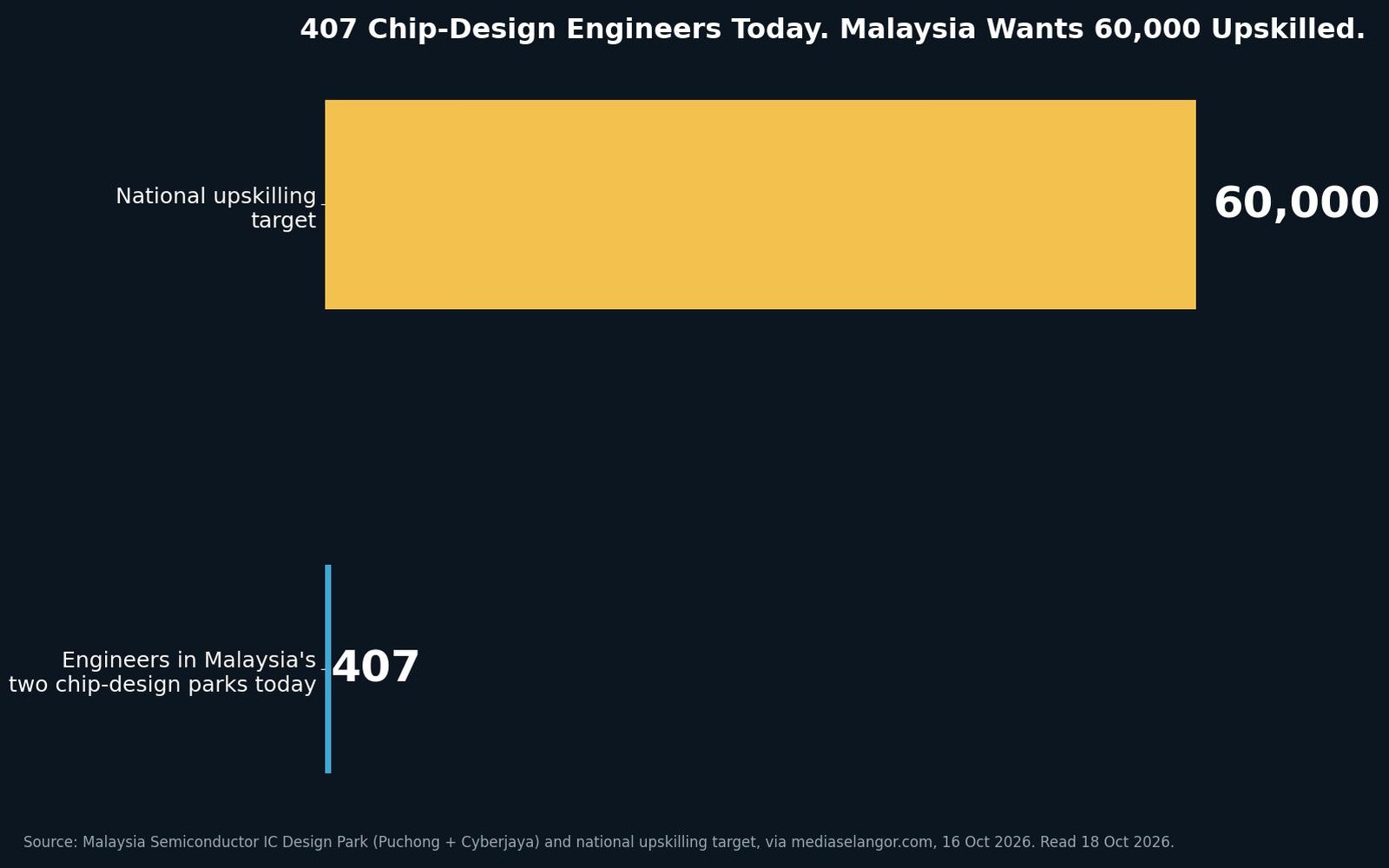
This is the context behind the minister's own framing: moving from "Made in Malaysia", assembling chips designed elsewhere, to "Made by Malaysia", owning the design. Akmal Nasrullah's point at the launch was that the teams behind these six chips were designing technology for demanding global applications, not just building products designed elsewhere.
This is not Malaysia's first large semiconductor number. ProductNation has tracked the same pattern before, in Penang's chip-investment pitch and in the country's data-centre investment boom: a large headline total arrives first, and the harder number to pin down afterward is how much of that value ends up Malaysian-owned. SkyeChip's RM3.97 billion first-day close is the one figure in this story that is no longer a target. Whether the other five chips launched this week, or the companies behind them, get a market to test themselves against is what is worth checking again next year.
Photo illustrations by ProductNation.