Malaysia has drawn the world's data centres onto its soil at remarkable speed. The next job, its own digital agency now says, is keeping more of what that data is worth.
In an interview published Monday by theSun's SunBiz, Malaysia Digital Economy Corporation (MDEC) chairman Ganesh Kumar Bangah said the country had made significant progress attracting digital investment and now had to shift its scoreboard. "The next phase must be about ownership and value capture," he said, arguing that support should be "tied to measurable outcomes such as revenue, exports, intellectual property and high-value employment." His sharpest line drew the distinction plainly: "The real transformation is from using technology to producing, owning and exporting it."
The scale of what has already landed explains why the question matters. The Malaysian Investment Development Authority (MIDA) says the country recorded RM385.7 billion in data-centre-related investment from 2021 to the first half of 2026, drawing in AWS, Microsoft, Google and a wave of specialist operators, mostly around Greater Kuala Lumpur and Johor. That is a recorded investment figure, not a ledger of money already spent on the ground, but it is an enormous sum by any measure.

Here is the distinction both agencies are now drawing. The biggest names MIDA lists, AWS, Microsoft and Google, are foreign companies. Data-centre economics split, roughly, into a physical layer, the land, the grid connection, the construction and the jobs of running a site, and a higher-value layer of software, products and intellectual property. Reading across the chairman's remarks, MDEC's push is to move Malaysia up from the first toward the second, though he did not frame it in those exact terms. That is the gap between hosting a boom and owning one, and it is why MIDA framed its own next phase, in the words of Sim Tze Tzin, deputy minister of investment, trade and industry, as moving "from building capacity to building capability, from attracting investment to creating value."
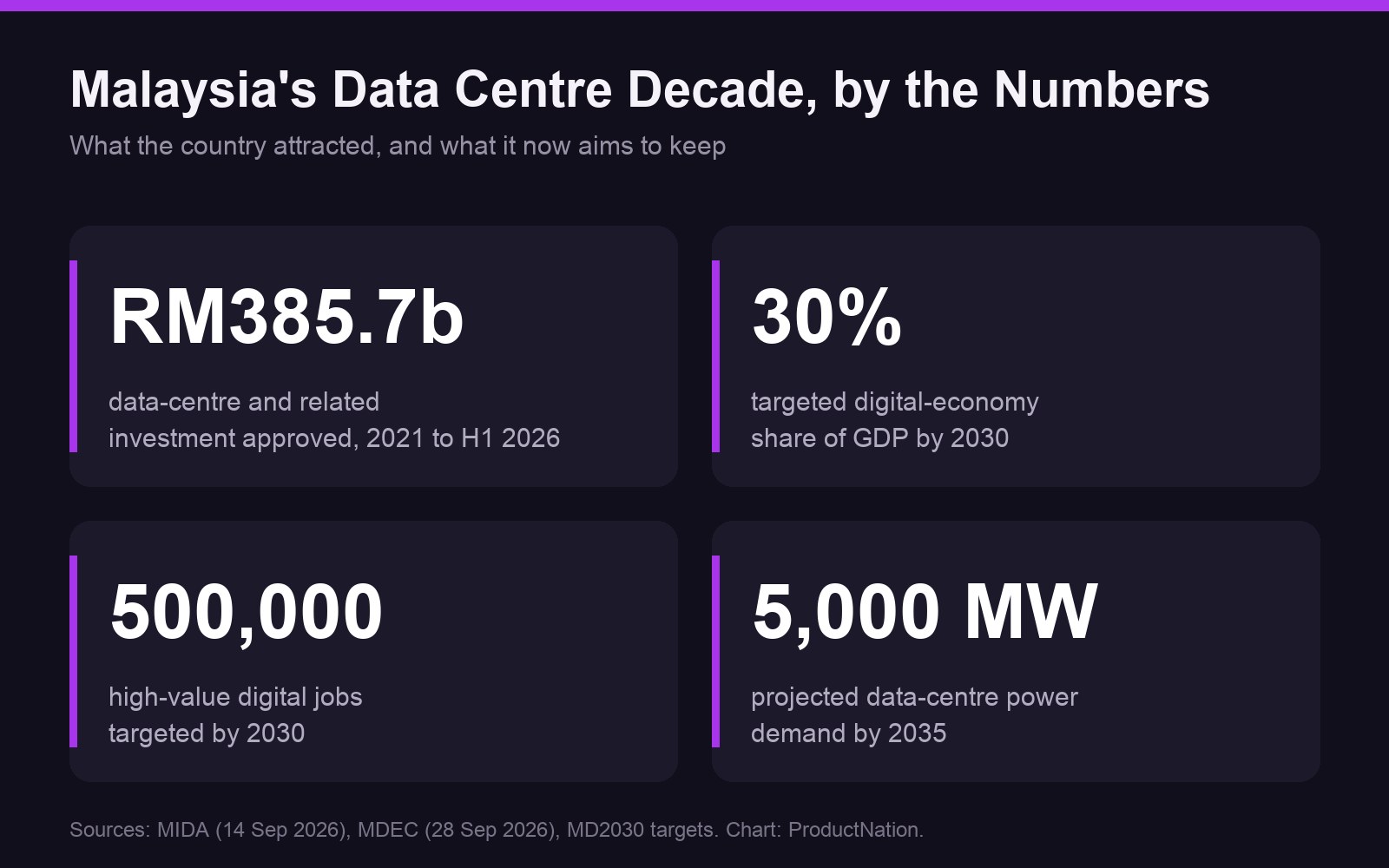
Value capture is not only about pride. It also ties to the country's own resources. MIDA says data-centre electricity demand is projected to pass 5,000 megawatts by 2035, much of it drawn from the national grid even as operators strike renewable and direct-supply deals. We have looked before at the other costs the boom brings. If Malaysia is supplying the power and the land, the argument for keeping more of the economic upside, in tax base, in local firms, in exportable products, gets stronger rather than weaker.
There are early, countable signals of intent, even if the results are not in yet. Putrajaya is trying to steer more of the work toward local firms, from the Arm-backed drive to design chips at home to a wider ministerial line that Malaysians should build the technology, not just adopt it. MIDA has also widened the role for local supply-chain firms at its annual data-centre showcase, though participation is not the same as contracts won. Each of these points the way the policy wants the money to flow, without yet proving it has.
For anyone working in tech here, that is the useful read. MD2030, the national plan launched in June, aims to lift the digital economy to 30 percent of GDP and create 500,000 high-value digital jobs by 2030. MDEC's framing puts the emphasis on the high-value, producing-and-owning kind of work rather than only operating the racks, though the plan does not yet break those jobs down by sector. The opportunity for a Malaysian founder, engineer or studio sits on the build side of that line.
One honest caveat runs under all of it: these are recorded and target figures, not a record of what Malaysia has actually retained. They say little yet about local ownership, procurement value or tax kept at home, which is exactly the ledger MDEC is now asking to be judged on. MD2030 puts a date on the ambition: a 30 percent digital-economy share of GDP and 500,000 high-value jobs by 2030. The investment is on the board. MDEC has now said, in its own words, that value capture, not the size of the inflow, is the scoreboard it wants Malaysia measured against.
Image(s) courtesy of Winston Chen and Chander Mohan on Unsplash.