WhatsApp is giving parents a new set of controls over how their teenagers use the app. It is a gradual, worldwide rollout, and it lands against a Malaysian backdrop where a minimum age for social media is already the law, even if it is not clear whether that law reaches WhatsApp.
Contents

What WhatsApp changed
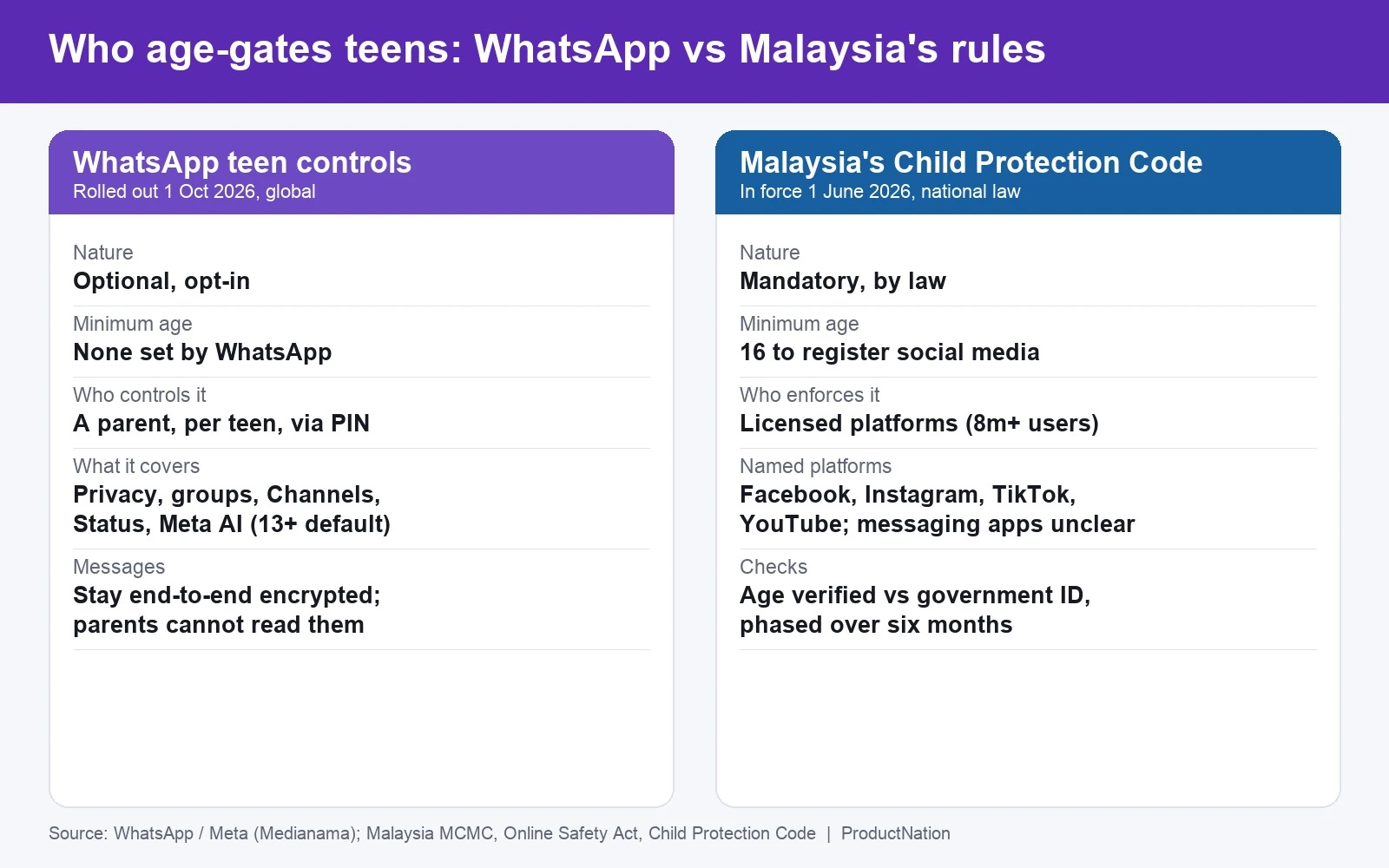
WhatsApp is rolling out optional parental controls for teen accounts, MediaNama reported on 1 October. Set up by a parent and teen together, they let a parent decide privacy settings such as who can see a teen's profile photo or add them to groups, and loosening one of those later needs a parent-set PIN. Parents can be notified when a teen joins or leaves a group, or when a group grows sharply, and can shape how the teen uses Channels and Status.
For Meta AI, the chatbot built into WhatsApp, parents choose between the default 13+ setting and a stricter Limited Content option. The part that matters most: the controls do not let a parent read a teen's messages or listen to calls, which stay end-to-end encrypted. They are opt-in, and a parent can adjust or switch them off. WhatsApp says the rollout is gradual, so the controls may not have reached every account yet.
Malaysia already set a legal limit
Malaysia did not wait for platforms to volunteer. Under the Online Safety Act 2025, the Child Protection Code took effect on 1 June 2026 and requires licensed social media providers to let only users aged 16 and above register, the Communications Ministry said in a statement reported by The Star. Age must be checked "using official documents such as MyKad, passports, birth certificates, or other recognised documents", the ministry said, and non-compliant providers face fines under the Act. The checks on existing users are being phased in over about six months, theSun reported.
The requirement applies to licensed social media services, MCMC has said, including Facebook, Instagram, TikTok and YouTube. WhatsApp sits in a greyer spot. It is inside Malaysia's broader internet-service licensing regime, Tech Policy Press noted, but the same piece flagged genuine confusion over what counts as "social media", which is the category the age limit targets. So it is not settled whether Malaysia's under-16 rule applies to a private messaging app at all, and that is the gap these in-app controls sit inside.
Optional, mandatory, and the same hard problem
The two approaches are not the same thing, and that is the point. Meta's controls ask a household to switch protection on. Malaysia's code puts a legal duty on the platform, backed by fines, with age checks tied to official identity documents. Both still run into enforcement. Tech Policy Press noted that a national age gate can be side-stepped with an older sibling's account or a borrowed identity, and that heavy, ID-based verification raises its own question about how much personal data gets collected to prove a birthday. We have written before on how fast AI can now clone a familiar voice to run a scam, and on the distance between voluntary safety pledges and binding law. Protecting children online is the same argument in a different room.
For parents here, the honest reading is this. The national age limit is aimed squarely at the social feeds, and whether it touches WhatsApp is unresolved. WhatsApp's controls, by contrast, are rolling out gradually and are optional, and switching them on takes a parent and a teen sitting down together. The verification side of the law, meanwhile, is still rolling out, with platforms given up to six months to confirm how old their existing users really are.
Image(s) courtesy of Richard Williams and Vitaly Gariev on Unsplash.