ElevenLabs says its latest models can build a usable voice clone from about ten seconds of audio. That is the number behind the AI audio company's newest release, and in Malaysia, where scam victims are already being fooled by voices that sound like someone they trust, it reads very differently than it does in a San Francisco demo.
Contents
What ElevenLabs actually shipped
On Monday, ElevenLabs launched two new text-to-speech models, Eleven v4 and a faster variant it calls v4 Turbo. TechCrunch reports the models now cover more than 90 languages, up from 70 in the previous v3, with the biggest quality jumps in Japanese, Brazilian Portuguese, Mandarin and Cantonese. A voice recorded in one language can now speak another while keeping the original speaker's identity.
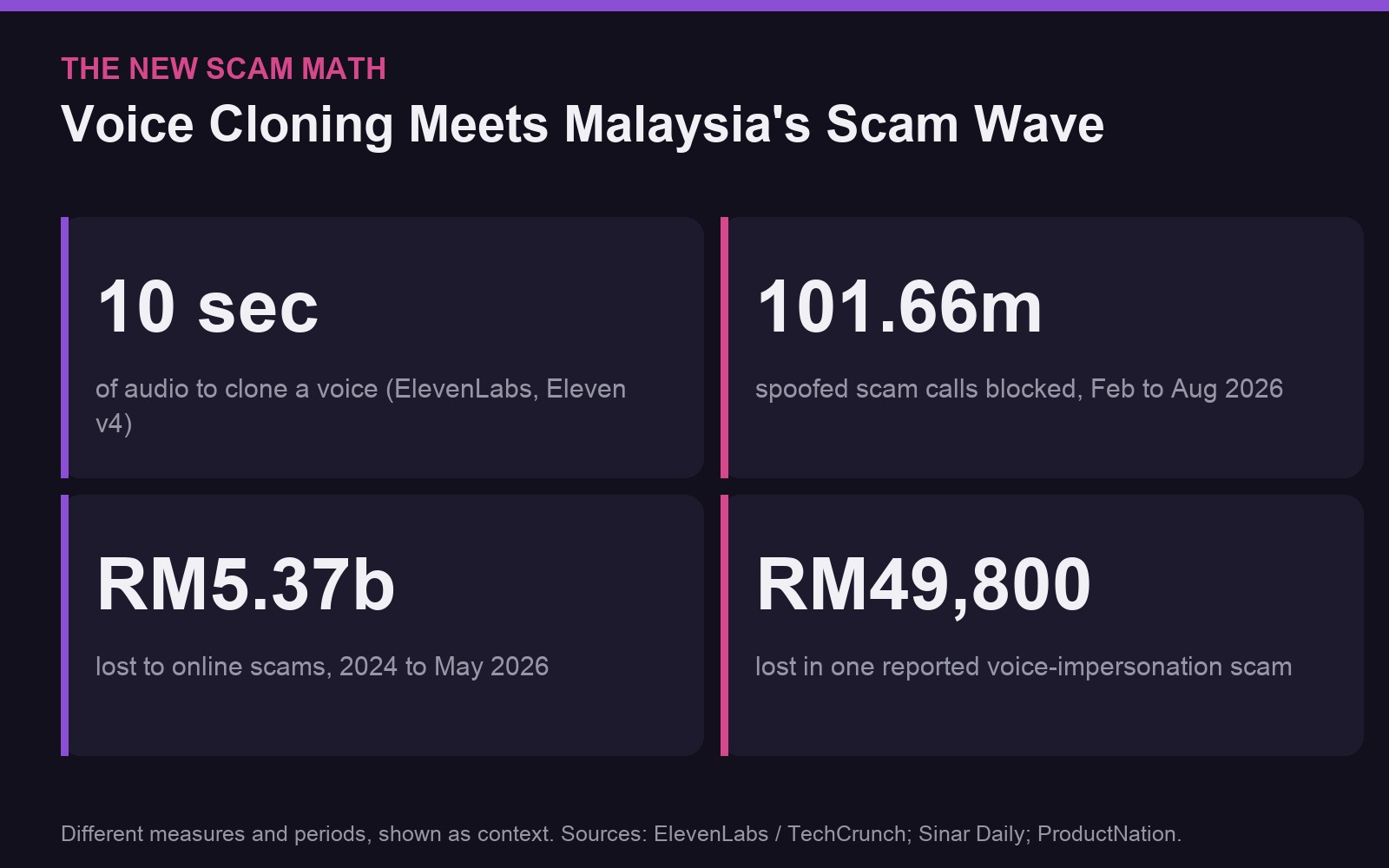
The line that matters most for everyone else is quieter. Per the same reporting, the company's Instant Voice Clone can now capture a usable voice from as little as 10 seconds of audio, and the Turbo model is tuned for real-time, back-and-forth conversation. That suits a live voice agent. It would also suit a live scam call.
Why 10 seconds matters in Malaysia
Malaysia is not a bystander to this. Sinar Daily reported a wave of cases where victims were fooled by a voice that sounded like someone they trusted: a Selangor woman who lost RM5,000 to a caller who sounded like her employer, and a travel agent in Kuala Terengganu who lost RM49,800 to what she believed was a friend. Investigators have not published forensic confirmation that AI cloning was used in each case, so read these as reported cases rather than proven ones. They still describe the ground this technology now lands on.
Two other numbers set the backdrop. Malaysia blocked more than 101 million spoofed scam calls between February and August 2026, a figure the MCMC and telcos reported, and Malaysians lost RM5.37 billion to online scams reported between 2024 and May 2026. Those are different measures over different windows, so read them as scale, not as a single sum, and neither counts losses caused by a cloned voice specifically. The shift they hint at is simpler. Number spoofing made a call look like it came from someone you trust. A cloned voice goes after the other half of that trust, the sound of the person, and it does not depend on faking the number at all. What it needs is a short clip of you talking, and short recordings of our own voices are everywhere now, in a WhatsApp voice note, an Instagram reel, a podcast, or a work call on speaker.
The same tool is a gift to creators
None of this makes the technology the villain, and it is worth being honest about the other half of it. For a small Malaysian studio or a solo creator, affordable and natural-sounding dubbing has been hard to get right. Mandarin and Cantonese, two of the languages ElevenLabs says improved most, are also two that a creator here juggles alongside Malay, English and Tamil to reach a domestic audience. Record a video once, and the same voice can often carry it into another language without hiring a booth or a second presenter.
That is real leverage for the kind of work we do, and it comes with a caveat we have written about before. When OpenAI wound its Sora video product down in stages through 2026, we argued that a workflow built on a model someone else can withdraw is a fragile one. The same holds here: when the tool sits on another company's servers, the craft has to be yours. Own the voice and own the footage, and a model that keeps improving is a bonus rather than a dependency.
What to actually do about it
You cannot un-publish your own voice, so the defence is not technical, it is a habit. Agree a family safe word that a real relative would know and a stranger would not. If a call asks for money in a hurry, however much it sounds like someone you trust, hang up and call the person back on a number you already have saved. A familiar voice on the line is no longer proof of anything, and the amount of audio it takes to mimic one is now measured in seconds.
Images courtesy of Hassan OUAJBIR and Amjith S on Unsplash.