
Reported online-scam losses in Malaysia have reached RM5.37 billion since the start of 2024. A new regional survey adds a harder detail: among people who did lose money to a scam, 82% got none of it back.
A regional survey published this month, the GSMA ASEAN Consumer Scam Report 2026, puts a figure on that. Across six markets, Indonesia, Malaysia, the Philippines, Singapore, Thailand and Vietnam, it found that around 8% of people were scammed in the past year. Among those victims, 68% lost money, and of that group, 82% recovered none of it. Only one in ten got everything back. Nearly half of all reported cases, 45%, were never resolved. Messaging apps were the single most common way a scam reached someone, at 41% of encounters. The figures come with caveats: they are from an online panel survey, and the six-country averages are equal-weighted, so a regional percentage is not automatically Malaysia's own rate.

What Malaysia's own numbers show
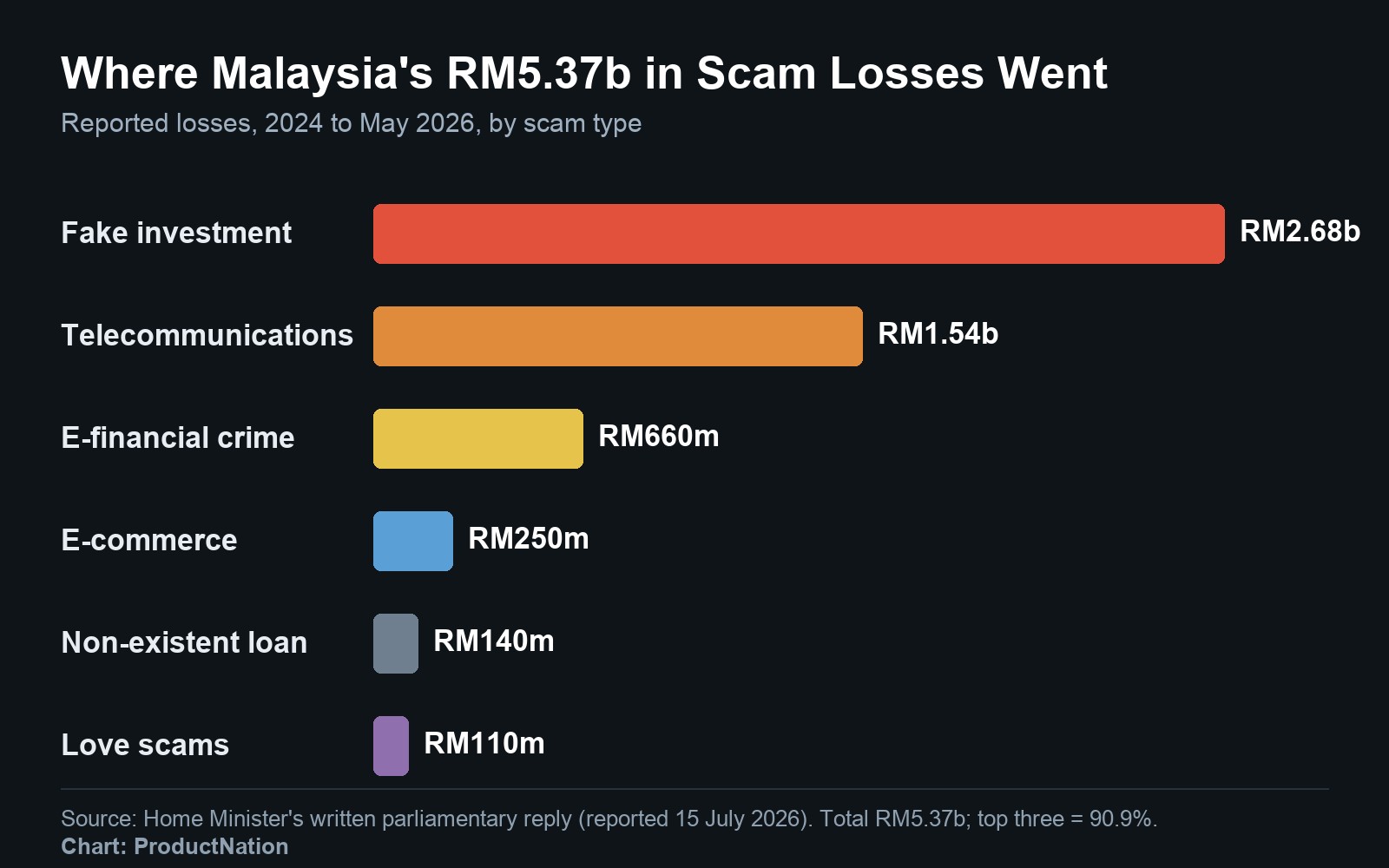
Malaysia is one of the six markets in that survey. Its national figures are not directly comparable, they are administrative totals rather than survey results, but they show the scale of the problem at home. In a written reply to Parliament reported in July 2026, Home Minister Saifuddin Nasution Ismail put total losses at RM5.37 billion between 2024 and May 2026. Fake investment schemes accounted for RM2.68 billion, telecommunications scams RM1.54 billion and e-financial crime RM660.64 million. Those three categories alone are more than 90% of the total.
What happens to the money afterwards is a separate question. The National Scam Response Centre (NSRC), run since 2025 by the police's Commercial Crime Investigation Department, is the body that tries to recover it. Home Minister Saifuddin Nasution Ismail said in September 2026 that it had returned RM5.16 million to victims between January and July, about 65% of the RM7.94 million it had seized over those months. Seizing the money is the first hurdle, and it depends on catching a transfer quickly, which is why the NSRC urges victims to call the moment something looks wrong.
Why the money vanishes
In the same survey, 96% of people said they worry about being scammed or hacked, and nearly nine in ten recognised at least one form of AI, from cloned voices to convincing investment chatbots, being used in scams. Banking security in Malaysia has been moving the same way, earlier in the chain. Bank Negara's requirement for stronger authentication on sensitive actions like transfers and account changes, and CIMB's switch to in-app transaction approval, are both attempts to block a fraudulent transfer before it leaves the account, rather than chase it afterwards.
Fake investment schemes are the single largest category of losses here at RM2.68 billion. Telecommunications scams come next at RM1.54 billion, the kind of phone-based fraud Google has been building on-device detection for.
What to do if it happens
For a victim, the number that matters is not the loss, it is the clock. Call the NSRC hotline on 997 the moment a transfer looks wrong, while the funds may still be sitting in the receiving account. The regional figures are blunt about the alternative: for most people who lose money to a scam, none of it comes back.
Image(s) courtesy of Kev Costello and Michal Biernat on Unsplash.