The AI tools now built into the apps Malaysians use every day, ChatGPT for a work email, Gemini inside a Google search, Meta AI in a WhatsApp thread, come from companies that have just agreed to police themselves. On 29 September, six major AI companies signed a voluntary safety accord with the White House. Malaysia is drafting rules that would take a different path.
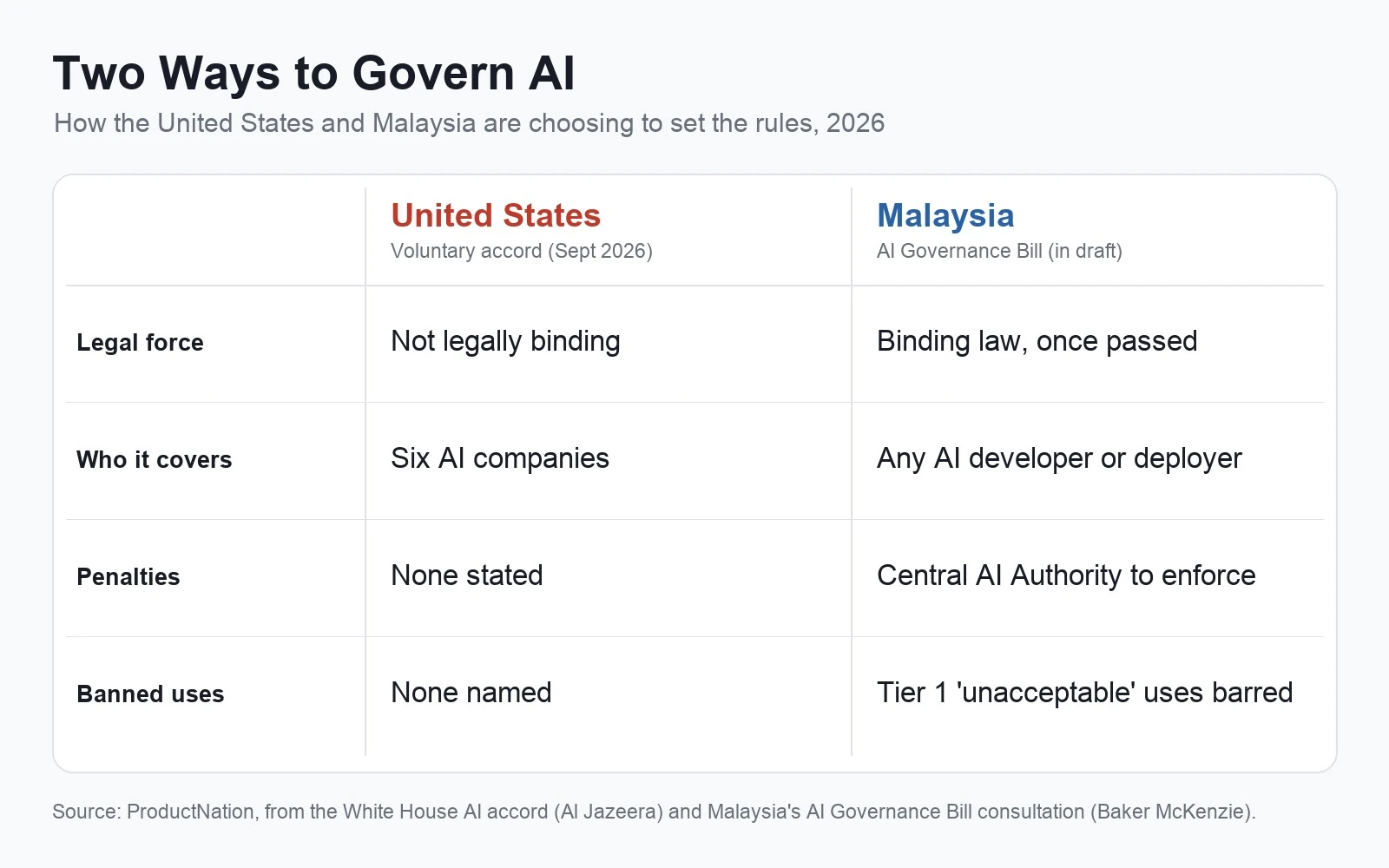
Meta, Nvidia, Google, OpenAI, xAI and Anthropic put their names to the deal, which Al Jazeera reports asks each company to keep internal safety controls, set up a team to oversee them, bring in outside auditors and form a board committee to review the results. What the accord does not do is make any of that enforceable. It is not legally binding, carries no penalties for falling short, does not require the audit findings to be made public, and specifies no government enforcement role. President Donald Trump called it "morally binding" and praised its "tremendous self-policing aspect". Google chief executive Sundar Pichai said it "contains real tangible steps to promote safe development".
That is a notable landing spot: several of the signatories, Al Jazeera notes, had previously pushed Washington to make such rules mandatory. The accord leaves the door open for its steps to be written into law one day. For now, on frontier AI safety, it leans on the companies to hold themselves to account.
Malaysia is writing rules with teeth
Malaysia is drafting something firmer, and the work is still at an early stage. The National AI Office, set up under the Ministry of Digital, ran a public consultation on a proposed AI Governance Bill from 10 July to 1 August. That paper, summarised by law firm Baker McKenzie, describes a framework that would reach well beyond a handful of signatories to the organisations that develop or deploy AI, with carve-outs for uses such as purely personal activity.
It splits them into two roles: "developers", who shape what an AI system can do, and "deployers", who put it to work in the real world, and a single organisation can be both. It sorts AI uses into three tiers, with systems built or used with the intent to cause harm prohibited outright, high-risk uses carrying structured obligations, and low-risk uses a baseline duty of care. Overseeing it would be a Central AI Authority with its own safety, investigation and enforcement, and promotion arms, backed by sector-specific regulators.
What it means for Malaysian businesses
Malaysian businesses already answer to plenty of law. A clinic, a bank or a retailer using AI already answers to the laws that govern its own industry, and the Ministry of Digital says the proposed framework would sit on top of those rather than replace them. What this voluntary accord does not add is any legally enforceable AI-specific duty. Under the consultation paper's proposals, such a framework would reach the "deployer" role, the category most businesses that simply use AI would fall into. The same OpenAI or Google system could, once a Bill along these lines is in force, fall inside an AI-specific framework with an enforcement authority behind it, depending on how a Malaysian business deploys it.
Malaysia is not a bystander in this. Its own government has been piloting AI agents inside MyGOV, so, by our reading of the draft's definition, the state would itself count as a deployer, though how a final law would treat the public sector is still open, and the kind of safety questions that recently led OpenAI to pause some work on its most capable models are exactly what frameworks like these are meant to address. The difference is what happens when the answer is unsatisfactory.
Neither is settled yet. The American one is a voluntary promise the accord attaches no penalties to. The Malaysian one is a set of proposals, out for consultation, that still has to be written into a Bill and clear Parliament before it binds anyone, and those proposals may still change. The consultation on them closed at the start of August, and the full legislative text has not been published yet. That text, not the accord in Washington, is what will decide the rules Malaysian companies actually answer to.
Images courtesy of Nico Smit and Albert Stoynov on Unsplash.