Malaysia is a motorcycle country. In the first eight months of 2026, 534,866 new motorcycles were registered here, almost as many as the 566,616 new cars (94.4 per cent of the car figure). For most of the last decade, almost none of those motorcycles were electric. That has changed quickly, and the shift is easy to miss because the share is still small.
We counted the Road Transport Department (JPJ) registration file for motorcycles, published on data.gov.my, for January to August of every year from 2018 to 2026, using the fuel field recorded against each registration. In the first eight months of 2026, 12,507 of the 534,866 new motorcycles registered were electric. That is 2.34 per cent, or about 1 in 43. In the same eight months of 2018 it was 255 out of 372,759, which is 0.07 per cent, or 1 in 1,462.
Contents
So the electric share of new motorcycles is about 34 times higher than it was eight years ago.
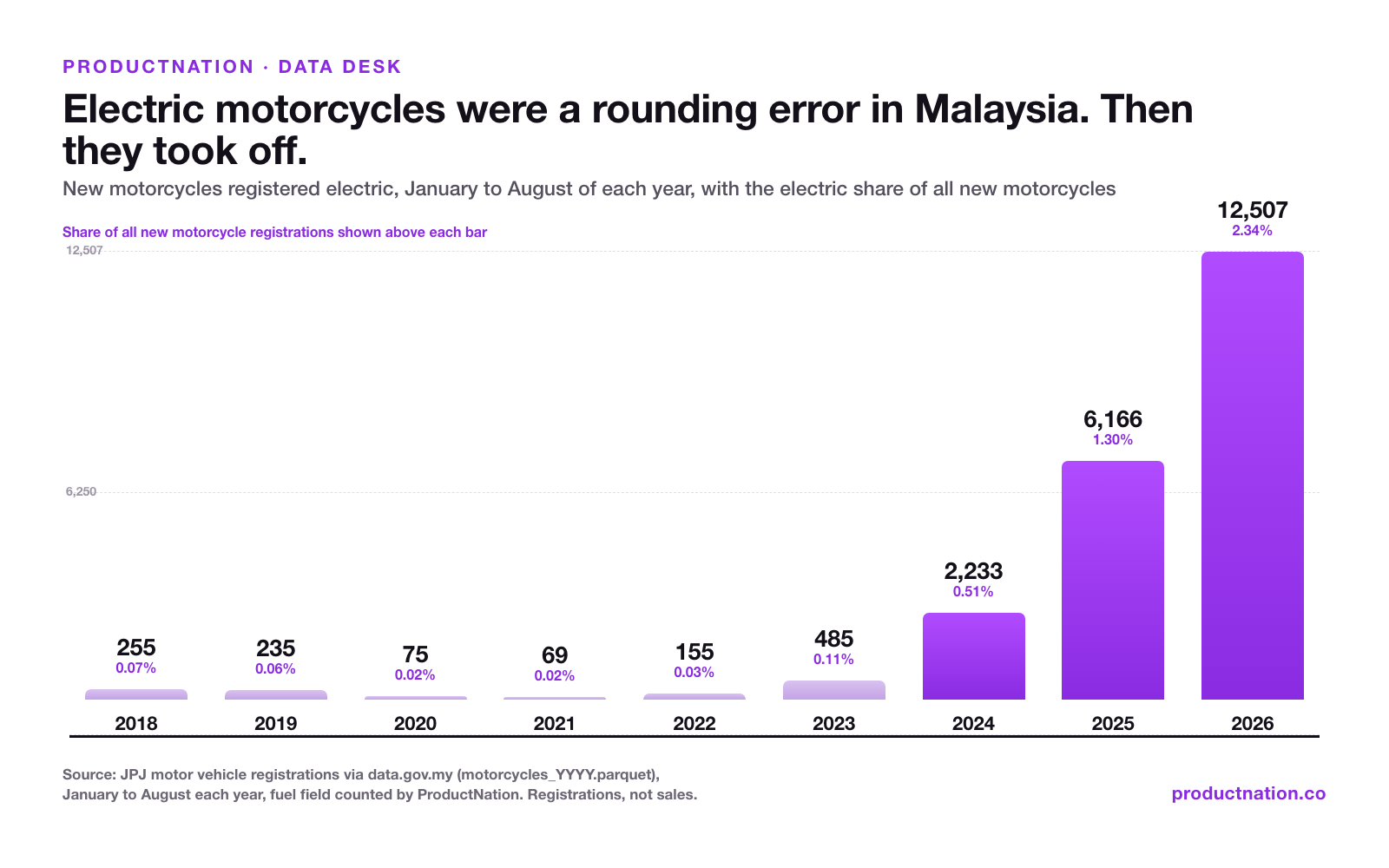
The climb was not a straight line, and the chart shows why. Electric motorcycles were a rounding error through 2022, and the count actually fell to a low of 69 in the first eight months of 2021, during the pandemic, when the overall market was also depressed. The take-off is recent: 485 in 2023, then 2,233 in 2024, 6,166 in 2025, and 12,507 in the first eight months of 2026. Almost all of the increase has come since 2023.
Here is the full series we counted, January to August of each year:
| Year (Jan-Aug) | Electric registered | All new motorcycles | Electric share | About |
|---|---|---|---|---|
| 2018 | 255 | 372,759 | 0.068% | 1 in 1,462 |
| 2019 | 235 | 401,475 | 0.059% | 1 in 1,708 |
| 2020 | 75 | 345,038 | 0.022% | 1 in 4,601 |
| 2021 | 69 | 369,149 | 0.019% | 1 in 5,350 |
| 2022 | 155 | 485,948 | 0.032% | 1 in 3,135 |
| 2023 | 485 | 447,423 | 0.108% | 1 in 923 |
| 2024 | 2,233 | 438,168 | 0.510% | 1 in 196 |
| 2025 | 6,166 | 475,426 | 1.297% | 1 in 77 |
| 2026 | 12,507 | 534,866 | 2.338% | 1 in 43 |
The two-wheel transition trails the four-wheel one
The surprise is not that electric motorcycles are growing. It is that in a country built on motorcycles, electric cars are being registered at a far higher rate than electric motorcycles. Counting the same JPJ files over the same January to August 2026 window, 47,508 of the 566,616 new cars registered were electric, which is 8.39 per cent, or about 1 in 12. The motorcycle rate, 2.34 per cent, is about 28 per cent of the car rate, closer to a quarter than a half. We reported the electric car trend separately (our electric-car piece); here both figures are counted the same way, from the same registration files, over the same eight months, so they can be compared directly. The two-wheel transition is running well behind the four-wheel one.
The petrol giants have registered none
The electric motorcycle market in Malaysia is not being led by the brands that dominate the petrol one. Over January to August 2026, Yamaha registered 257,465 new motorcycles here (48.1 per cent of the whole market) and Honda registered 89,562 (16.7 per cent). Between them they account for about two in three new motorcycles registered. The JPJ file contains a single Yamaha maker label and a single Honda maker label, and neither carries any electric registration over those eight months. In other words, the two biggest petrol brands recorded no electric motorcycles at all.
The field is led instead by newer entrants. The three largest were Yadea (3,962), GGR (3,530) and Ezi (2,002), which together accounted for 9,494 registrations, or 75.9 per cent of all electric motorcycles registered. Yadea is a Chinese electric-two-wheeler brand. Twenty-two different maker labels recorded at least one electric motorcycle, and the rest form a long tail: Zeeho (1,196), Superlux (519), Blacknight (400), QJMotor (383) and others.
Malaysia's national motorcycle brand is barely in it. Modenas, a joint venture involving DRB-HICOM and Kawasaki, registered 25,327 new motorcycles over the eight months (the fourth-largest maker overall), but only 41 of them were electric.
What this does and does not show
These are registration counts from JPJ, not sales. A registration can lag a purchase, and fleet and company registrations are included, so the figures describe what reached the road, not retail demand. We counted the fuel field recorded against each registration directly; we did not infer electric from model names. The share figures are the electric count divided by all new motorcycle registrations in the same eight months.
We cannot break this down by state. In the motorcycle file, 84.6 per cent of 2026 registrations are filed under "Rakan Niaga" (a dealer or business channel) rather than a state, so any geographic split would be unreliable, and we have not attempted one.
Anyone can reproduce the count. Download the yearly motorcycle files from data.gov.my (motorcycles_2018.parquet to motorcycles_2026.parquet), keep the rows dated January to August, and count them by the fuel field.