More new Chinese-brand cars were registered in Malaysia in the first eight months of 2026 than Hondas. Eight years ago, Honda registered about forty-six cars for every one a Chinese brand did. It shows how much the mix of new cars registered in the country has changed in eight years, and it runs against the easy headline about it.
We counted this from JPJ's new-vehicle registration records, published monthly on data.gov.my, comparing the same January-to-August window in 2018 and in 2026 so the part-year 2026 file is matched like for like. By brand origin, Chinese marques went from 1,635 registrations in that window in 2018, under four-tenths of one per cent of the market, to 50,638 in 2026, which is 8.9 per cent. Honda registered 37,194 cars over the same 2026 window. So the group of Chinese brands, taken together, now out-registers what was Malaysia's second-biggest car brand in 2018.
Contents
The Chinese rise is real, and it is not the takeover the headlines describe
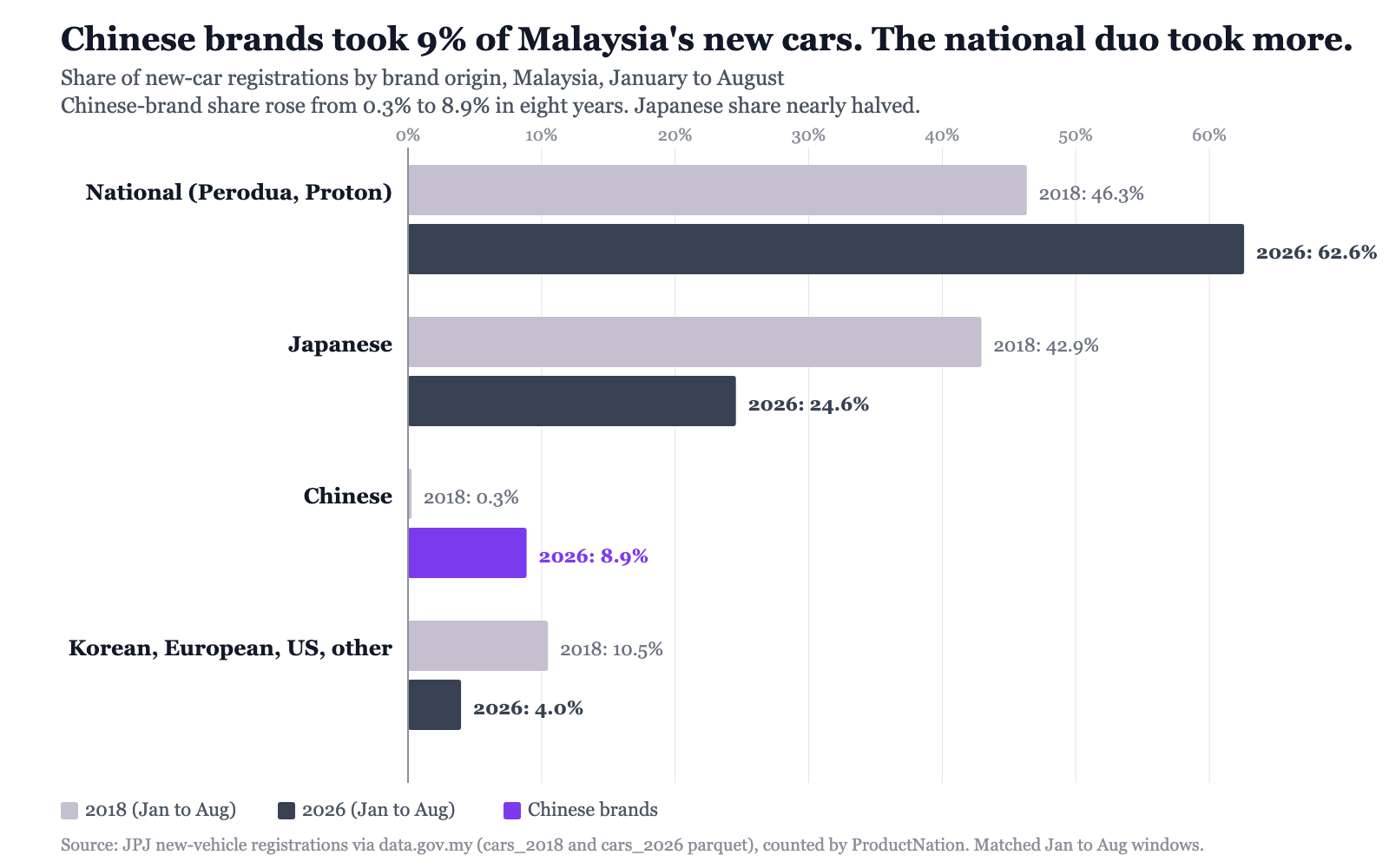
Chinese brands rising from almost nothing to nearly one car in eleven in eight years is a genuine shift. But one car in eleven is not a takeover, and the record shows the brands whose registration share rose most are the two national ones. Perodua and Proton together went from 202,902 registrations in the 2018 window to 354,728 in 2026, lifting their combined share from 46.3 per cent to 62.6 per cent. Nearly two in every three new cars registered in Malaysia in the first eight months of 2026 carry a Malaysian badge.
The group whose share fell most is Japanese. Japanese brands went from 188,019 registrations to 139,092, a fall of 26 per cent in a market that grew 29 per cent over the same window, so their share fell from 42.9 per cent to 24.6 per cent, a drop of more than two-fifths. Korean, European, American and other brands together fell from 10.4 per cent to 3.9 per cent of registrations.
| Brand origin | 2018 registrations | 2018 share | 2026 registrations | 2026 share |
|---|---|---|---|---|
| National (Perodua, Proton) | 202,902 | 46.3% | 354,728 | 62.6% |
| Japanese | 188,019 | 42.9% | 139,092 | 24.6% |
| Chinese | 1,635 | 0.4% | 50,638 | 8.9% |
| Korean, European, American, other | 45,382 | 10.4% | 22,158 | 3.9% |
| Total new cars registered | 437,938 | 100% | 566,616 | 100% |
Every figure in this piece counts JPJ's maker field exactly as the file records it, and the origin groups are our own label applied to those maker values, not JPJ's. The maker labels we count as Chinese are: Chery, Jetour, Jaecoo, iCaur, Lepas, BYD, Denza, Great Wall (GWM), Zeekr, MG, Leapmotor, Xpeng, GAC, GAC Aion, GAC Motor, Wuling, Dong Feng, Neta, JAC, JMC, Maxus, Foton, BAIC, Hycan, Skyworth and Shineray. A note on the data's own untidiness, which we have not corrected: JPJ is inconsistent about sub-brands, so most Omoda, Jaecoo and iCaur cars are filed under the Chery label while a handful carry their own, and we report the labels as the file gives them rather than re-sorting them, because that is what keeps the count reproducible. Two judgment calls sit behind the classification. First, MG is British in heritage but is today a marque of China's SAIC, so we count it as Chinese. Second, Volvo, Polestar, Lotus and LEVC are European marques now controlled by China's Geely, and smart is a joint venture between Geely and Mercedes-Benz; we count all of these under European or other, not Chinese, because they remain European marques. On the same reasoning Proton is national, a Malaysian marque built in Malaysia, though Geely holds a minority stake in it. The commercial-vehicle label Cam, a Malaysian assembler of imported kits, sits in the fourth group, not the Chinese one. The Japanese group covers Toyota, Honda, Nissan, Mazda, Mitsubishi, Subaru, Suzuki, Lexus, Isuzu and Daihatsu. The national group is Perodua and Proton. Everything else, including Korean, European and American marques, falls in the fourth group.
Which Chinese brands, and it is mostly one label
The Chinese total is not spread evenly. The maker label Chery accounts for 21,206 of the 50,638, which makes Chery the fifth-largest maker label in JPJ's records for the first eight months of 2026, behind only Perodua, Proton, Toyota and Honda. The same label covered six registrations in the 2018 window. On its own it out-registers Nissan, Mazda and Mitsubishi combined (19,657). As the methodology note below explains, this label also carries most of Chery's Omoda, Jaecoo and iCaur cars, filed that way by JPJ.
| Chinese brand | 2026 registrations (Jan to Aug) |
|---|---|
| Chery (with Omoda, Jaecoo, iCaur, Tiggo) | 21,206 |
| Jetour | 7,503 |
| BYD | 7,472 |
| Great Wall (GWM) | 4,608 |
| Zeekr | 2,957 |
| MG | 1,696 |
| Leapmotor | 1,512 |
| Xpeng | 920 |
| GAC (with GAC Aion, GAC Motor) | 939 |
| Wuling | 634 |
| Dong Feng, Denza, Foton, Neta and eleven smaller marques | 1,191 |
| All Chinese brands | 50,638 |
This is not the electric-car story
It would be easy to read the Chinese rise as the arrival of electric cars, and it is only partly that. Of the 50,638 Chinese-brand cars registered in the 2026 window, 22,985 were petrol, 7,982 were petrol hybrids, 19,366 were battery electric and the remaining 305 were diesel or diesel hybrid. So 61 per cent of the Chinese-brand cars registered in the window run at least partly on petrol. The biggest of these brands shows it plainly: of Chery's 21,206 registrations, 13,870 were petrol and 3,525 were battery electric. The Chinese brands are being registered across petrol, hybrid and electric cars, not only electric ones.
The Japanese picture is a split, not a collapse
The fall in the Japanese share hides two different stories. Toyota held its ground and grew: 66,056 registrations in 2018 to 72,942 in 2026, up 10 per cent, still the third-biggest brand in the country. Mitsubishi also grew. The decline sits with three brands. Honda fell 51 per cent, from 75,563 to 37,194. Nissan fell 85 per cent, to 2,981. Subaru fell 86 per cent, to 603.
| Japanese brand | 2018 | 2026 | Change |
|---|---|---|---|
| Toyota | 66,056 | 72,942 | +10% |
| Honda | 75,563 | 37,194 | -51% |
| Mitsubishi | 6,836 | 8,824 | +29% |
| Mazda | 9,777 | 7,852 | -20% |
| Nissan | 20,169 | 2,981 | -85% |
| Subaru | 4,331 | 603 | -86% |
What this measures, and what it does not
These are registration counts, not sales. A registration is a car being entered on JPJ's records, which usually follows a purchase but can lag it or, for a fleet or a dealer, differ from a single retail sale. Where we write that a brand registered more cars, that is what the record shows, and it is not the same as a sales league table a manufacturer might publish, which counts a different thing over a different period.
These counts come from JPJ's car-registration file, which covers motorcars, MPVs, SUVs, jeeps, pick-ups and vans but not motorcycles, so a small number of commercial and specialist vehicles are included in the totals. The comparison runs over a single matched window, January to August, in both years, because the 2026 file is a part year and both sides must cover the same months before anything is counted. The brand-origin groups are our own, assigned by the carmaker that builds each marque as described above, where the national, Japanese and Chinese groups are listed in full. The fourth row, Korean, European, American and other, is the residual that holds every maker outside the first three groups, including those few commercial and specialist makes. We do not claim that the Chinese brands took their registrations from the Japanese ones, or from anyone else: we show what each group registered in each year, and the two movements happened over the same period.
Anyone can reproduce this. Download the yearly car-registration files (cars_2018 and cars_2026) from data.gov.my, keep the rows dated January to August, and count them by the maker field, then group the makers by origin using the list above. The national duo comes to 62.6 per cent of the 2026 window and the Chinese brands to 8.9 per cent.