Malaysians are paying for more and more with a tap, a QR code or an instant transfer, and the country's central bank keeps the count. We pulled Bank Negara Malaysia's payment statistics from data.gov.my, three separate series that record payments by system, by instrument, and by the channel people use to make them, and totalled every category for two full calendar years six years apart, 2019 and 2025 (2025 is the most recent complete year). The picture is a wholesale shift in how the country pays. Instant transfers through DuitNow rose about fiftyfold. Debit cards, mobile banking and e-wallets grew several times over. Cheques and cash withdrawals went the other way. Here are six facts, each measured over the same two full years, 2019 against 2025.
Contents
- 1. DuitNow instant transfers went from 109 million payments to 5.4 billion, about fifty times as many.
- 2. In-person debit card payments rose 8.5 times, from 224 million to 1.9 billion.
- 3. Mobile banking transactions grew 7.6 times, from 490 million to 3.7 billion.
- 4. E-wallets already recorded the most transactions of any instrument in 2019, and still tripled to 6.4 billion.
- 5. Cheques fell 63 per cent, from 84 million to 31 million.
- 6. ATM cash withdrawals fell 18 per cent, from 846 million to 696 million.
- The numbers, in full
- The limits, so you can trust the numbers
- How to check this yourself
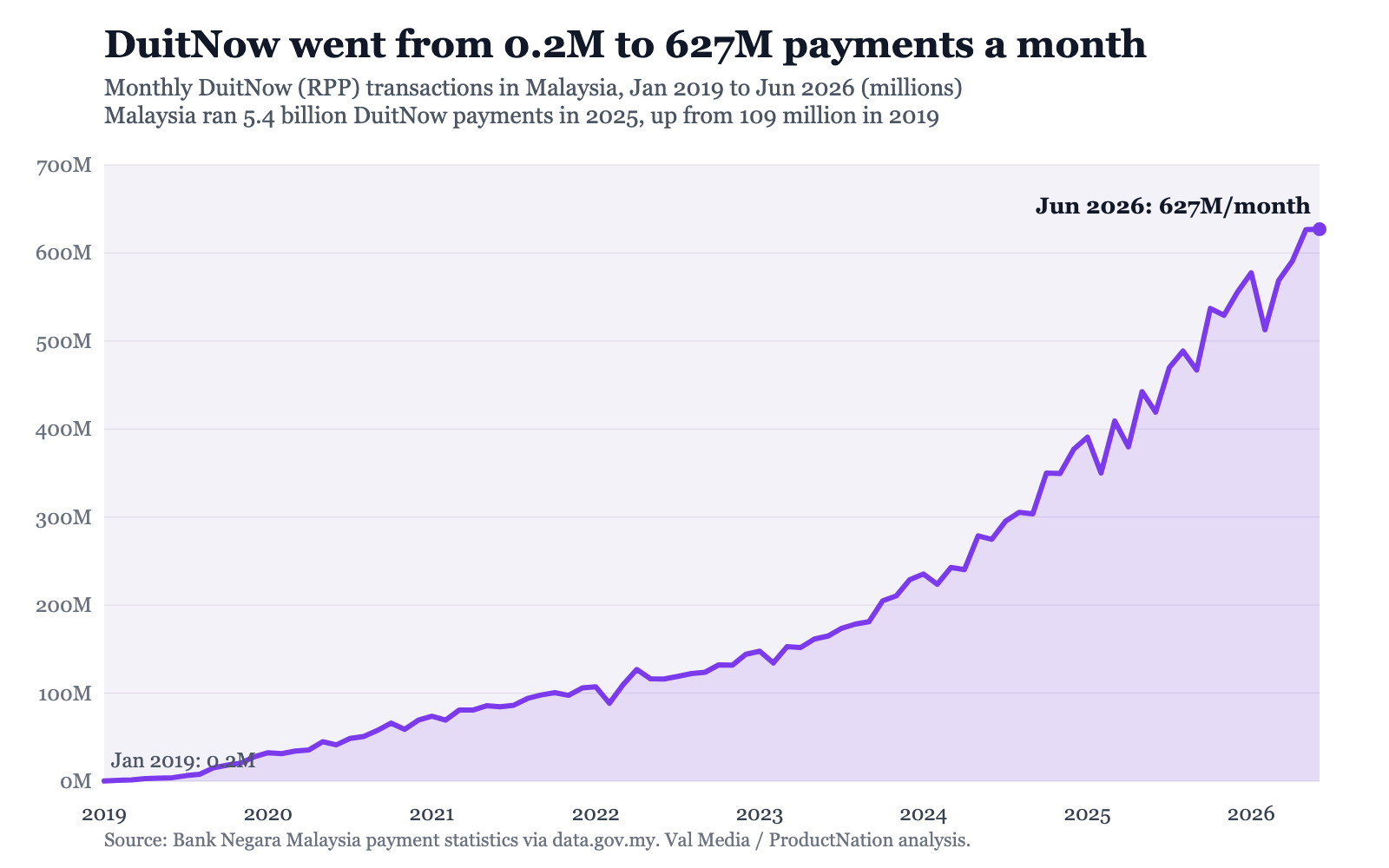
1. DuitNow instant transfers went from 109 million payments to 5.4 billion, about fifty times as many.
DuitNow, the instant credit-transfer and QR service that Bank Negara records under its retail payments platform (RPP), ran 109 million transactions in 2019, which was its first full year of operation. In 2025 it ran 5.44 billion, roughly 15 million payments every day. That is a rise of about fifty times in six years. Because 2019 was DuitNow's launch year, some of that multiple reflects starting from a low base, but the annual total rose every year after it too, reaching 5.44 billion in 2025 and running at 627 million in June 2026 alone. Measured by ringgit, DuitNow moved RM151 billion in 2019 and RM3.6 trillion in 2025.
2. In-person debit card payments rose 8.5 times, from 224 million to 1.9 billion.
Face-to-face debit card transactions, the ones made at a physical payment terminal rather than online, grew from 224 million in 2019 to 1.9 billion in 2025, more than eight times as many. This series counts a debit card being used to pay directly at the point of sale, which is separate from using the same card to withdraw cash at an ATM. It is one of the fastest-growing of the six figures here.
3. Mobile banking transactions grew 7.6 times, from 490 million to 3.7 billion.
Banking moved onto the phone. Transactions made through mobile banking apps rose from 490 million in 2019 to 3.7 billion in 2025. Their combined value grew even faster, about twelvefold, from RM204 billion to RM2.5 trillion, so the average mobile banking transaction was larger in 2025 than in 2019 as well as far more numerous.
4. E-wallets already recorded the most transactions of any instrument in 2019, and still tripled to 6.4 billion.
E-money, the category that covers e-wallets such as the ones Malaysians use for tolls, transit and everyday retail, already recorded the highest transaction count of any payment instrument in this Bank Negara dataset back in 2019, at 2.1 billion. It still tripled, to 6.4 billion transactions in 2025. The sharper change is in value: e-money moved RM17.6 billion in 2019 and RM272.5 billion in 2025, about fifteen times as much. That means the average e-money transaction rose from about RM8 to about RM43, so the growth is not only more taps but larger amounts per tap.
5. Cheques fell 63 per cent, from 84 million to 31 million.
The cheque recorded the largest decline of the six figures here. Cheque transactions dropped from 84 million in 2019 to 31 million in 2025, a fall of 63 per cent. By value they fell from RM1.27 trillion to RM802 billion. A payment instrument that once cleared more than a trillion ringgit a year is now used less than a third as often as it was six years ago.
6. ATM cash withdrawals fell 18 per cent, from 846 million to 696 million.
ATM cash withdrawals fell from 846 million in 2019 to 696 million in 2025, down 18 per cent, and by value from RM428 billion to RM369 billion. This series covers cash taken out at an ATM, which is not the only way to get cash but is the main one the data tracks. It is the only one of the six figures, alongside cheques, to fall rather than rise, and it fell while every digital category climbed.
The numbers, in full
| Payment type (transactions per year) | 2019 | 2025 | Change |
|---|---|---|---|
| DuitNow instant transfers (RPP) | 109 million | 5.44 billion | x49.8 |
| Debit card, in person | 224 million | 1.91 billion | x8.5 |
| Mobile banking | 490 million | 3.70 billion | x7.6 |
| E-money (e-wallets) | 2.09 billion | 6.37 billion | x3.0 |
| Cheques | 84 million | 31 million | -63% |
| ATM cash withdrawals | 846 million | 696 million | -18% |
The limits, so you can trust the numbers
These are transaction counts, the number of payments, not sales figures and not a measure of how many people pay each way. They come from three different Bank Negara series that count payments through different lenses: by system (DuitNow sits here), by instrument (cards, e-money, cheques) and by access channel (mobile banking, ATM). Those lenses overlap, because a single DuitNow transfer made inside a banking app is counted by both its system and its channel, so the six figures describe the same payment landscape from different angles and must not be added together. DuitNow's fiftyfold rise is measured from 2019, its first full year, so part of the multiple is a low starting base; we show the full monthly path above so the climb can be seen for itself. Where we give a ringgit value we label it as value; every other figure is a count of transactions. All figures are our own totals of Bank Negara Malaysia's published monthly data for the full calendar years 2019 and 2025, chosen as two complete years six years apart with 2025 the most recent complete year; 2026 is still in progress and is shown in the chart only.
How to check this yourself
The data is public. Open data.gov.my and take three datasets: payment systems, payment instruments and payment channels. For each, sum the monthly transaction volume for a category across the twelve months of 2019, then across the twelve months of 2025, and compare. DuitNow is the RPP row in the payment-systems set, e-wallets are the e-money row in payment instruments, and mobile banking and ATM withdrawals are rows in payment channels. The source is Bank Negara Malaysia, and these are our own counts of its monthly figures.