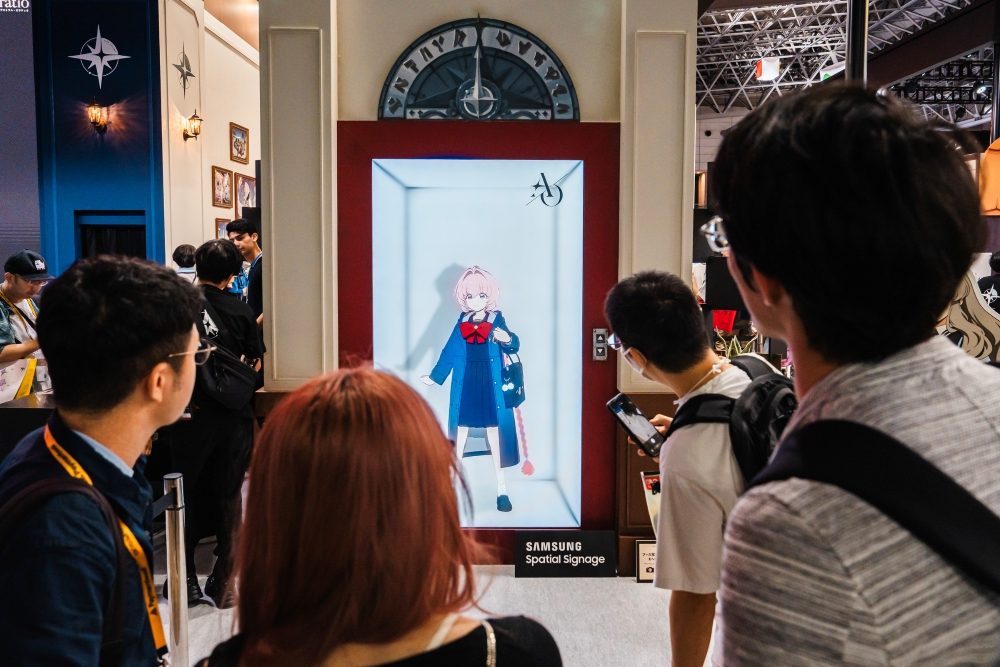
If you have ever wished a video game character could step off the screen and stand in front of you, Samsung has been testing exactly that in public. At Tokyo Game Show 2026, held from 17 to 20 September at Makuhari Messe near Tokyo, the company turned a game booth into a walk-through demo of glasses-free 3D screens, and the reaction on the floor says a lot about where public displays are heading.
Contents
What Samsung Spatial Signage actually did
Samsung Spatial Signage is a display built to create a sense of depth without asking anyone to wear 3D glasses. Working with Korean game publisher NC, Samsung placed an 85-inch panel at the entrance of the booth for Astrae Oratio, an upcoming urban fantasy role-playing game, and set it inside an elevator-themed installation so the characters looked like they were stepping into the hall at close to life size. The effect comes from Samsung's patented 3D Plate technology, which is what removes the glasses from the equation.
Smaller 32-inch versions were placed along the queue and waiting areas so the characters stayed with visitors as they lined up to play. The panels are slim, 52mm on the 85-inch model and 49.4mm on the 32-inch, close to the earlier 32-inch 3D signage Samsung aimed at retail shelves and part of why they fit into tight spaces.
Why the floor reaction matters
Depth on a screen is easy to claim and hard to sell, so the useful signal is what visitors said when nobody was asking them to buy anything. One attendee said he did not realise he was looking at a screen at all, and thought it was a transparent case with a real space behind it. Yongsoo Lee, who heads the Astrae Oratio business division at NC, put the commercial case plainly: "since Spatial Signage is very slim, it was really easy to install and make effective use of the space," he said, adding that the wall behind the display doubled as hidden storage for merchandise.
A strong visual with a small footprint is the same problem every mall kiosk, cinema lobby and pop-up store in Malaysia is trying to solve. It is also why signage is quietly turning into a real display category rather than an afterthought, a shift we saw earlier this year when LG launched a low-power e-paper signage screen for the same commercial buyers.
Beyond the game show
Tokyo Game Show is one of several places Samsung has put the technology to work. At Everland's safari attraction in Korea it was built into the queue area, and at the Governors Ball music festival in the United States an 85-inch panel showed merchandise inside the live-event space. Samsung frames all of this as evidence that the screens can carry digital content into physical rooms where ordinary displays have not fit well.
What it means for Malaysia
Samsung has not announced Malaysian pricing or availability for Spatial Signage, and this run was a commercial showcase rather than a consumer launch, so there is nothing to buy here yet. What it does tell local readers is where the display roadmap points: glasses-free 3D is moving out of the lab and into shopping and entertainment spaces, and the venues most likely to use it first are the ones Malaysians already visit. For the official detail, Samsung has posted it on the Samsung Newsroom.