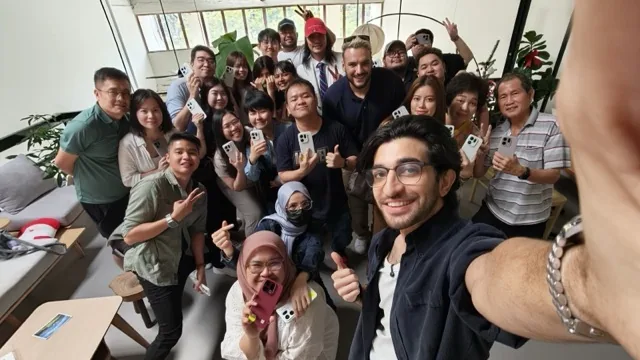
When we reviewed the Galaxy Z Fold8 we scored its cameras 7.0 out of 10, the lowest mark anywhere in that review. Not because the photographs are bad. Because Samsung left the telephoto lens out, and at this price that is a real cost rather than a detail to wave away.
So the useful question is not whether the Fold8 out-shoots a flagship slab. It is narrower than that, and more practical: what can two lenses actually do in the hands of someone walking around a city?
Contents
On the afternoon of Wednesday 20 August we took one Fold8 into the middle of Kuala Lumpur to find out. Every photograph below was taken between 5.44pm and 6.00pm, a span of fifteen minutes and forty six seconds, on one walk from Dataran Merdeka up Jalan Raja. Nothing has been retouched, colour graded or cropped. The only thing we have done to these files is resize them so this page loads quickly.
What is actually in the phone
The Fold8's rear camera is a pair, not a trio.
| Camera | What it is |
|---|---|
| Main | 50MP, F1.8, optically stabilised, with a 2x setting Samsung describes as optical quality zoom |
| Ultra wide | 50MP, F1.9, covering 120 degrees |
| Cover screen camera | 10MP |
| Inner screen camera | 10MP |
| Telephoto | None. The 3x telephoto belongs to the Fold8 Ultra |
The last line shapes everything else. Samsung's phrase "optical quality zoom" is doing some quiet work: at 2x the phone is not switching to a second lens, it is reading a smaller area out of the middle of that 50MP sensor at full resolution. It is a good trick, and as you will see below it holds up. Past 2x there is no trick left. The phone is enlarging and filling in.
Which makes the spread of this walk worth stating up front. Of the nine photographs here, exactly one was taken at the phone's widest setting. Four were shot at 2x. Four were shot at 4x, well past the point where Samsung stops claiming optical quality.
1x: the frame the phone gives you by default

Start here, because this is what the camera does before anyone touches the zoom. The sky gradient runs from deep blue to near white behind the buildings without a hint of the banding that cheap processing produces. The cream stone of the Sultan Abdul Samad Building sits under a bright sky and keeps its texture instead of blowing out. The printed panel in the foreground stays legible down to the small type.
Nothing here is a surprise. A 50MP sensor at F1.8 in tropical afternoon light is the easiest job a phone camera ever gets, and the Fold8 does it properly. The interesting part starts when you push past it.
2x: where most people will actually live

This is the frame that made the case for us. The bird was not planned and could not be repeated, and the phone froze it cleanly at 1/1930 second with the wing shape intact. Look at the building and the lettering is sharp, the vertical mullions on the glass are resolved as separate lines rather than smeared into a grey wash, and the leaves at the bottom of the frame keep real texture.
At 100 per cent this frame holds together. That matters, because 2x is the setting people reach for constantly without thinking about it, and on a phone with no zoom lens it is fair to expect it to fall apart. It does not.

The hardest exposure of the walk, and a fair test of dynamic range: a brilliant cloud bank behind a building whose lower half sits in its own shadow. The cloud keeps its shape rather than clipping to a flat white, and the shadowed stonework under the arches still shows detail. The processing leans a little cool here, which is a house look rather than a fault.

Sixteen minutes later the light had dropped and warmed, and this is the frame we would put in front of anyone who says a Fold cannot shoot. Copper against cream is an awkward pair for automatic white balance, because pulling one right usually pushes the other wrong. The Fold8 keeps the domes coppery and the stone neutral.

Dark foreground, bright sky, and the phone metering for the whole scene rather than the trunks. The bark keeps its texture instead of collapsing into a silhouette, and the sky behind holds its blue. This is the sort of frame that separates a phone that handles high contrast from one that simply exposes for the middle and hopes.
4x: where the phone starts to invent
Now the honest part. At 4x the Fold8 has run out of sensor to crop into and is reconstructing detail. Four frames from the walk were shot there, and the results split cleanly into two groups.


Hard edges survive. Lettering, window frames, the perforations in that lattice, the stripes of a flag: all of it comes through, and at the size you are reading this page these frames look genuinely good. The moving monorail is frozen and readable. If your 4x shots are of buildings and signage, you will be pleased.


Soft organic texture does not. Look closely at the trees behind the colonnade. At full size the foliage turns painterly, individual leaves dissolve into blocks of green, and the bare branches take on a watercolour softness that no tree has. The lettering on the colonnade a few metres in front of it is crisp. Same frame, same moment, two completely different outcomes, and it tells you exactly what the phone is doing: it recognises and rebuilds structure it can find, and smooths over what it cannot.
There is a second tell on the lattice frame. Look along the vertical edges of the concrete fins at full size and there is a faint bright halo, the signature of sharpening pushed hard to make a digital crop look like a lens. It is invisible at web size and obvious at 100 per cent.
None of this makes 4x useless. It makes it a compromise you should know about, which is a different thing.
Every frame, and what it was shot at
| Frame | Setting | 35mm equivalent | Shutter | ISO | Time |
|---|---|---|---|---|---|
| Dataran Merdeka and the palace | 1x | 23mm | 1/3309s | 80 | 5.58pm |
| Clock tower against cloud | 2x | 46mm | 1/1399s | 25 | 5.44pm |
| KL Tower and the copper dome | 4x | 92mm | 1/1894s | 25 | 5.48pm |
| The colonnade across the field | 4x | 92mm | 1/590s | 25 | 5.49pm |
| White lattice facade | 4x | 92mm | 1/1751s | 25 | 5.50pm |
| Palms and the OCBC building | 2x | 46mm | 1/1962s | 25 | 5.52pm |
| Bird past the Maybank tower | 2x | 46mm | 1/1930s | 25 | 5.54pm |
| Monorail, KWSP and UOB | 4x | 92mm | 1/970s | 25 | 5.56pm |
| The palace in late light | 2x | 46mm | 1/1022s | 25 | 6.00pm |
Two things stand out in that table. The first is the shutter speeds. Tropical afternoon light let the phone sit at ISO 25 for eight of the nine frames while still running shutter speeds between 1/590 and 1/3309 second, which is why the bird and the monorail are frozen rather than smeared. The second is that we barely used 1x. Given the choice, a photographer walking a city reaches past the default constantly, and on this phone that means leaning on a crop.
What the shape gives you, and no slab can
The camera hardware is only half of what a folding phone offers a photographer, and the other half rarely shows up on a spec sheet.
The best camera on the Fold8 is the rear one, and unlike on a normal phone you can use it on yourself and still see what you are doing, because the cover screen becomes the viewfinder. The same trick works pointed outward: your subject watches themselves on the cover screen while you shoot them on the good lens, which is the single fastest way we know to get a natural expression out of someone who hates being photographed.
Fold the phone to ninety degrees and it stands up on any flat surface without a tripod, which turns a wall or a table into a camera support for a group shot or a long exposure. And when the shooting is done, you open it and review and edit on an eight inch screen instead of squinting at a phone.
For a studio that shoots on phones, that last one is not a gimmick. It is the difference between checking a frame and actually seeing it.
What this test does not cover
One walk, one afternoon, one set of conditions. Everything here was shot in bright to golden light between 5.44pm and 6.00pm, so this tells you what the Fold8 does when the light is generous and nothing about what it does after dark, which is where phone cameras are usually won and lost. We are shooting that separately and will publish it as its own piece rather than fold a guess into this one.
The verdict
Two lenses is fewer than the competition and the missing telephoto is a genuine loss, exactly as our review said. What this walk shows is that the loss is narrower than the spec sheet implies. The main sensor is excellent, the 2x crop is strong enough that most people will never think about it, and 4x is usable on architecture and signage while it struggles with anything soft and organic.
If your photography is buildings, streets, signs and people, the Fold8 will not hold you back, and the cover screen will do things your slab cannot. If you shoot wildlife, stage lighting or anything else where reach decides the picture, the Fold8 Ultra and its 3x telephoto is the phone in this family for you, and that gap is the clearest reason to spend the extra.
Prices and the full configuration list for both are in our Galaxy Z Fold8 price and specs guide.
All photographs in this article were taken by ProductNation on a Galaxy Z Fold8 in Kuala Lumpur on 20 August 2026, and are published straight from the phone with no editing beyond resizing.