
The National Scam Response Centre (NSRC) is to build an app that checks a stranger's phone number, a bank account or a web link before any money leaves your hands. Prime Minister and Finance Minister Anwar Ibrahim announced the plan while tabling Budget 2027 in the Dewan Rakyat on 9 October. The idea is simple and overdue: let people verify who they are about to pay, in the seconds before they pay, instead of finding out afterwards.
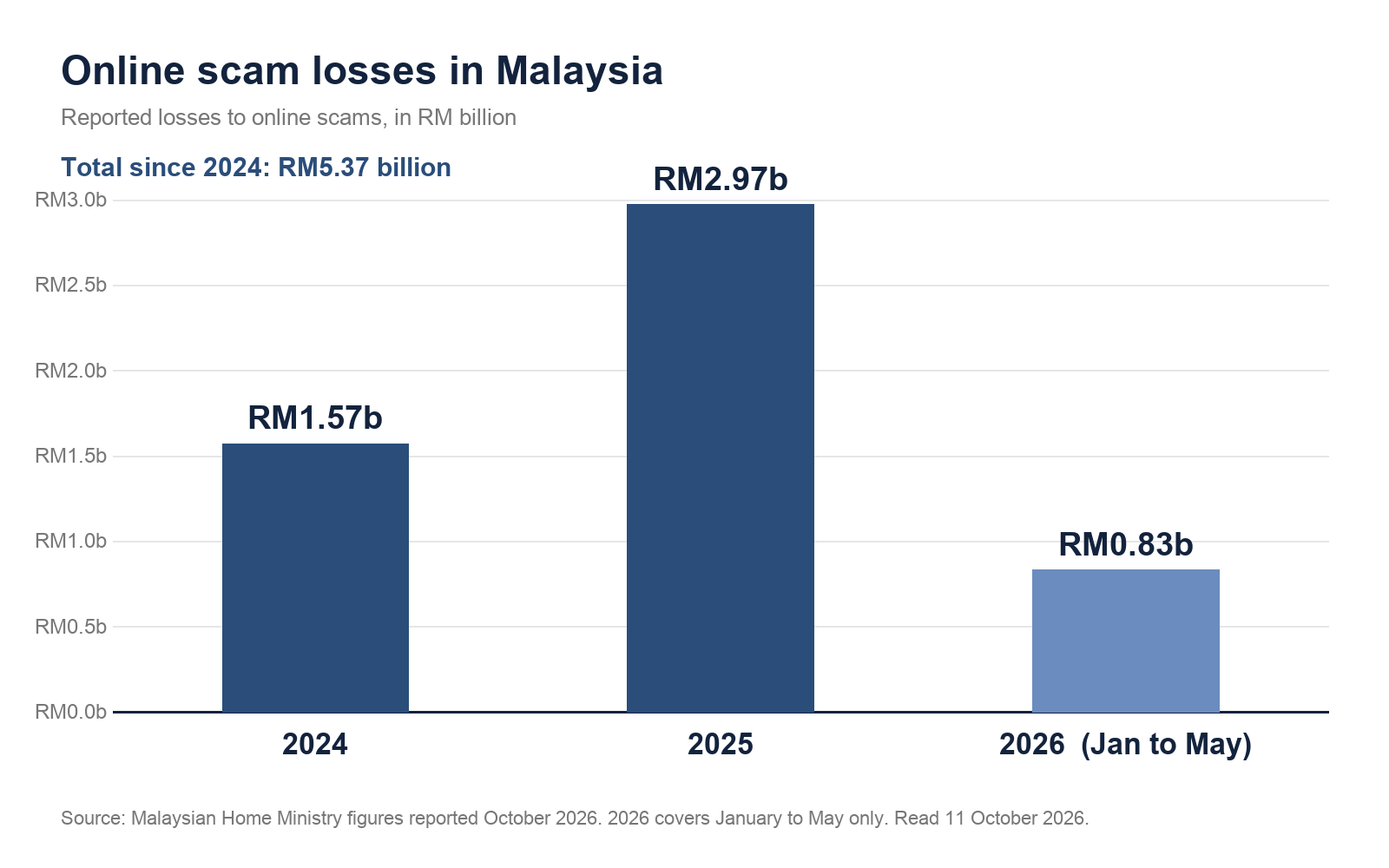
The scale it is aimed at is the reason it matters. Malaysians have lost RM5.37 billion to online scams since the start of 2024, according to Home Ministry figures: RM1.57 billion in 2024, RM2.97 billion in 2025, and a further RM830 million in just the first five months of 2026. Investment scams account for the largest slice at RM2.68 billion, followed by telecommunications scams at RM1.54 billion.
None of this is for lack of machinery. The NSRC, which began operating in October 2022, handled 146,167 complaint calls in 2025 and took freezing action on 138,915 accounts that year, according to Home Ministry figures. Malaysia also already has a public lookup in Semak Mule, the police tool for checking whether a phone number or account is tied to known fraud. The checks the new app is billed to offer, suspicious numbers, accounts and links before a transaction, were set out when the budget was tabled, as Fintech News Malaysia reported, and the government calls it AI-powered. The funding, launch date and technical specification that would show how it works were not part of the announcement.
The threat it is meant to answer increasingly lands on the same device people bank on, from fake links to cloned voices: we have reported how a voice can be cloned from ten seconds of audio. Reacting to the announcement, National Cyber Security Agency chief Dr Megat Zuhairy Megat Tajuddin said the tool could give early warnings before money changes hands, but cautioned, in remarks reported by The Star, that a result showing no known scam record "is not a guarantee of safety."

Malaysia Cyber Consumer Association president Siraj Jalil, quoted in the same report, called a real-time, pattern-reading tool urgently needed, and pressed for banks and telcos to share the responsibility when safeguards fail. Both reactions land in the same place: welcome the tool, do not mistake it for a wall. Dr Megat's caution is the one to keep in mind, because a check that returns no known record is not a clearance, and it still asks a frightened or hurried person to stop and run it in the very moment they are being pressured not to. That makes a checker a filter, not a shield.
For now, the detail that would tell us how good it will be is missing. The budget speech, which also expanded free AI subscriptions for young Malaysians, named no funding figure, no launch date and no technical specification for the scam app. The next thing worth watching is narrow and concrete: whether this ships as a new standalone app or as an AI layer on top of the Semak Mule check Malaysians can already use today.
Image(s) courtesy of Gilles Lambert and Vitaly Gariev on Unsplash.