Malaysia is now almost entirely online. In 2025, 98.3 per cent of Malaysians aged 15 and over used the internet, up from 81.2 per cent in 2018, and 97.1 per cent of households had internet access at home. And one device dominates how they get there. The phone towers over every other device Malaysians carry to go online.
The government measures which portable devices Malaysians use to get online. In 2025, 99.4 per cent of internet users used a mobile phone. Only 39.5 per cent used a laptop, the survey's "portable computer". Tablets reached 27.4 per cent and other portable devices 14.4 per cent. The phone is close to universal; every other device is a minority.
Contents
We counted the Department of Statistics Malaysia (DOSM) ICT Use and Access by Individuals and Households Survey, published on data.gov.my. The device figures are the share of people who use the internet who go online using each type of portable device. A person can use more than one, so the shares do not add up to 100 per cent. The survey asks about portable devices, so a desktop computer at home or at work is not counted here.
The finding, in one line
In 2025, 99.4 per cent of Malaysian internet users went online by phone and 39.5 per cent by laptop, a gap of almost 60 percentage points. In no year from 2019 to 2025 did laptop use reach even half of internet users. Its highest point in that period was 45.1 per cent, in 2021.

The laptop was at its highest in the pandemic, and below that peak ever since
The intuition is that as a country digitalises, laptop and computer use climbs. In Malaysia that is not what the figures show. Laptop use among internet users was 35.6 per cent in 2019, rose to 45.1 per cent in 2021, and then fell to 38.4 per cent in 2022. It has edged up slowly since, to 39.5 per cent in 2025, still below the 2021 level.
The 45.1 per cent high point falls in 2021, during the pandemic years when much work and schooling moved into the home. We are noting when the peak occurred, not asserting a single cause for it. What the numbers show plainly is that the laptop's highest year in this series was a pandemic year, and that laptop use has been lower in every year since. The phone, by contrast, barely moved: it was 99.6 per cent in 2019 and 99.4 per cent in 2025, near the ceiling the whole time.
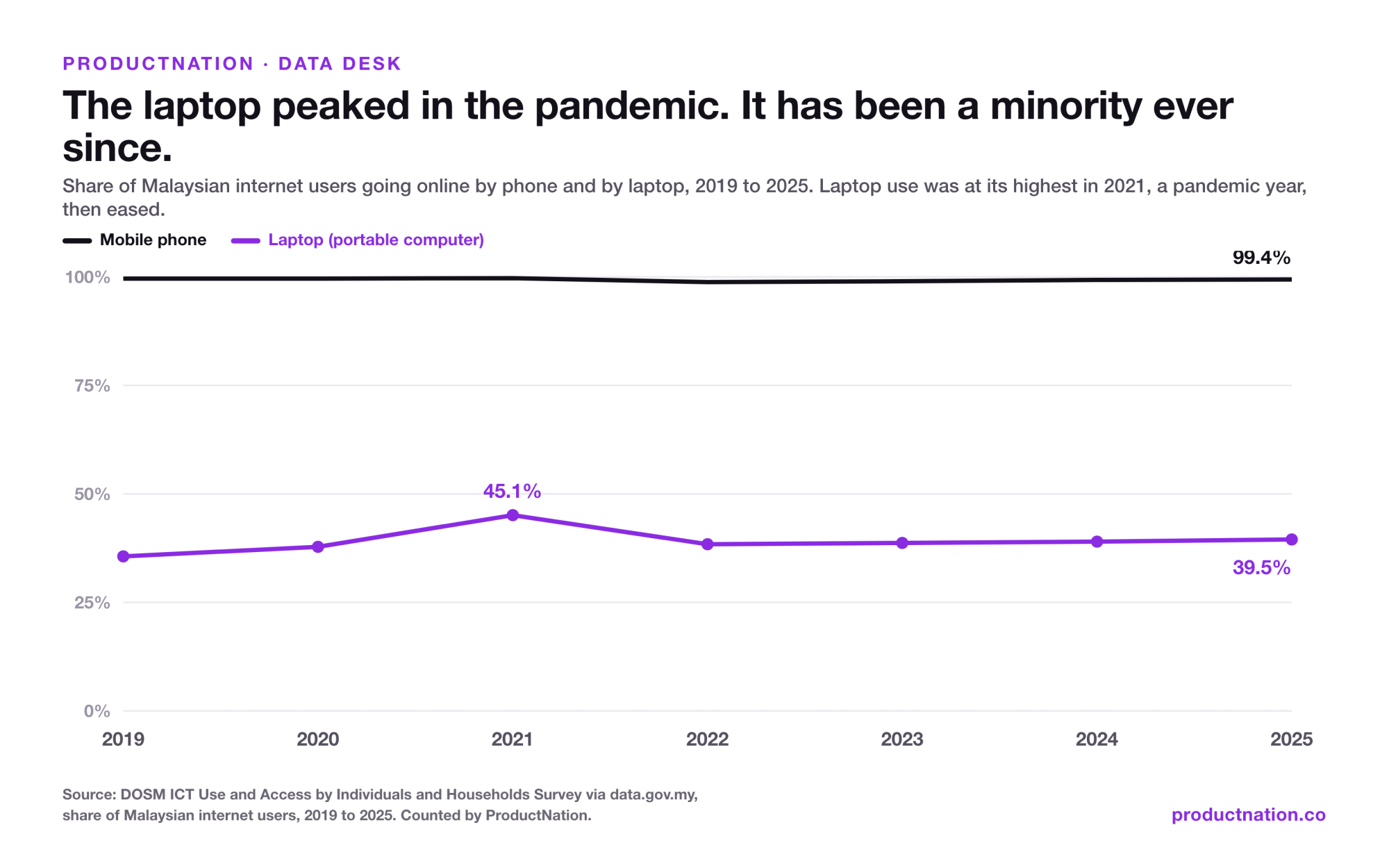
Here is the full series, as the share of Malaysian internet users using each portable device.
| Year | Mobile phone | Laptop | Tablet | Other |
|---|---|---|---|---|
| 2019 | 99.6% | 35.6% | 13.0% | 7.0% |
| 2020 | 99.6% | 37.8% | 14.1% | 7.4% |
| 2021 | 99.7% | 45.1% | 30.9% | 18.0% |
| 2022 | 98.8% | 38.4% | 26.2% | 13.1% |
| 2023 | 99.0% | 38.7% | 26.5% | 13.5% |
| 2024 | 99.3% | 39.0% | 26.9% | 14.0% |
| 2025 | 99.4% | 39.5% | 27.4% | 14.4% |
Between town and village, the phone is level. The laptop is not.
Malaysia used to have a wide gap between urban and rural internet use. In 2018, 84.9 per cent of urban Malaysians used the internet against 69.4 per cent in rural areas, a gap of more than 15 percentage points. By 2025 that gap had nearly closed: 99.2 per cent urban against 95.7 per cent rural.
The phone is level across that divide; the laptop is not. In 2025, phone use among internet users was 99.4 per cent in urban areas and 99.3 per cent in rural areas, a difference of one tenth of a percentage point. Laptop use was 43.6 per cent urban against 27.2 per cent rural, a gap of more than 16 percentage points. Rural laptop use has risen, from 18.8 per cent in 2019 to 27.2 per cent in 2025, but it remains far below the phone and far below the town.
| Share of internet users, except as noted | Urban | Rural | Gap (points) |
|---|---|---|---|
| Internet use, all individuals, 2018 | 84.9% | 69.4% | 15.5 |
| Internet use, all individuals, 2025 | 99.2% | 95.7% | 3.5 |
| Go online by phone, 2025 | 99.4% | 99.3% | 0.1 |
| Go online by laptop, 2019 | 39.6% | 18.8% | 20.8 |
| Go online by laptop, 2025 | 43.6% | 27.2% | 16.4 |
What this does and does not show
These are results from a household survey, not a count of devices, and they cover individuals aged 15 and over living in private households, reporting their own internet use in the three months before the interview. The device percentages are shares of people who use the internet, not of the whole population, and because a person can use several devices the shares overlap and do not sum to 100 per cent. The survey asks only about portable devices, so its "portable computer" is a laptop or notebook, and a desktop computer is not counted at all. Household internet access (97.1 per cent of homes) and individual internet use (98.3 per cent of people) are two different measures, and we have kept them apart. We report the national figures and the urban and rural splits, which rest on large samples; we have not drilled into individual states, where the survey samples are smaller and single-state readings can swing on a handful of responses.
Anyone can reproduce this. Download the "ICT Use and Access by Individuals and Households" datasets from data.gov.my (internet use by strata, household access to internet, and internet use by type of portable device), and read the rows for Malaysia overall, and for the urban and rural strata, for each year.
Why we care about this
We build our Malaysian product guides mobile-first: the card, not the page, is the unit, and everything is laid out to be read one thumb-scroll at a time. The national picture sits alongside that choice. In a country where almost everyone who is online is online on a phone, the small screen is the one we treat as the default rather than the exception.