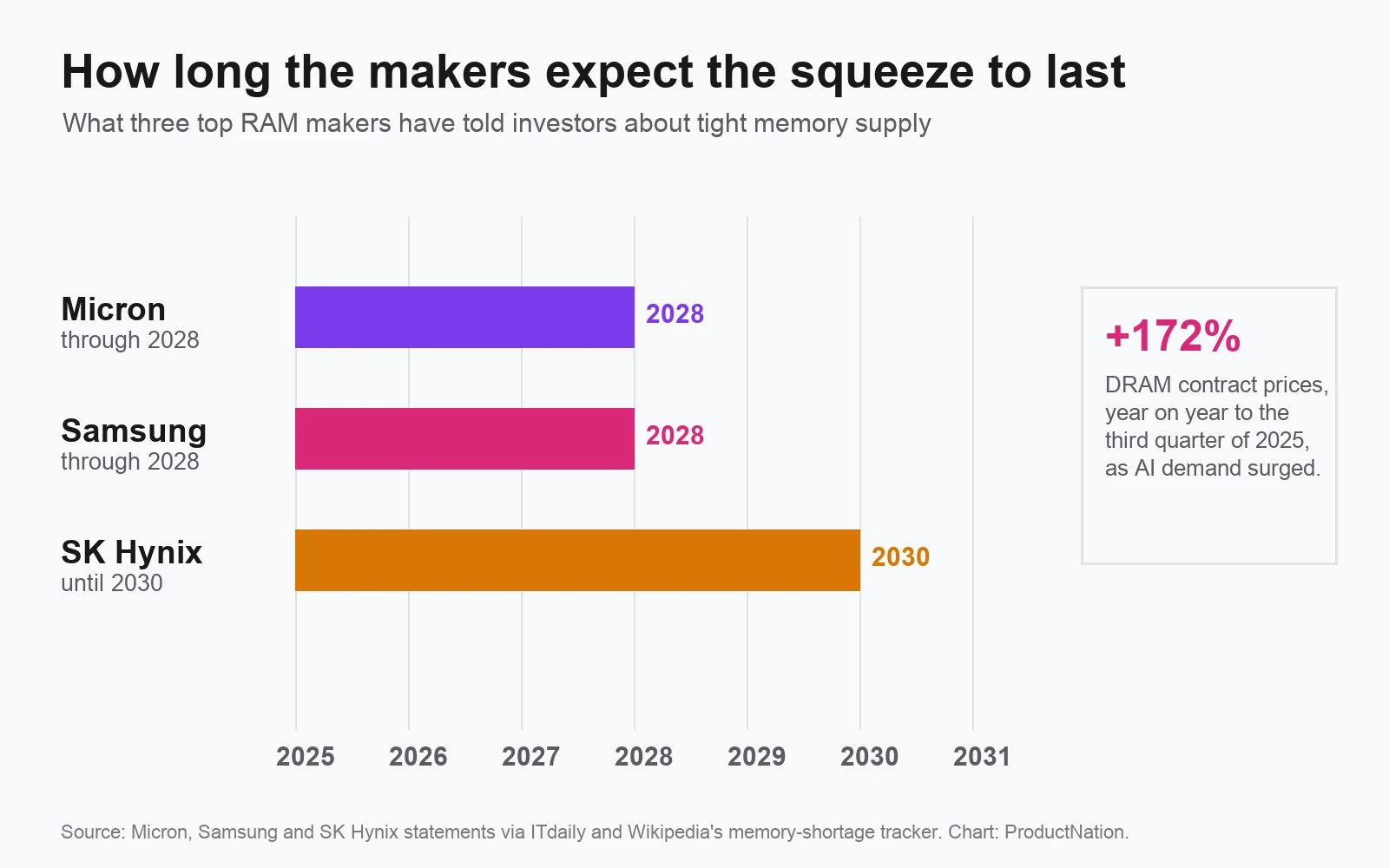
The companies that make the world's memory chips keep telling investors the same thing: the shortage that pushed RAM and storage prices up over the past year is not easing soon. This week, on Micron's earnings call, chief executive Sanjay Mehrotra said supply was only getting tighter, with demand set to outpace what the company can produce across 2027 and 2028. Micron has already committed the bulk of its 2027 output to customers, and says the conditions stay tight even as new factory space comes online in 2028.
Micron is not alone, though the others spoke earlier in the year. Samsung's memory chief Jaejune Kim gave a through-2028 view over the summer, and SK Hynix's Kwak Noh-Jung said in August that it could last until 2030, as tracked across the industry's coverage of the shortage. Their statements were made months apart and cover somewhat different slices of the memory market, so they are not one matched forecast. But they point the same way: this is measured in years, not months.
Why memory got expensive, and stayed that way
The cause is the force reshaping the rest of tech. Memory makers have been steering factory capacity toward the high margin chips that artificial intelligence data centres need, chiefly high bandwidth memory and server grade DRAM, which sell for far more than the sticks that go into a laptop or a gaming PC. What is left for consumers commands a premium. One contract price measure tracked across the shortage put DRAM up about 172 per cent year on year by the third quarter of 2025, and the makers are signalling more increases rather than relief. That is a contract benchmark rather than a Malaysian shelf price, but it shows the direction the whole market has moved.
This is the next leg of a story we have followed all year. In August we covered how the AI build out was pricing Malaysian buyers out of graphics cards, and in September how RAM and SSD prices climbed up to 18 per cent in a single quarter on analyst numbers. Memory is simply the next part of the same squeeze.

What it means in Malaysia
Memory is a globally priced, imported commodity, and Malaysia does not make its own memory chips at scale. So when the world price rises, the increase reaches buyers here in ringgit, and a weaker ringgit can make it bite harder still. We do not have a public local price series to put an exact figure on how much a build has gone up, and any single retailer's price also moves with stock on hand, promotions and margins. What is not in doubt is the direction: the people who make the chips expect tight supply for years, so it is unlikely to get cheaper here in the near term.
There is a second, less comfortable angle. Malaysia has been courting the very kind of investment that is driving the squeeze, the data centre push around Cyberjaya and Johor we have covered before. Those projects bring jobs, power deals and a place in the regional AI economy, and the country's own facilities are a small part of a global demand surge, not its cause. But it is worth naming the trade honestly: the same class of build out that Malaysia wants is, worldwide, what is pulling memory off the shelf and into the server rack.
Should you buy now
For anyone planning a build or an upgrade, from gamers to the small studios and freelancers who run memory hungry editing and rendering rigs, the usual instinct is to wait because parts get cheaper. That instinct looks weaker when the makers themselves expect tight supply into 2028, and on SK Hynix's reading beyond it. New capacity is coming, Micron expects its Idaho plant to begin output in 2027, but the makers still expect supply to stay tight as that ramps up. None of this is a promise about next month's shelf price. It is a reason not to assume that waiting will save money this time.
Image(s) courtesy of Harrison Broadbent and Andrey Matveev on Unsplash.