In the United States, one of BMW's new electric cars now lists below a petrol version of the same 3 Series. It is a narrow comparison, but a telling one, and it lands at a moment when Malaysia's own EV prices are tied to a tax incentive that is running out.
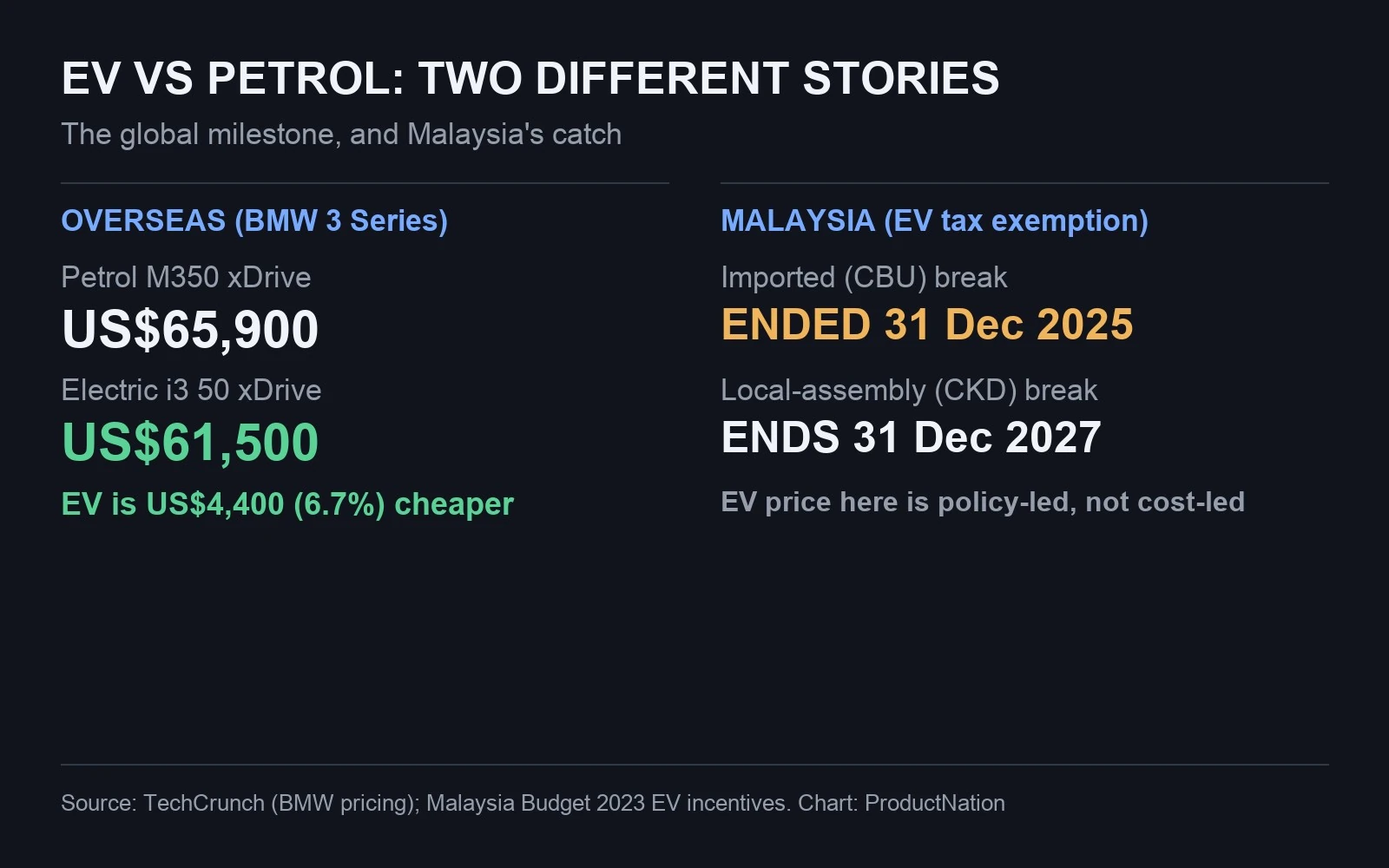
BMW has announced its 2027 3 Series in both petrol and electric form, with US prices announced ahead of a first-quarter 2027 launch. TechCrunch compared two of them: the petrol M350 xDrive at US$65,900 and the electric i3 50 xDrive at US$61,500, both base prices excluding the same US$1,350 destination charge, which makes the electric car US$4,400, about 6.7 per cent, cheaper. That comparison is specific, not sweeping: the M350 is BMW's petrol M Performance trim, and cheaper 2027 petrol trims such as the 330 xDrive, at US$51,900, still undercut the electric i3. What is notable is that an electric BMW has landed below a petrol 3 Series on price at all, even against a single higher trim.
Why the pairing matters
The comparison is narrow, and cheaper petrol 3 Series trims such as the 330 (US$49,900) and 330 xDrive (US$51,900) still cost less than the electric i3. What is worth noting is simply this: against the petrol M350 xDrive, the performance version of the same 3 Series, the electric car came out lower in price. That is a narrow result, not a market-wide rule.
What it means for Malaysia
In Malaysia, a major factor in EV pricing is a set of government incentives, and those incentives carry expiry dates. Budget 2023 set them out to spur demand and encourage locally assembled electric vehicles.
Under those incentives, fully imported (CBU) electric cars were exempt from import and excise duty only until 31 December 2025, a window that has now closed. Locally assembled (CKD) electric cars keep their excise and sales tax exemption until 31 December 2027. The two halves of the market are therefore no longer on the same footing: a fully imported EV no longer benefits from that exemption, while one built here still does, for now.
The practical implication for a buyer is that local assembly carries the tax advantage. A locally produced model like the Proton e.MAS 7 we covered this week still sits inside the CKD exemption until the end of 2027. The same logic makes announced local-assembly plans worth watching, such as JAC's EV and PHEV pickups we reported from Kedah.
What to watch
Overseas, BMW has shown an electric model can be priced below a petrol one in the same range, even if only in one comparison so far. In Malaysia, the exemptions reduce the tax applied to a qualifying EV, so when the CKD exemption lapses after 31 December 2027, locally assembled EVs that qualify would no longer be shielded from excise and sales tax, unless the exemption is extended again, as it has been before.
The date to circle is 31 December 2027. Until then, the tax-advantaged route to an electric car in Malaysia generally runs through locally assembled models that qualify for the CKD exemption, not through the global pricing shift BMW just put on display.
Cover and showroom photos courtesy of CHUTTERSNAP and Crosby Hinze on Unsplash. Chart by ProductNation.