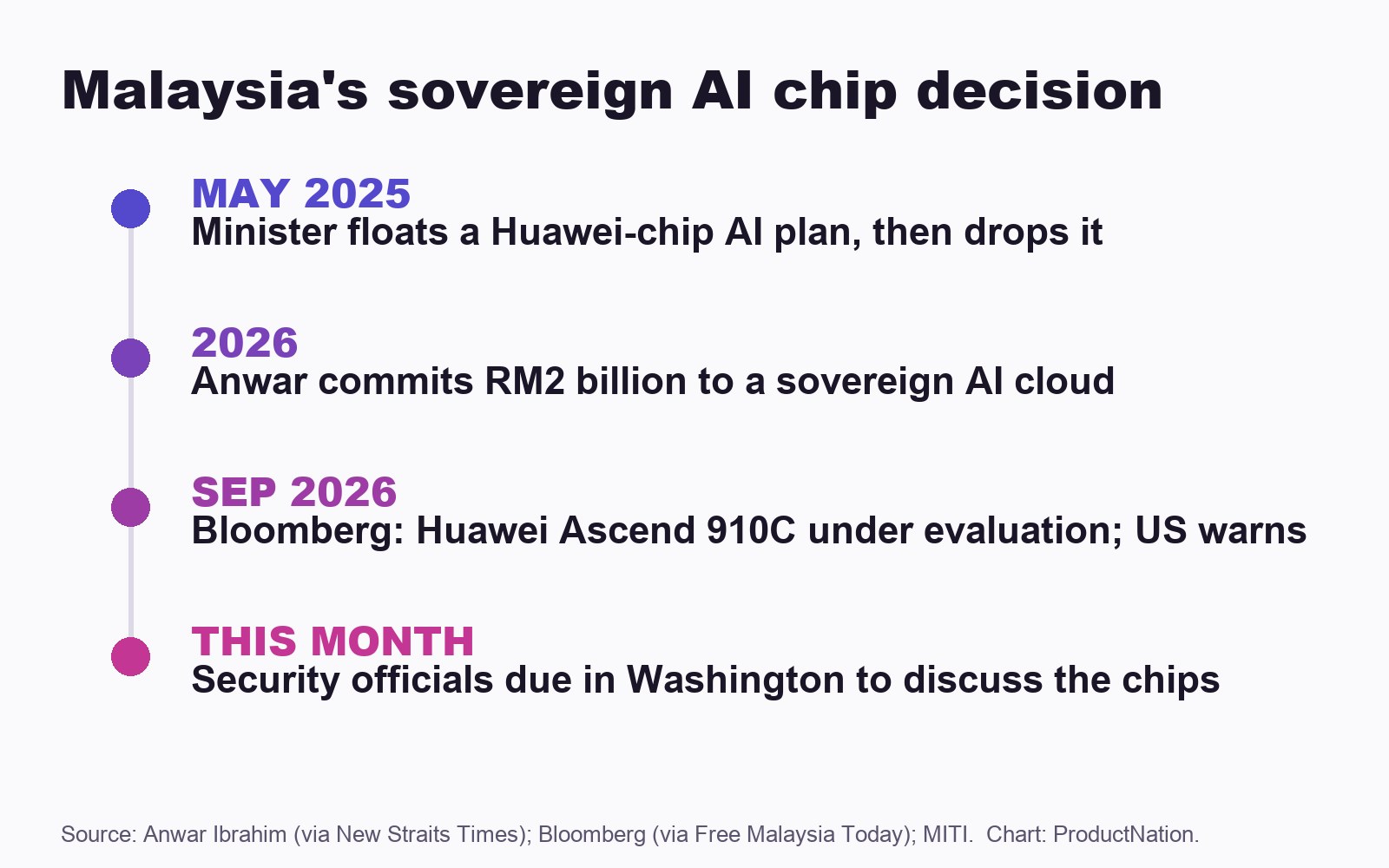
Malaysia is considering Huawei hardware to build a RM2 billion sovereign AI cloud, according to a Bloomberg report this month that cites unnamed sources and was carried locally by Free Malaysia Today. The cloud itself is not a rumour: Prime Minister Anwar Ibrahim has committed a RM2 billion investment to a national sovereign AI cloud, framing it as a way to make Malaysia a developer of technology rather than only a consumer of it. What Bloomberg adds is the sensitive part, that the chips under evaluation are Huawei's Ascend 910C, one of the Huawei chips Washington warned last year could put buyers at risk of breaching US export controls. Bloomberg says no final decision has been made, and that the prime minister's office and the digital ministry did not comment.
It helps to separate what is official from what is reported. The government's stated aim is to strengthen Malaysia's own secure national AI capability. That is the confirmed part. Bloomberg's contribution, from unnamed sources, is that Telekom Malaysia has been lined up to operate the backbone and that the choice of chips is still open. Read it as well-sourced reporting on an open decision, not a settled one. The concern that has pulled it into diplomacy, going by the quoted US position, is about the supplier: who makes the chip, and which government stands behind it.
Washington's stated concern is trust. A US State Department line quoted in the reporting warns that "untrusted suppliers can be manipulated, disrupted or controlled by authoritarian regimes," and Bloomberg reports that American officials have told Malaysia they are uneasy about Huawei equipment handling intelligence material, including information shared by other governments. Officials from Malaysia's National Security Council are reported to be travelling to Washington later this month to discuss it.
The idea has surfaced before, and stumbled. In May 2025, then deputy communications minister Teo Nie Ching floated a national AI build using Huawei Ascend chips. Her office withdrew the statement within days, and the trade ministry clarified that the initiative was private, not a government project. The current sovereign AI cloud is a government initiative rather than that withdrawn private plan, but it revives the same question about Chinese chips, and Bloomberg reports it now carries a hedge: a second process is under discussion that could let Nvidia and Advanced Micro Devices bid for the work.
The difficulty is that neither path is friction-free. Advanced American AI chips sit under US export controls administered by the Bureau of Industry and Security, and that same agency warned in May 2025 that using certain Chinese chips, the Ascend 910C among them, could risk breaching those rules. Sovereignty runs into the export map either way.
Here is the part easy to miss in the wire coverage. Foreign technology companies keep investing in Malaysian AI capacity: we reported this month that OpenAI signed on as anchor customer of two new Firmus data centres here, and that Tencent Cloud agreed with U Mobile to develop 5G and AI services. Those are foreign players taking part in commercial AI projects on Malaysian soil. The sovereign cloud is a different animal, a system the state wants to keep under its own control, and that is exactly why the origin of its chips carries a weight that a commercial partnership does not.

So Malaysia is balancing two things at once: an open door to foreign-invested data centres that bring investment, and a national system where the origin of the hardware, and the export rules that can restrict its supply, turn into a security question in a way a commercial hosting deal does not. To our reading, the two are not contradictory, but they do not sit comfortably together, and the sovereign cloud is where the seam shows.
The National Security Council's reported trip to Washington is the next thing on the calendar. What that trip signals will matter more than any single figure in the plan.
Image(s) courtesy of Laura Ockel and Winston Chen on Unsplash.