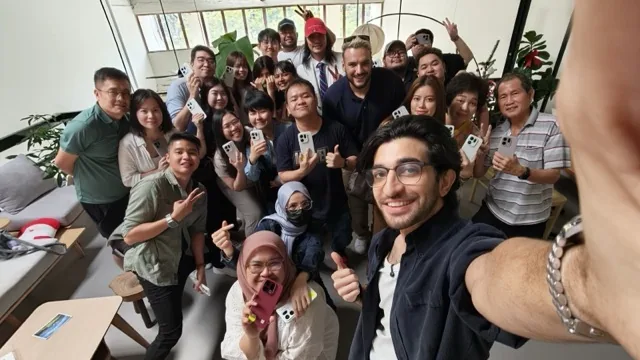
Produced in paid partnership with Samsung. Every photograph here is our own, taken on the review units Samsung provided.
For most of the last decade, switching phones meant choosing between two rectangles of almost identical size. The interesting question was the camera. Everything else was a rounding error.
Contents
That has quietly stopped being true. Malaysians who have never owned a foldable are now walking into stores and walking out with one, and the tone of the conversation has changed with them. Two years ago the fold was a curiosity you justified. Now it is the thing people move up to.
We have been carrying the Galaxy Z Fold8 as our own phone, not as a test unit passed around an office. This is what we would tell a friend who has had an iPhone since university and is finally wondering.
1. Why people are finally switching
The honest answer is that the last visible objection has gone.
Every person who has picked up our Fold8 has done the same two things: opened it, then run a thumb down the middle. They are looking for the seam. On this generation, they do not really find one. Under normal room light, with something on screen, it is not there. You have to turn the screen off and tilt the phone into a lamp before the fold shows itself at all.


That matters more than it sounds, because the crease was never really about the crease. It was shorthand for "this is a prototype and I am paying to test it". A screen that looks like one continuous surface removes the argument.
The second reason is duller and more convincing. The Fold8 is shorter and wider than the Fold before it, which means that when it is closed it behaves like a normal phone. You can reach the far corner of the cover screen with one thumb. You can hold it while standing on the LRT. Previous Folds asked you to accept an awkward closed shape in exchange for the open one. This one does not ask.
Then, several times a day, it opens into an 8 inch screen and you stop squinting at a PDF, a spreadsheet, a Grab receipt, a WhatsApp video call with your mother and the recipe you are supposed to be following at the same time.
2. The honest adjustments
We would be doing you no favours by pretending this is free.
It is heavier. Not dramatically, but you will notice it in a shirt pocket and you will notice it on a long call held to your ear. This is the single most common thing people mention in the first week, and the single most common thing they stop mentioning by the third.
Some things become two-handed. Anything on the big screen needs a second hand. That is not a flaw, it is geometry, and it is the trade you are making for the screen. The cover screen absorbs most of the quick jobs, replying, checking, paying, so the two-handed moments are the ones you chose to open the phone for.
You are learning two phones. Apps behave differently open and closed, and for about a week you will open the phone for something you did not need to open it for. This settles. It settles faster if you spend ten minutes at the start setting which apps continue from the cover screen to the inner screen, because the default is more conservative than most people want.
The camera is very good, not the best on the market. If your reason for buying a phone is the camera above everything else, a conventional flagship still wins on paper. On the Fold8 specifically there is no telephoto, so distant subjects are the compromise. What you get instead is the biggest viewfinder anyone makes.
3. The practical move, and how little it hurts
This is the part that stops people. Ten years of photographs, WhatsApp history, two-factor codes, boarding passes, the lot.
In practice, the move is one sitting. You put the two phones next to each other, tell the new one it is replacing an iPhone, and it copies across your contacts, messages, photographs, calendar and most of your apps. You make a cup of coffee. It finishes.

Three things are worth doing before you start, and nobody tells you any of them.
Move your photo library off iCloud first. Not because it will not transfer, but because leaving your only copy in a service you are walking away from is how people lose a decade of pictures two years later. Get them into Google Photos, or onto a drive at home, before you hand the iPhone in.
Turn off iMessage on the iPhone before you wipe it. If you do not, texts from other iPhone users can keep disappearing into a service your new phone cannot read. It takes one toggle and it saves a month of confusion.
Deal with two-factor codes on the day. Banking apps and authenticator apps are the one category that does not simply copy across. Do the migration while you still have the old phone working and in your hand, not after you have traded it in.
On trade-in: check what is running when you buy rather than assuming. The value of an old flagship against a fold moves around, and it is usually the difference between this being a considered purchase and an easy one.
4. The thing new switchers actually show people
Ask someone who has just moved what sold them and they rarely say the specification. They say the trick.
Open the camera, turn on the preview that mirrors onto the outer screen, and the person you are photographing can see themselves while you shoot. No more taking eleven versions and handing the phone over. They fix their own hair, they choose their own moment, and you take one photograph.

It is a small thing. It is also the clearest example of what a folding phone is for: the hardware does something a flat sheet of glass cannot, rather than doing the same thing slightly faster.
5. So, should you?
Switch if you read on your phone, work on your phone, or have ever emailed yourself a document because it was unreadable on a small screen. Switch if you have been curious for two generations and were waiting for the crease to be solved, because it is. At RM7,299 the Fold8 is a serious purchase, but it is no longer a gamble.
Stay where you are if your phone lives in a gym pocket, if you buy on camera alone, or if you are hard on your devices. A fold is a more complicated object than a slab and it deserves a little more care.
And if you want the fold without the price, the Galaxy Z Flip8 at RM5,399 is the other half of this conversation. It folds the other way, into something that genuinely disappears into a pocket, and it is how a lot of people meet the format for the first time.
One honest caveat to end on, because we would rather say it than have you find it out. This is a guide to switching, written by people in their first weeks of it. Whether a fold is still the right answer after a year of being opened and closed forty times a day is a different question, and one we are going to answer properly in a few weeks with the same phone and no fresh enthusiasm.