Artificial intelligence just got cheaper to run, and the timing matters for anyone in Malaysia building on it. On 22 September, OpenAI released two new models, GPT-6 Sol and GPT-6 Luna, and says they cost about half as much to use through its programming interface as the earlier 5.6 versions. About 90 minutes earlier, rival lab Anthropic had cut the price of its own top model. Two of the biggest names in AI lowered prices on the same afternoon.
The headline for developers is the cost. OpenAI says GPT-6 Sol and Luna carry roughly 50 per cent lower API prices, a cut it measures against its own earlier prices for the 5.6 versions and credits to better caching and more efficient processing. OpenAI frames the drop as about half across the two models, though the exact reduction varies by model and by how the tokens are counted. Sol is built for heavier work like coding, while Luna handles high volume tasks such as summarising documents and answering quick questions. OpenAI also says Sol makes about half as many factual mistakes as the model before it, based on its own internal test of conversations that users had flagged as wrong. TechCrunch reported the launch and the pricing.
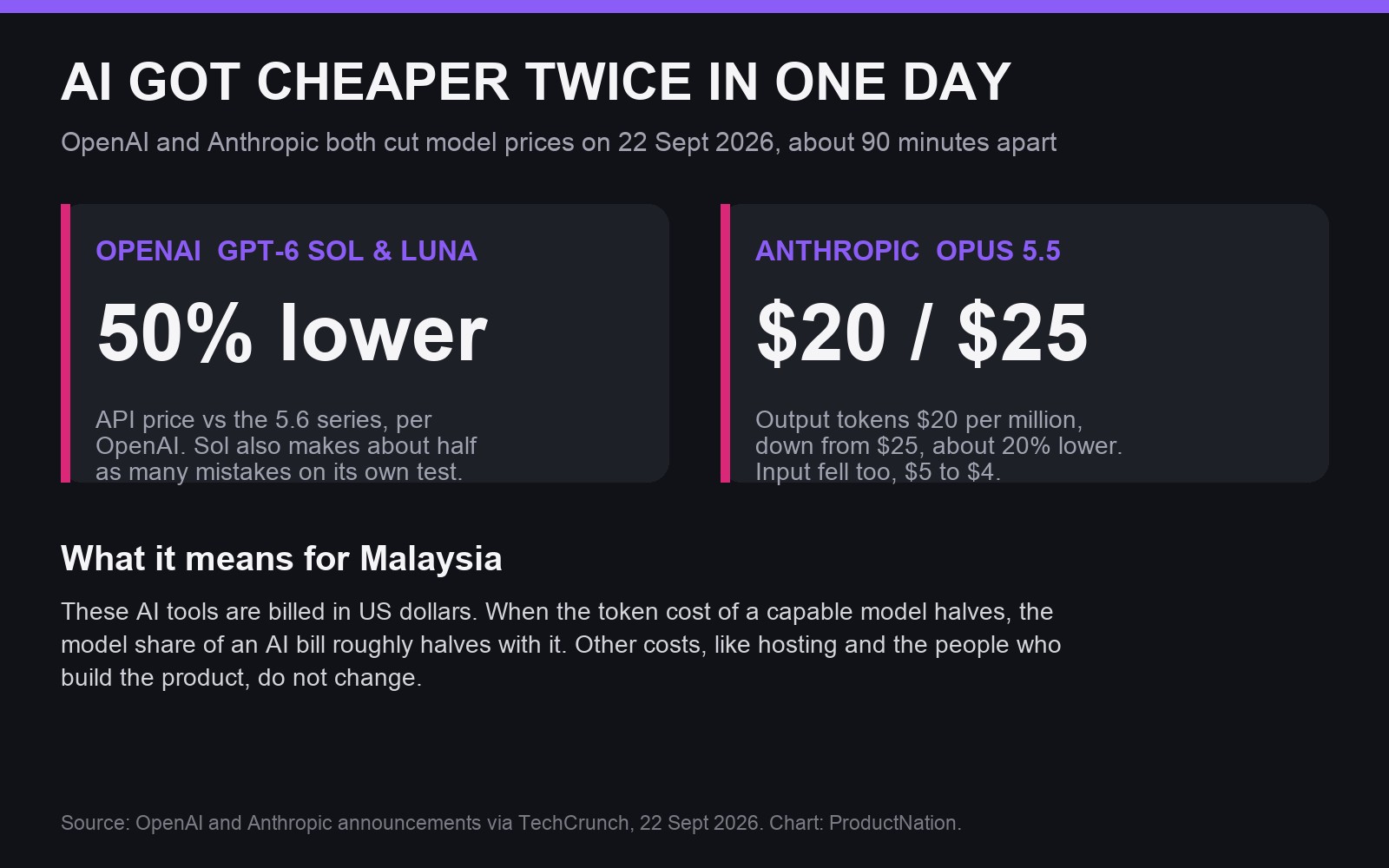
Anthropic's move points the same way. As TechCrunch also reported, its new Opus 5.5 now charges 20 US dollars per million output tokens, down from 25, and runs on less computing power than the Opus model before it. Two competitors cutting prices on the same day is a strong signal, though two announcements on their own do not guarantee the trend holds, and each figure is measured against the company's own earlier pricing rather than a market average.
What cheaper AI means for Malaysia
The AI tools from OpenAI and Anthropic are priced in US dollars and billed by how much text the model reads and writes. That is where a price cut lands. When the token cost of running a capable model halves, the model portion of an AI bill roughly halves with it. Other costs do not move, things like hosting, storage and the people who build the product, so this is not a claim that everything gets 50 per cent cheaper. But for a product where the model is the main expense, it is a real cut, and for a small team weighing whether an AI feature is affordable, it can be the deciding number.
There is a consumer side too. OpenAI says Free and lower cost Go users can try Luna, starting in its desktop app, with a gradual rollout across ChatGPT's app and website. AI is also spreading into the apps people here use daily, from AI agents arriving inside WhatsApp to writing tools, so a cheaper model reaching non-paying tiers could widen the number of Malaysians who reach for AI in everyday work, once the rollout arrives here.
It fits a bigger local picture. Malaysia has been drawing the physical side of this boom too, including the AI data centre investments our earlier reporting covered. If those investments land as announced, cheaper models plus more compute on Malaysian soil would be a useful combination for anyone here who wants to build with AI rather than only use someone else's app. That is our read, not a settled outcome.
The catch worth remembering
Lower prices are not the whole story. These are rented tools, and the terms can change with a single announcement. OpenAI is shutting down what remains of its Sora AI video product this week, with the developer interface due to close on 24 September after the app and website were pulled back in April. It is a reminder that a model you build a workflow around can be repriced, changed in ways that break your prompts, or withdrawn, and the pace of releases from both labs is quick enough that today's models may not be the cheapest option for long.
For now the direction favours the buyer. Malaysian teams that held off on an AI feature because the running cost did not add up have a fresh reason to run the numbers again. OpenAI has started rolling Luna out to free users, and the API prices dropped this week, not next quarter.
Images courtesy of Zulfugar Karimov and Bayu Syaits on Unsplash.