

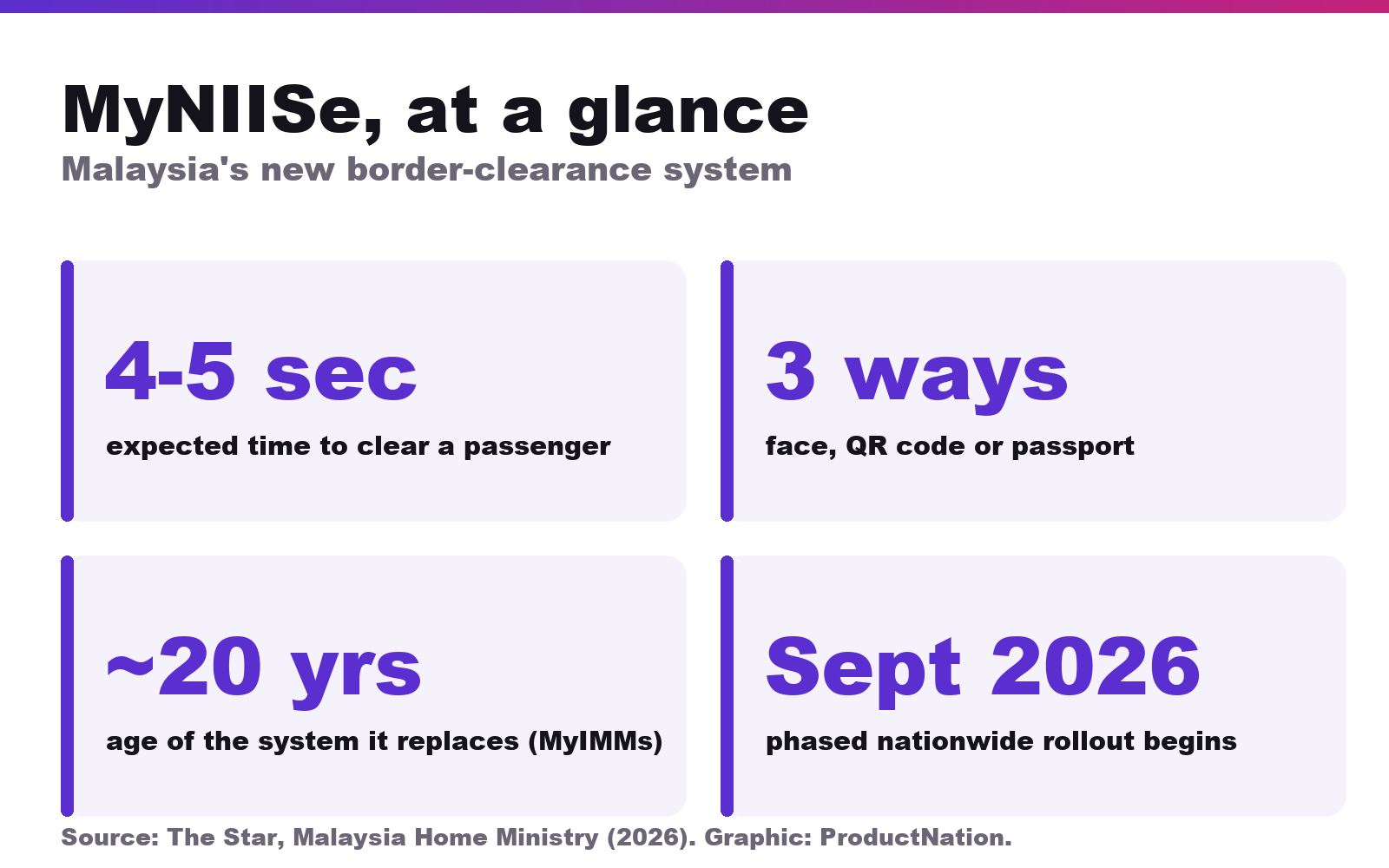
Walk up to a Malaysian autogate in the coming months and the border check should be over almost before it starts. The government is rolling out MyNIISe, a new immigration system that, according to The Star, the Home Ministry expects to clear a traveller in four to five seconds. For anyone who has queued at arrivals after a red-eye flight, that is the promise that lands first.
MyNIISe, the National Integrated Immigration System, replaces MyIMMs, the platform Malaysia has relied on for years. Home Minister Datuk Seri Saifuddin Nasution Ismail called it a "game changer" for congestion, saying after a visit to Kuala Lumpur International Airport that "we do not want to continue facing situations where airports are crowded, either at departure or arrival points." He said travellers will be able to clear immigration through one of three methods: facial recognition, a QR code or a passport.
Table of Contents
A five-second walk through the border
The four-to-five-second figure is the ministry's expectation for the new gates, not a measured nationwide average, and the test conditions behind it have not been made public. What is on the record is the rollout plan. The Star reported in January that integration with the airport e-gates was scheduled to begin on 1 March across five international airports, covering both KLIA terminals, Penang, Kota Kinabalu and Kuching, with 46 pedestrian gates. The ministry has since said the system will extend to all entry points nationwide from September 2026.
Just as important is what MyNIISe does not do. It is not compulsory. Passports and the existing autogates stay available, so nobody is forced onto the new route, and manual counters stay open too. Malaysia already runs a national digital identity app, MyDigital ID, and the app-based route builds on it, while passports and the older lanes still clear you at the gate.
Faster gates, a bigger question about your face
The public messaging so far has led on speed. It has said less about what happens to the face data afterwards: how long a gate image is kept, who can see it, and what a breach would trigger. The government has indicated the biometric records sit in Immigration Department systems under immigration and public-sector security rules rather than the data-protection law, but the day-to-day specifics of retention, access and breach handling are not something a traveller can readily look up. That is what decides whether a faster queue is also a safe one.
The timing makes the question sharper. Malaysia's Personal Data Protection Act, amended in 2024, treats biometric data as sensitive personal data that organisations must protect when they process it in commercial dealings. That same Act has long carved the federal and state governments out of its scope. So one of the country's most visible new uses of face data sits with an actor the data-protection law does not bind. That is not an argument against faster gates. It is an argument for putting the data rules in public before the system spreads. Rules like these could sit in something like the AI governance bill Malaysia is drafting.
What travellers should do
For most people nothing urgent changes. The old lanes still work, so the practical move is to keep your passport handy and watch for official guidance as the app-based route is phased in. The same kind of on-phone approval is turning up elsewhere, such as the biometric sign-off banks like CIMB are moving to, so it is a habit worth getting used to.
The nationwide phase is due from this September, going by that reporting. The rules around what the cameras keep are the thing worth watching as it spreads.
Image(s) courtesy of CHUTTERSNAP and Global Residence Index on Unsplash.


