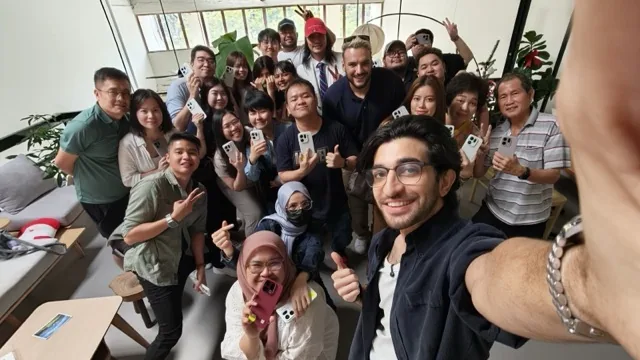
Produced in paid partnership with Samsung Malaysia. Every photograph is our own, taken at each launch from 2021 to 2026, or a frame from our film The Evolution of the Fold. Dimensions and weights are Samsung’s published figures; Malaysian prices are the launch prices we reported during each generation’s pre-order period.
The first Fold reached Malaysia in October 2019 at RM8,388 and 276 grams. Seven generations later the Galaxy Z Fold8 is 201 g and RM7,299. We have reviewed every one of them since 2021, on this site and on our channel, and we kept the notes. Laid side by side with Samsung’s published engineering record, they tell a story that is not simply “the Fold got thin”. It is a list of engineering steps, and the exact year each one landed.
Contents
- The numbers that stopped us
- How we know: seven years of our own record
- 2019: the year it had to exist first
- 2020: a hinge with more than sixty parts, and glass you could fold
- 2021: the year it gained water resistance
- 2022: fewer parts, a taskbar, and our first scored Fold review
- 2023: the gap closes
- 2024: thinner again, IP48, and Galaxy AI
- 2025: the big step
- 2026: two shapes, the lightest Fold yet, and a long-running request answered
- Four areas of engineering progress, and the year each one turned
- What Malaysian readers did with all this
- The whole line, on one page
- Moving to a Fold from whatever you have now
The numbers that stopped us
- 75 g lighter. 276 g in 2019, 201 g in 2026
- Up to 48% thinner. 17.1 mm to 8.9 mm, Samsung’s own figure for the Fold7 and Fold8 Ultra
- RM1,089 cheaper. RM8,388 in 2019, RM7,299 in 2026
Put the 2019 Galaxy Fold next to the 2026 Galaxy Z Fold8. The weight fell from 276 grams to 201, which is 75 grams, about a large egg lifted out of your pocket. The maximum folded thickness fell from 17.1 millimetres to 9.7 on the Fold8 and 8.9 on the Fold8 Ultra. By Samsung’s own arithmetic the 8.9 millimetre Fold7 was 48 per cent thinner than the original and 26 per cent thinner than the year before it; the wider Fold8, at 9.7 millimetres, is 43 per cent thinner than the 2019 phone. The Malaysian starting price fell from RM8,388 to RM7,299, so the eighth generation costs RM1,089 less than the first.
A phone that does more, weighs less, is in the Fold8 Ultra’s case nearly half as thin as the original, and costs less in ringgit than it did seven years ago. It did not happen in one leap. It came one engineering step a year, and because we were reviewing it every year, we can show which year each step landed and what we said about it at the time.
Two smaller numbers surprised us. The weight did not fall in a straight line: the 2020 Fold2 was heavier than the original, 282 g against 276, the year it took on a larger cover screen and the more complex Hideaway Hinge. Every standard Fold since has been lighter than the one before it: 271, 263, 253, 239, 215 and now 201 g. The Fold8 Ultra holds at 215 g, the same as the Fold7. And battery capacity stayed at 4,400 mAh from 2021 through the Fold7; the 2026 models are the first to raise it, to 4,800 and 5,000 mAh.

How we know: seven years of our own record
We are not reading a spec sheet. Our first Fold review on this site was the Galaxy Z Fold3 on 21 September 2021, and our first Fold video went up three days earlier. For this piece we went back through fourteen of our own Fold videos, from that 2021 review to last month, and transcribed them, so the camera verdicts below are what we actually said, not what we remember saying. Since then we have reviewed the Fold4 in 2022, the Fold5 in 2023, the Fold6 in 2024, the Fold7 in 2025 and both Fold8s in 2026, in writing and on camera, and we reported the Malaysian launch price of every generation during its pre-order period. The quotes in this article are lifted from those pieces as they were published. The original quotations show how the Fold changed from one generation to the next.
Our readers were watching too. Our unboxing of the Galaxy Z Fold8 on 23 July 2026 had been viewed approximately 4.38 million times on YouTube as of 7 September 2026, our most-watched Samsung foldable clip. The follow-up, “Something we immediately noticed with Samsung’s new foldable”, was at approximately 452,000, and our Fold7 camera test against the Galaxy S25 Ultra at approximately 694,000. This is a phone people want to watch other people hold.

2019: the year it had to exist first
The Galaxy Fold opened for pre-order in Malaysia on 9 October 2019 at a recommended price of RM8,388, in Cosmos Black and Space Silver. It carried a 7.3-inch Infinity Flex main display and a 4.6-inch cover screen, a 4,380 mAh battery, 12GB of memory, and six cameras: three on the back, two inside and one on the cover. It closed to a maximum of 17.1 millimetres, opened to 7.6, and weighed 276 grams.
Samsung’s own description of what it set out to do is still the best summary of the line: a phone that gives a natural big-screen experience when unfolded and a compact, portable one when folded. The display used a new polymer layer about half the thickness of a typical phone screen, and the hinge was a set of interlocking gears that closed with a click. Everything that followed is a record of what that phone made possible and what it could not yet do. It had no rated water resistance. It had a gap when closed. It had no glass in the display stack.

2020: a hinge with more than sixty parts, and glass you could fold
The Galaxy Z Fold2 introduced the Hideaway Hinge, built from more than 60 components on a dual CAM mechanism, and with it two things the line still relies on. Flex Mode, the ability to stand the phone half open on a table, is where the video-call and camera behaviour of the Folds that followed started. And Sweeper technology, a set of fibre brushes inside the hinge, helps block dust and debris from getting in through the hinge gap. The main screen grew to 7.6 inches, gained a 120Hz refresh rate, and became the first Fold to carry Samsung Ultra Thin Glass in its display stack. The cover screen jumped from 4.6 to 6.2 inches, which made everyday use of the cover display far more practical.
It closed to 16.8 millimetres, opened to 6.9, weighed 282 grams and carried a 4,500 mAh battery. In Malaysia it went on sale in September 2020 at RRP RM7,999. It is the one generation that gained weight, and it is also the generation that introduced the Hideaway Hinge the Fold3 built on.

2021: the year it gained water resistance
The Galaxy Z Fold3 and its sibling the Z Flip3 were the first Galaxy foldables with an IPX8 water-resistance rating, which Samsung achieved with rubber gaskets, corrosion-resistant hinge metals and a cured-in-place sealing process. It was the first Fold to take the S Pen, and the first with an Armor Aluminum frame. It closed to 16.0 millimetres, opened to 6.4, weighed 271 grams, and kept a 7.6-inch main screen, a 6.2-inch cover and a 4,400 mAh battery.
In Malaysia it went on pre-order in August 2021 at RM6,699, which we reported on 23 August. That is RM1,300 below the Fold2 a year earlier, and it is still the largest single price cut in the line’s history. On 8 September 2021 we reported that the Malaysian pre-order allocation had sold out, with Samsung taking registrations for the next batch.
What we wrote at the time
“The crease on here is no better or worse than last year. It’s very noticeable but still perfectly useable, so it’s just something you’ll need to get used to.”
ProductNation, Galaxy Z Fold3 review, 21 September 2021
“It’s smaller and slightly lighter than the previous generations. We now finally have IPX8 water resistance, which is pretty impressive considering this is two folding panels as well as a hinge. But the crease on here is no better or worse than the previous generation.”
ProductNation on YouTube, Galaxy Z Fold3 review, 18 September 2021
Read that again in 2026: the crease and the weight. Those lines are the scorecard for everything that follows.


2022: fewer parts, a taskbar, and our first scored Fold review
The Galaxy Z Fold4 replaced the gear-based rotary hinge with a linear movement mechanism. Fewer internal parts made a hinge Samsung says was 21 per cent lighter than its predecessor, and the phone came down to 15.8 millimetres closed, 6.3 open and 263 grams. The cover screen was made wider and shorter. The main camera went to 50 megapixels alongside a 12 megapixel ultra-wide and a 10 megapixel telephoto, with a 4 megapixel camera hidden under the inner display.
The software change mattered as much as the hardware. As we reported on 17 August 2022, the Fold4 was the first device to ship with Android 12L, the version of Android built for large screens, and it introduced a redesigned, PC-style taskbar for switching and pairing apps. Malaysian pre-order opened on 10 August 2022 at RM6,799.
What we wrote at the time
“Our rating: 8/10. Pros: superb for multitasking, bright and vivid display, flagship-level rear camera, decent battery life. Cons: thick and heavy. When the phone is opened up flat, the crease is barely noticeable and easy to ignore once you get used to it.”
ProductNation, Galaxy Z Fold4 review, 12 September 2022
“The small screen makes it feel like a normal phone, and if you need to work on something the larger screen is a must-have, letting you split the screen in half and have apps float around.”
ProductNation on YouTube, Galaxy Z Fold4 vs Z Flip4, 30 September 2022
One year on from “very noticeable”, the crease had become “barely noticeable”. At 263 g, weight and folded thickness were still the areas with the most room to move in 2022.


2023: the gap closes
The Galaxy Z Fold5 replaced the Hideaway Hinge with the Flex Hinge, built on four drive shafts and a dual rail. The display curls inward in a water-drop shape as the phone closes, which let the two halves shut flat against each other for the first time. The gap that had been there since 2019 was gone, and Samsung describes the result as more than two millimetres thinner than the Fold4: 13.4 millimetres closed, 6.1 open, 253 grams. It ran the Snapdragon 8 Gen 2 for Galaxy and kept the 7.6-inch screen and the 4,400 mAh battery.
In Malaysia the Fold5 held its price at RM6,799 when it launched on 26 July 2023, the same starting figure as the Fold4, with RM7,299 for 512GB and RM8,299 for 1TB.
What we wrote at the time
“Despite the improvement on the hinge, the screen itself still does have a crease. Truth be told, it’s not really visible until the light hits it just so or if you purposely run your finger across it. The Galaxy Z Fold5 is still a pretty solid multi-productivity powerhouse, building on the very solid foundation of its predecessors.”
ProductNation, Galaxy Z Fold5 review, 14 August 2023
“Samsung has modified the build of the phone, which means now there is no gap in between.” And a month later, editing a photo shoot on it: “Instead of carrying two devices or even three, your tablet, your laptop, you just carry your one phone that fits into your pocket and does it all.”
ProductNation on YouTube, Galaxy Z Fold5 hands-on, 26 July 2023, and The Ultimate Content Creator Phone, 16 August 2023
From the outside the Fold5 looked much like the Fold4. The hinge underneath it was a different machine, and closing the gap is what made the next two years of thinness possible.


2024: thinner again, IP48, and Galaxy AI
The Galaxy Z Fold6 refined the hinge into a symmetrical dual rail design that supports Flex Mode at angles between 75 and 115 degrees, and it brought the closed thickness down to 12.1 millimetres and the open thickness to 5.6, at 239 grams. Its rating went from IPX8 to IP48, which adds tested protection against solid objects larger than one millimetre to the water resistance, though it does not make the phone dustproof. It ran the Snapdragon 8 Gen 3 for Galaxy, and it was the first Fold to launch with Galaxy AI, which put the big screen to work on live translation, note summaries and Circle to Search.
Malaysian pricing when it went on pre-order on 10 July 2024 started at RM7,299.
What we wrote at the time
“The Galaxy Z Fold6 is also one of the thinnest and lightest foldables Samsung has produced to date. IP48 is an upgrade from the IPX8 rating in the Galaxy Z Fold5. The highlight of the Galaxy Z Fold6 is Galaxy AI, and Samsung hasn’t disappointed.”
ProductNation, Galaxy Z Fold6 first impressions, 10 July 2024
“This is lighter and thinner, which means it’s much more comfortable to hold in your hand for longer periods of time.”
ProductNation on YouTube, Two Weeks with the Galaxy Z Fold6, 5 August 2024


2025: the big step
The Galaxy Z Fold7 is the generation where the curve bends. It closed to 8.9 millimetres and opened to 4.2, at 215 grams, and Samsung’s own arithmetic is worth repeating: 48 per cent thinner than the 2019 Fold, and a 26 per cent reduction in a single year. The hinge became the Armor FlexHinge, a new structure fused from stronger materials, and, according to Samsung, the Ultra Thin Glass was made 50 per cent thicker and Advanced Armor Aluminum in the frame and hinge housing raised strength and hardness by 10 per cent, both compared with the Fold6.
The screens grew at the same time. The cover display went to 6.5 inches and the main display to 8.0, which Samsung puts at 11 per cent more screen area than the Fold6. It was the first Fold with a 200 megapixel main camera, and it ran the Snapdragon 8 Elite for Galaxy. The battery stayed at 4,400 mAh. Malaysian pre-order opened on 9 July 2025 at RM7,799.
What we wrote at the time
“Now slimmed down to 8.9mm when folded versus 12.1mm on the Galaxy Z Fold6, the Galaxy Z Fold7 actually feels more like a candybar smartphone.”
ProductNation, Galaxy Z Fold7 review, published 22 July 2025 and updated 19 August 2026, headlined “So Far The Most Solid Foldable This Year”
“It’s the thinnest and lightest Fold Samsung has ever made. Compared to the Fold6 it is 26 per cent thinner when folded, just 8.9mm, and 4.2mm thick when unfolded. That’s basically thinner than some wallets.” And on the camera, two months later: “Samsung brought the big guns to the Fold7.”
ProductNation on YouTube, 9 July 2025 and 10 September 2025 (694,000 views)
Thick and heavy, the 2022 note, was gone. Battery capacity remained at 4,400 mAh from 2021 through the Fold7, and the 2026 models raise it to 4,800 and 5,000 mAh.


2026: two shapes, the lightest Fold yet, and a long-running request answered
For 2026 the line became two phones. The Galaxy Z Fold8 was reshaped: its 7.6-inch main display is a squarer 4:3, the cover screen is a 5.5-inch panel you can type on with one thumb, and at 201 grams it is the lightest Fold Samsung has made. It closes to 9.7 millimetres and opens to 4.5. Under the display is Flex Titanium, a titanium alloy film bonded to a titanium plate, and our review described the crease as barely there. It carries a 50 megapixel wide camera, a 50 megapixel ultra-wide and a 4,800 mAh battery, the first increase since 2020.
The Galaxy Z Fold8 Ultra keeps the tall book shape at 8.9 millimetres closed and 4.1 open, weighs 215 grams, and carries an 8.0-inch panel, the largest size in the line and matching the Fold7’s, which Samsung rates at up to 3,000 nits peak brightness under its test conditions. It has a 200 megapixel main camera, a 50 megapixel ultra-wide, a 10 megapixel telephoto and a 5,000 mAh battery, and it records 8K video in Samsung’s APV codec.
In Malaysia the Fold8 starts at RM7,299, RM500 below where the Fold7 started a year earlier, with RM8,099 for 512GB and RM9,699 for 1TB. The Fold8 Ultra starts at RM8,099.
What we wrote and said at the time
Our review said the wider shape, the featherweight body and the near-invisible crease answered three of the questions prospective foldable buyers ask most, and summed the phone up in one line:
“We would call this the most likeable foldable Samsung has built.”
ProductNation, Galaxy Z Fold8 review, published 4 August 2026
“This is the finest hardware Samsung has ever folded in half.”
ProductNation, Galaxy Z Fold8 Ultra review, published 3 August 2026
“When you open it up it feels like a mini tablet. It’s crazy to me that I get a mini tablet in my pocket.”
ProductNation on YouTube, Galaxy Z Fold8 hands-on, 22 July 2026
“One thing they’ve got right with the Galaxy Z Fold8 is the crease. Samsung has massively improved this year’s foldable experience. Barely visible: you really have to tilt it to the light to see even just a trace of it.”
ProductNation on YouTube, Something we immediately noticed, 24 July 2026 (452,000 views)
On 27 August 2026 we went further and used the Fold8 and Fold8 Ultra in place of a laptop and a cinema camera for the scripting, review and filming tasks of a production day. The Fold8 ran the script and the footage side by side on one screen while the edit was reviewed; the Ultra shot the top-down product sequence in Flex Mode with no tripod. That video is on our channel, and the phones completed every task we set them in that test.


Four areas of engineering progress, and the year each one turned
Every quote below is ours, from the review of that year. The table shows when four areas of the Fold experience changed. On our Galaxy Z Fold8 review unit the crease appeared faint and needed a deliberate angle to notice.
| Area | Then, the turn, and now |
|---|---|
| The crease | What we wrote at the time: 2021: “very noticeable but still perfectly useable” The year it turned: 2023, Flex Hinge What we wrote most recently: 2026: “barely there” |
| Thick and heavy | What we wrote at the time: 2022: “Cons: thick and heavy” The year it turned: 2025, Armor FlexHinge What we wrote most recently: 2025: “feels more like a candybar smartphone”. 2026: the lightest Fold, 201 g |
| The battery | What we wrote at the time: 4,400 mAh from 2021 through the Fold7 The year it turned: 2026, 4,800 and 5,000 mAh What we wrote most recently: 2026: the first capacity increase since 2020, on both models |
| Water and dust rating | What we wrote at the time: 2019 to 2020: no rated water resistance The year it turned: 2021, IPX8 What we wrote most recently: 2021: IPX8. 2024: IP48, adding protection against solid objects over 1 mm |
What Malaysian readers did with all this
We log every press of a buy button on every product card we publish, across the nine markets ProductNation covers; a buy click is a reader leaving our page for a retailer’s listing of that product. Across July and August 2026, Malaysian readers on our English and Bahasa editions pressed a buy button on a Galaxy Z Fold 1,510 times, spread across every generation from the Fold3 to the Fold8. A click is interest, not a sale, so we will not stretch it further than it goes. But seven years of coverage still drawing readers to the buy button, on generation after generation, is the plainest measure we have of a line that kept its audience.

The whole line, on one page
Screen sizes, weights and batteries are Samsung’s published figures; thicknesses are Samsung’s published maximums, since the early phones were thicker at the hinge than at the open edge. Malaysian prices are the launch RRP of the entry model as we reported it during pre-order.
| Generation | What changed |
|---|---|
| Galaxy Fold 2019 | Main / cover screen 7.3 in / 4.6 in. Max folded / unfolded 17.1 / 7.6 mm. 276 g. 4,380 mAh. Malaysia launch RRP RM8,388. Named first: The first. |
| Galaxy Z Fold2 2020 | Main / cover screen 7.6 in / 6.2 in. Max folded / unfolded 16.8 / 6.9 mm. 282 g. 4,500 mAh. Malaysia launch RRP RM7,999. Named first: Hideaway Hinge, Flex Mode, UTG. |
| Galaxy Z Fold3 2021 | Main / cover screen 7.6 in / 6.2 in. Max folded / unfolded 16.0 / 6.4 mm. 271 g. 4,400 mAh. Malaysia launch RRP RM6,699. Named first: IPX8, S Pen, Armor Aluminum. |
| Galaxy Z Fold4 2022 | Main / cover screen 7.6 in / 6.2 in. Max folded / unfolded 15.8 / 6.3 mm. 263 g. 4,400 mAh. Malaysia launch RRP RM6,799. Named first: Taskbar, Android 12L, 50MP. |
| Galaxy Z Fold5 2023 | Main / cover screen 7.6 in / 6.2 in. Max folded / unfolded 13.4 / 6.1 mm. 253 g. 4,400 mAh. Malaysia launch RRP RM6,799. Named first: Flex Hinge, gap closed. |
| Galaxy Z Fold6 2024 | Main / cover screen 7.6 in / 6.3 in. Max folded / unfolded 12.1 / 5.6 mm. 239 g. 4,400 mAh. Malaysia launch RRP RM7,299. Named first: IP48, Galaxy AI. |
| Galaxy Z Fold7 2025 | Main / cover screen 8.0 in / 6.5 in. Max folded / unfolded 8.9 / 4.2 mm. 215 g. 4,400 mAh. Malaysia launch RRP RM7,799. Named first: 200MP, Armor FlexHinge. |
| Galaxy Z Fold8 2026 | Main / cover screen 7.6 in (4:3) / 5.5 in. Max folded / unfolded 9.7 / 4.5 mm. 201 g. 4,800 mAh. Malaysia launch RRP RM7,299. Named first: Wide shape, Flex Titanium. |
| Galaxy Z Fold8 Ultra 2026 | Main / cover screen 8.0 in / 6.5 in. Max folded / unfolded 8.9 / 4.1 mm. 215 g. 5,000 mAh. Malaysia launch RRP RM8,099. Named first: 8.0-inch, APV 8K video. |
Moving to a Fold from whatever you have now
Every year the Fold has become an easier phone to live with, and the move onto one has become easier at the same rate. Samsung Smart Switch is the tool that carries your old phone across, and Samsung Malaysia’s Smart Switch page walks through each route step by step.
What can come across, in Samsung’s own list: contacts, messages, photos, videos, music, documents, call logs, alarms, calendar, notes, home screen layout, installed apps and device settings down to the keyboard and ringtone. Exactly which of those transfer depends on the old phone, what it runs and which method you use. Samsung lists Android 6.0 or newer as the minimum for an Android source; compatibility from other sources varies by device, operating system and method.
Three ways to do it:
- Wirelessly, phone to phone: open Smart Switch on both phones, set the old one to send and the new Fold to receive, choose what to bring, and let it run. Some routes pair the two phones by scanning a code on screen.
- By cable: a USB-C to USB-C cable between the two phones, often the quicker option for a large photo library.
- From a computer backup: Smart Switch’s computer app restores a compatible saved backup straight onto the new phone.


The Galaxy Z Fold8 is RM7,299 at Samsung Malaysia and the Galaxy Z Fold8 Ultra is RM8,099. Every launch price above is the one we published during that generation’s Malaysian pre-order period, every dimension is Samsung’s own published figure, and every quote is ours, as we wrote it.